From Classrooms to Careers: Preparing Future Generations for a Green Economy
Revising vocational education curricula to equip students with new skills

- English
- Македонски
- Shqip
When the new school year began in September 2025, more than 7,000 vocational education students across North Macedonia stepped into classrooms that were familiar, but were teaching something fundamentally new. Alongside technical knowledge, they were now learning how to design, test, engineer, build, manufacture, cook and deliver services with the environment in mind.
Behind this transformation is a growing national effort to modernize vocational education and bring it closer to the realities of today’s labour market. Working together, UNICEF, the Ministry of Education and Science and the Vocational Education and Training Centre (VETC) have gradually introduced environmental awareness into classrooms, with the support of Nelt and Sweden.
“This shift is part of a broader reform aimed at preparing a new generation of students for jobs in a rapidly changing labour market. The impact of the reform is already unfolding in classrooms and workshops, where students are connecting their future professions with environmental responsibility. Building on this momentum, the revision of all first-year vocational education curricula is now underway,” highlighted Ardijana Isahi Paloshi, representative of the VETC.
Circular Chemistry: Building Solutions for the Future

In chemistry and technology programmes, students are learning to rethink how products are designed, produced, and managed across their entire lifecycle.
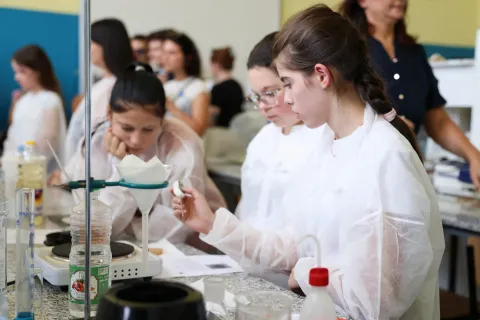
Future chemical laboratory technicians, food technicians, technicians for cosmetic and chemical products, and environmental protection technicians explore the responsible use of materials to minimize waste, apply circular economy principles, and develop environmentally friendly products and packaging. Through laboratory work, they also learn how to conduct experiments with minimal environmental impact.
“Students are beginning to see that sustainability is not an abstract concept, but part of everyday work and every decision they make – from the materials they choose to how they manage energy and waste. It is becoming a natural part of their professional thinking,” noted Martin Trpevski, teacher at the secondary VET school “Marija Kiri – Sklodovska”.
Hospitality and Culinary Students Bring Sustainability on the Menu

In hospitality and tourism programmes, the green transformation comes to life in kitchens. From sourcing ingredients to managing waste and energy use, students are learning how sustainability shapes the entire food value chain, influencing not only future workplaces, but also existing businesses and local communities.
Their learning includes reducing food waste and reusing leftovers, using local and seasonal ingredients to lower environmental impact, donating surplus food, designing eco-friendly events, and improving energy efficiency in kitchen operations. For many students, these ideas are closely connected to their daily lives. Some, already involved in family-owned restaurants, are planning to introduce greener practices into their businesses.
Connecting Technical Skills with Environmental Responsibility
Regardless of the vocation they choose to pursue, students are increasingly discovering that green skills are no longer tied to a single profession but rather becoming essential across all sectors. Whether training in mechanical engineering, electrical engineering, construction, or transport, they are developing an understanding of the environmental impact of their jobs.
Mechanical vocation students explore the recyclability of metals, energy efficiency in industrial processes, and the environmental effects of material use and production. In electrical engineering, they examine renewable energy systems, energy efficiency in buildings, and smart technologies such as devices for monitoring energy consumption, alongside the management and recycling of electronic waste.
In transport and logistics, they analyze environmentally friendly vehicles, alternative fuels, and ways to reduce emissions. In the construction field, students focus on energy-efficient building design, and waste management on construction sites.
The revised curricula are shaping a new generation of professionals who see sustainability as a standard of practice, equipping them to actively drive greener industries and more resilient communities. In doing so, they are helping turn the green transition from a policy goal into a lived reality across everyday professions.