Girls Leading Change Through Science, Innovation & Climate Action
On the International Day of Women and Girls in Science, we celebrate their voices, their determination, and their vision for a more sustainable future.

- English
- Македонски
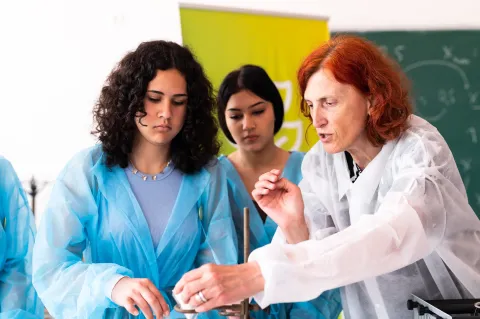
Across the country, adolescents are using science, innovation and teamwork to shape solutions to some of today’s most urgent environmental and climate challenges. Through the social innovation programme UPSHIFT, adolescent girls have been turning ideas into action - showing that when girls are given tools, support and space, they lead with creativity, courage and purpose.
On the International Day of Women and Girls in Science, we celebrate their voices, their determination, and their vision for a more sustainable future.
“Including girls in science and climate solutions is not only a matter of equality, but also effectiveness. Girls bring different perspectives, especially since many environmental decisions have a direct impact on girls and women, who may experience the consequences in different ways.”

For Rosica, working on climate challenges showed her that science is a practical tool for everyday life and community change. UPSHIFT helped her build confidence, showing her that problem-solving is about asking the right questions - not having perfect answers.
“Science helped me understand the problems, technology helped me find practical ways to solve them, and teamwork showed me the importance of different perspectives and viewpoints in creating a functional solution.”
“When young people are trusted with real responsibility, they rise to it!”

Participating in UPSHIFT helped Sara understand how structured problem-solving works in practice. She learned how to break down an issue, research, analyze, question and act. She now sees teamwork and clear communication as powerful drivers of impact.
“When given the opportunity and the space to grow, women can create powerful change and contribute greatly to the world. This has been proven countless times.”
“I understood how scientific data, measurements, and research affect the quality of the air we breathe, the water we use, and the environment we live in. Science helped me look at problems more objectively and seek solutions based on facts, rather than assumptions.”

Vanja’s UPSHIFT journey built her self-confidence, patience and perseverance – helping her overcome the doubts she once felt as a girl pursuing science. She now speaks openly about the importance of girls’ participation in shaping environmental and climate solutions.
“Girls often approach issues with empathy, creativity, and a sense of responsibility toward the community – qualities that are especially important when it comes to climate action. Different perspectives lead to more supportive and sustainable solutions.”
“Science gives us the freedom to understand and to influence the world.”

Nadica discovered that science and innovation are not distant concepts – they are spaces where every girl can belong. Her UPSHIFT project on air pollution helped her see herself as a future engineer. Today, she is studying electrical engineering, inspired by the confidence and direction she gained through UPSHIFT.
“I learned that an idea on its own is not enough - taking action is essential. Instead of simply expecting change, we need to actively work and do something good and useful for ourselves and for the community.”
“Science is everywhere - and we can use it to protect our environment.”

For Iva, climate related challenges were her gateway to understanding science as a part of daily life - from how we use energy to how we manage waste. Her experience encouraged her to pursue studies linked to sustainable development and social impact.
“Girls have ideas, creativity, and potential that are often underestimated, and inclusion means greater equality and stronger, more sustainable solutions for society.”
“UPSHIFT taught me that young people really can create change.”

Andrea describes UPSHIFT as one of the most valuable experiences of her adolescent years. Through teamwork and local problem-solving, she discovered the power of practical innovation - and her own leadership.
“I learned to think differently, to work in a team, and to transform ideas into real solutions. Young people can make positive change.”
Girls belong in science. Girls lead in science.
And when girls innovate, communities grow stronger.
They approach challenges with empathy, creativity and integrity. They bring diverse perspectives that make solutions more inclusive, sustainable, and human - centered.
This International Day of Women and Girls in Science, we celebrate every girl who asks questions, tests ideas, imagines solutions - and dares to change her world.
UPSHIFT is a social innovation programme implemented by UNICEF in cooperation with the Ministry of Education and Science, with financial support from Sweden. The programme, delivered in partnership with the Leaders for Education, Activism and Development Association (LEAD), equips young people with the skills, mentorship and resources to design solutions to real challenges in their communities. By investing in girls’ leadership in science and innovation, we invest in a healthier, fairer and more sustainable future for all.