Walking into Nature’s Classroom: Discovering the Home of the Flycatcher
On a forest path near the village of Negrevo, curiosity leads the way.
- English
- Македонски
- Shqip
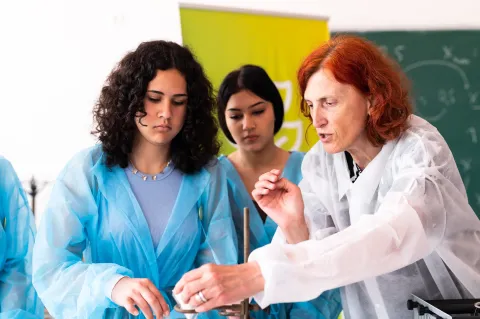
A group of grade 5 students from the Trebovishte, Razlovci and Delchevo walk through nature, guided by their teachers and educators - not toward a traditional classroom, but toward something far more unexpected: a carnivorous plant known as Flycatcher (Drossera rotundifolia) thriving in the wild, right here in North Macedonia. What awaits them is a lesson that cannot be found in textbooks alone. The visit is an extracurricular activity organized through the Experiential Learning Network (ELN), an innovative approach to education that brings learning outdoors and connects science, nature and real-world challenges. For these students, nature itself becomes the classroom.

Learning where nature tells the story
The day begins at the Nature Conservation Educational Center in Negrevo, where students explore an exhibition and learn about local biodiversity. Soon, the learning becomes hands-on. The group sets off on a hike toward a nearby peat bog, where the Flycatcher - more commonly associated with distant wetlands - has adapted to survive.
Peatlands may look quiet, but they are among the planet’s most valuable ecosystems. They retain and purify water, store carbon, and help regulate the climate. Rather than memorizing these facts, students experience science directly by observing, asking questions, experimenting and discussing what they see around them.

Education beyond classroom walls
The primary school visit is part of the Experiential Learning Network, established with UNICEF support and funding from Sweden. The network links schools with institutions such as national parks, botanical gardens, and research centres, offering structured learning experiences outside the classroom. The Nature Conservation Educational Center in Negrevo is one of eleven ELN partners across the country, coordinated by the Macedonian Ecological Society. Together, they ensure children - especially those from smaller and rural communities – an equal chance to learn about the environment and climate change through exploration, experiments, hands-on activities, and reflection.
Along the trail, students work in teams to identify different habitats, animal and plant species, and potential threats to nature. Excited voices echo through the hills:
“Hey, look what I found!”
“Look at this fungus!”
“There are tadpoles in this pond!”
“Look! An ant colony!”

Understanding climate risks through real examples
As the group approaches the peat bog, they pass through forest areas still bearing the marks of wildfires that swept through the Negrevo–Pehchevo region two years ago. The charred tree trunks and emerging greenery quietly reflect both destruction and renewal.
Educators explain that after intense forest fires, natural regeneration is slow, often taking two to four years before new plants can fully establish. Among the remnants of burned woodland, children learn about how climate change increases wildfire risks and how delicate ecosystems require time, safeguarding, and thoughtful human involvement to recover.

A workshop that sparks curiosity
After squishing through the peatlands, the group come back to the education center where they take a closer look at what their discoveries. One of the most sought-after activities, the Home of the Flycatcher workshop invites students to explore nature firsthand, observe rare species, and understand why wetland ecosystems are critical for biodiversity and climate regulation.
“It is one of our most attractive and exciting workshops,” says Mare Paraskova, Head of the Nature Conservation Educational Center in Negrevo. “It sparks curiosity not only among children, but teachers as well. As soon as registration opens, the workshops are fully booked.”


Teachers as enablers of discovery
For teachers, experiential learning offers a powerful way to transform how students engage with science.
“Students have very few opportunities for extracurricular activities,” explains Ana Popova, a natural science teacher from Delchevo. “That’s why every year I sign up for the programmes offered through the Experiential Learning Network. This type of learning deepens understanding, increases motivation, and encourages active participation.”
For students from smaller communities such as Trebovishte and Razlovci, these opportunities help ensure all children can access quality of learning regardless of where they live. Now that all eleven Experiential Learning Network sites are included in the national rulebook for school excursions and field trips, schools nationwide can access these experiences more easily.

Building skills for a changing world
The Experiential Learning Network functions as a bridge, linking schools with professionals, scientists, and educators who mentor students and introduce them to modern ways of thinking and learning. “When children explore peatlands, they learn how nature protects us and how we must protect nature. Beyond science, they learn to ask better questions, work as a team and communicate what they observe. These are essential skills for today’s world,” says Valentina Stanoevska, Educator at the Nature Conservation Educational Center in Negrevo. Programmes are adapted to students’ needs and offer equal opportunities regardless of background, ensuring that every child can learn through experience.

Learning that lasts

For many students visiting the Home of the Flycatcher, this day will be remembered not just as a field trip, but as a moment when learning felt real and meaningful. As Paraskova reflects: “Experiential learning modernizes education. It helps students connect theory with real life, nurtures curiosity, and builds responsibility toward nature and society. This is how we raise generations who understand environmental protection and sustainable development - not as abstract ideas, but as lived experiences.”
As the students from Trebovishte return home, they carry more than notes or photographs. They leave with questions, ideas and a deeper connection to the natural world they are growing up in.

The Experiential Learning Network is part of the UNICEF initiative “Empowering children and young people to act as change agents to reduce the vulnerability of climate change to communities” funded by Sweden.