One Year After the Earthquake
Why Child-Friendly Spaces Still Matter for Children in Myanmar

- English
- မြန်မာ
Two children, two journeys, one fragile city.
For 12-year-old Aye Mya1, home used to be a spacious two-storey wooden house in Madaya Township. She remembers feeding the family’s animals, playing with her younger sister and sleeping under a solid roof. Then the fighting came close. One night, heavy weapons landed near the village, killing a neighbour just outside their house. Her father woke everyone and told them to run.
“We couldn’t stay in one place for long. We had to keep moving,” she recalls. “I was afraid of being shot.”
Hundreds of kilometres to the south, in Tanintharyi Region, 14-year-old Aung Phyo lived through a similar nightmare. One evening, gunfire erupted as his family finished dinner. They ran towards the paddy fields as bombs fell from above, then up a mountain as shooting came from the other side. Hiding in bamboo groves, his family ran out of food and money. “We didn’t eat for three days,” he says quietly.

Both children eventually came to Mandalay to be safe and continue their education – separated from parents who had to remain behind to protect their homes and land. But just as they were beginning to adjust to life in a new city, another disaster struck.
On 28 March 2025, a powerful 7.7 magnitude earthquake hit near Mandalay. Buildings cracked, furniture collapsed and families rushed out onto the streets in fear. For children like Aye Mya and Aung Phyo, who had already fled airstrikes and shelling, the shaking ground brought all the old terror back.
“When the earthquake happened, we had to sleep outside in front of our house,” says Aye Mya. “I kept thinking about my mother and grandmother. I didn’t know if they were safe.”
In the weeks that followed, UNICEF and partners such as Terre des Hommes Lausanne established child-friendly spaces in affected neighbourhoods – places where children could feel safe, play, learn and begin to process what had happened. One year on, thanks to the generous support of its partners, UNICEF and partners continue to keep these spaces open and staffed with trained social workers for the children who need them most.
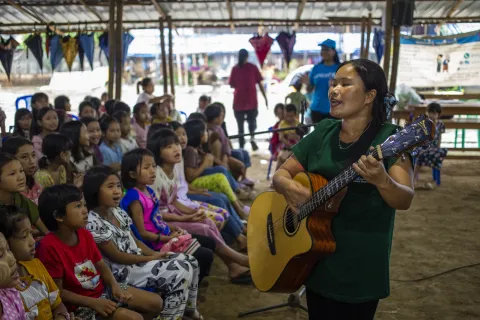
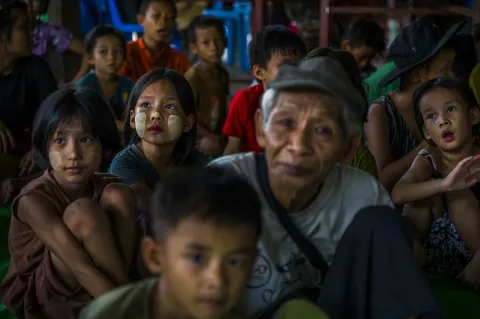
In a small, shaded compound in Aye Mya’s neighborhood, dozens of girls and boys now gather on weekends. Mats cover the floor, simple games and books line the walls, and the air fills with songs, clapping and laughter that had gone missing from many streets after the quake.
“At first, many children were very withdrawn,” says Thuzar, a social work officer with Terre des Hommes Lausanne. “Some were scared to be inside buildings. For children like Aye Mya and Aung Phyo, the earthquake came on top of the trauma they were already carrying from the conflict.”
One year on, the progress is visible – but the needs remain.

The team combines structured play with Psychological First Aid – starting with games and songs to help children relax, then moving into short discussions about feelings and ways to cope with fear. “Over time, we see changes,” says Thuzar. “Children who used to sit alone now join group games. Those who were too shy to speak start answering questions. Some even help us lead activities.”
For Aung Phyo, the child-friendly space has become a bridge back to learning. After losing three years of schooling because of COVID-19 and conflict, he is back in Grade 4 and is one of the most focused children in the sessions. He dreams of finishing school and finding work that will allow him to support his mother and grandmother.

For Aye Mya, the space is where she found new friends – and a new dream. When she first arrived in Mandalay, she felt “constrained” living in someone else’s home and was the only displaced child in her class. In the child-friendly space, she is no longer alone.
“I want to be a doctor,” she says. “If my mother or others get sick, I want to be able to treat them.”

Behind the scenes, with thanks to the support of partners, Community -based Child Safety Groups – volunteers, many of them mothers – help keep the spaces running by identifying children who might benefit most and sharing information about families in difficulty.
For most children who attend, the child-friendly space is a response to the fear and disruption caused by the earthquake. For children like Aye Mya and Aung Phyo, it is much more: a place where the trauma of conflict and displacement is recognised, where separation from parents is understood, and where dreams are gently rebuilt.
One year after the earthquake, Mandalay is still living with aftershocks, both literal and emotional. But these spaces continue to offer something rare – a few protected hours where children can learn, laugh and imagine a different future.
[1] Names and locations in the story have been changed to protect the identities of individuals involved.