Children making movies about children
Children’s voices for education

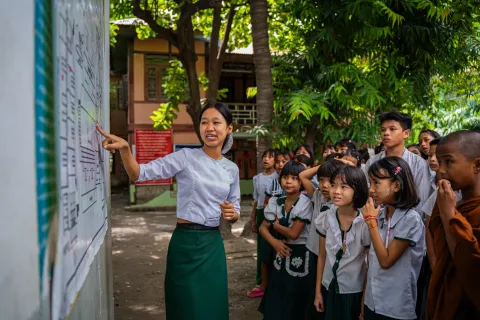
Phyo Min Tun, 12, is making his first movie. He takes us to his home in Lin Thar, southern Rakhine, recreates the scene, acts and speaks to the camera. Until three months ago, Phyo Min Tun used to do his homework by candlelight; now his house has electricity and his life has changed. His one-minute video, Enlighted, shows the difference a lightbulb can make in a child’s life, and makes us reflect on the challenges that many children still face in completing their education. It is one of 19 mini-films depicting the school experience of 19 children from different backgrounds, ethnicities, and religions in Thandwe township, Rakhine State.
The One minutes Jr Project ‘brings together youngsters from all over the world for video workshops to make their voices heard. The one-minute video is a powerful format. Within the span of a single minute, anything is possible. The limited time frame forces the young filmmaker to think carefully about her or his idea, whether it is a statement, an experiment, a short narrative or a documentary. For the audience, The One Minutes offers a challenging way of viewing the moving image’[1].
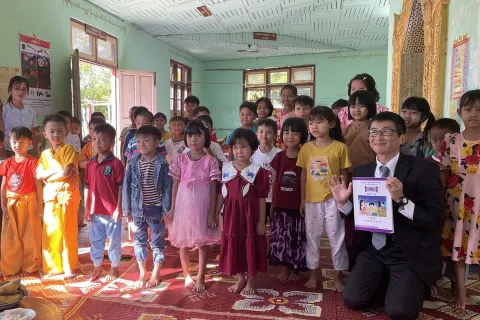
With support from the Korean International Cooperation Agency (KOICA), and in collaboration with the Ministry of Education and the State Education Department, UNICEF and two One minutes Jr trainers focused on the learning experiences of children in Shan, Kachin and Rakhine states. The final product is impressive: 60 one-minute videos about Myanmar children’s challenges and dreams across three states.

On the first day, children seemed uncertain about being able to use a camera and making their own film, but through interactive theoretical activities and practical assignments, they quickly gained confidence and opened their creative minds. They also quickly became familiar with the technology, including children who had never used technology before. In Rakhine State, for example, only one child in the group had ever had access to a mobile phone.
On the third day, U San Hlaing, 11, is thinking about his film while remembering his hand framing exercise from the first day. His video is about missing his family while at boarding school. He only speaks to his parents twice a year on the phone and his video manages to capture his delight during the phone scene as well as the challenges of being in boarding school.

Saung Hnin Pyu, 12, is making a video about her favourite teacher in a non-formal primary education centre managed by the Ministry of Education and supported by UNICEF in Lin Thar. The programme offers out-of-school children who never enrolled in school or dropped out, like Saung Hnin Pyu, a second chance and the possibility to enter middle school after two years of learning an accelerated curriculum.

Saung Hnin Pyu looks forward to joining a formal Grade 5 class in the nearby government school next year. She adores her teacher and wants her to star in her film.

Hein Htet Zan’s film is about bullying. Acting the scene is much easier than the reality, but his message is clear, “I have told my teacher about how the other kids are bullying me, and nothing has changed. So now, what should I do?” The film is his call to adults and school representatives. He hopes that more children in Rakhine will see his video and have the courage to stand up against bullying.

Freedom for the books! That is the title of Phyo Wai Yan’s film. He loves books. He is banging on the closed door of the school library before taking us to the town library where he can find what he needs. “I only wish the school library was open every day and to all the children.”

It is homework time for Hnin New Kyaw, 14, in her monastic boarding school in Greik Taw. She shares a dormitory with 50 girls and is craving for more space and quietness. The video takes us through her daily routine after school, and how she engages in hypnotic singing to find happiness.

Space is also the issue in Min Khant Nyi Nyi’s film. The school courtyard is full of lush green plants but there is no space for the 800 students to play sport. Min Khant Nyi Nyi would love to play football.

Every video, every minute is totally different; from joy to sadness, it is a journey in Rakhine children’s universes. One girl has the courage to describe the physical violence she faces at home.
On the last day of the workshop, in the afternoon before the screening for local authorities, the children are excited; they prepare posters for their films and finalize the voice-over process. The Rakhine State Education Officer is attending, as well as the Township Education Officer, teachers and parents. It is a big event! It is a possibility to create a dialogue between students and educators. It is also the opportunity for these young Thandwe filmmakers to make their voices heard.

The screening is a success; the children are full of pride and the adults are impressed. This is just the first screening; the objective is for the films from Rakhine, Shan and Kachin to be shown for advocacy and to inform decision-making at state and national levels, to discuss the challenges highlighted in the videos in order to improve the learning environment of children in Myanmar. The films will also be used in classrooms and communities for different UNICEF activities to spark discussions amongst students, teachers and community members, so that all understand the role they play in supporting access and participation to education for every child.