A safer and shorter journey helps Saviana stay in school
UNICEF's Bicycles for Education initiative seeks to overcome these barriers by making school more accessible, reducing the physical effort of travelling and helping students remain in education.

Mapupulo, Cabo Delgado`- For 20-year-old Saviana José, getting to school used to mean leaving home at 5 a.m., while it was still dark, and walking for an hour and a half to reach her classroom.
The long journey was exhausting. Sometimes she arrived late and struggled to concentrate during lessons. On other days, she was simply too tired to make the journey.
"Some days I was so tired and exhausted that I stayed at home instead of going to school," she recalls.
Saviana is a Grade 7 student at Escola Básica de Mapupulo in Montepuez District. Originally from Macomia, she fled her home with her family in 2020 because of attacks by armed groups in Cabo Delgado. They eventually settled in Entele resettlement camp, where Saviana has continued her education despite the challenges of travelling to school.
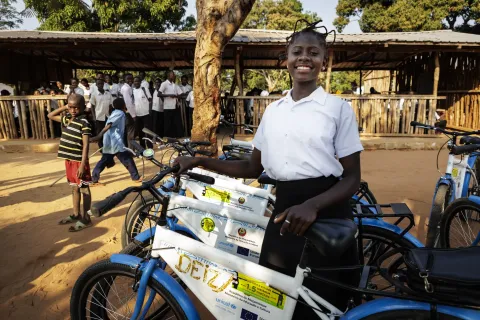
Her daily routine changed when she received a bicycle through UNICEF's Bicycles for Education initiative in May 2026. It was the first bicycle she had ever owned.
"I was very happy to receive it," she says. "It is great to have my own bicycle."
Now, instead of leaving home at 5 a.m., Saviana can leave an hour later, at 6 a.m. Her journey takes just 30 to 40 minutes, giving her more time to sleep and prepare for the day.
"I can sleep more, so I am happy," she explains. "I have time to take a bath and organise things at home before leaving for school."
The bicycle has also made her feel safer.
"I feel safer now because before I had to start walking in the dark," she says.
Most importantly, Saviana is attending classes more regularly. The shorter journey means she arrives at school with more energy to concentrate and participate in lessons.
"Now it is much easier with the bicycle, so I come to school," she says.
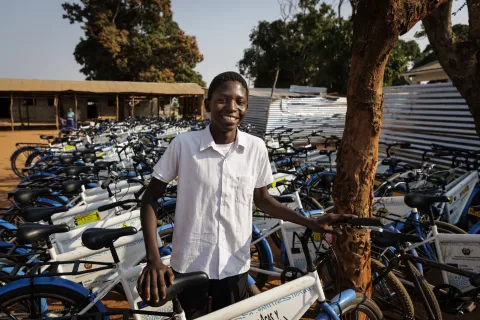
At Escola Básica de Mapupulo, which has 2,533 students, long distances are a major obstacle to education. Some students travel up to 20 kilometres each way, often arriving tired or late.
UNICEF's Bicycles for Education initiative seeks to overcome these barriers by making school more accessible, reducing the physical effort of travelling and helping students remain in education.
The bicycles also provide a lasting benefit, as they belong permanently to the students who receive them.
"The bicycles belong to the students. They are theirs to keep," explains school director Belmiro Yahaier.
For Saviana, who has already experienced the disruption of displacement, having her own bicycle has made continuing her education easier. She now has more time to study and the opportunity to work towards her ambitions.
"I want to be an English teacher," she says.
In May 2026, UNICEF provided 187 bicycles to students, 92 girls and 95 boys, at Escola Básica de Mapupulo and one other school in Cabo Delgado. The pilot initiative was implemented in collaboration with the Government of Mozambique and Mozambikes, with support from the European Union and UNICEF Regular Resources.