How our colleagues helped transform Mozambique’s emergency response
A staff-led effort to strengthen disaster information systems is helping government and humanitarian partners make faster, smarter decisions when disaster strikes.
When cyclones, floods and droughts hit Mozambique, every hour matters.
For years, however, emergency responders faced a familiar challenge – critical information often arrived too late.
In one of the world's most climate-vulnerable countries, where disasters can affect hundreds of thousands of people in a matter of days, damage reports were frequently shared through spreadsheets, WhatsApp messages and manually compiled updates. Humanitarian partners often waited for meetings to receive the latest information. Data could be inconsistent from one day to the next. Decision-makers were forced to respond to rapidly evolving emergencies without a clear, real-time picture of needs on the ground.
For Claudio De Sandra Julaia, UNICEF Mozambique's Emergency Specialist, and colleagues across the Mozambique Country Office, the consequences were impossible to ignore.
"One of the critical gaps was the availability of information, but also the speed and frequency with which it was being provided and the access people had to it," he recalls. “We were always running behind information. Sometimes you would see one figure today and a completely different figure tomorrow, or sometimes no figures at all.”
The challenge became starkly apparent in the aftermath of Cyclone Idai in 2019, one of the most devastating storms ever to hit Mozambique.
Claudio arrived in the affected area shortly after the cyclone struck. Roads were damaged, flights were limited and humanitarian teams were scrambling to understand the scale of destruction.
While supplies and services were urgently needed, another challenge was unfolding behind the scenes.
"The information was mainly being shared through WhatsApp and different formats that were inconsistent and prone to mistakes," he says. "Partners had to wait for information to be shared instead of having direct access to it whenever they need."
The experience planted a simple but powerful idea: what if government and humanitarian responders could access verified information in near real time through a single platform?
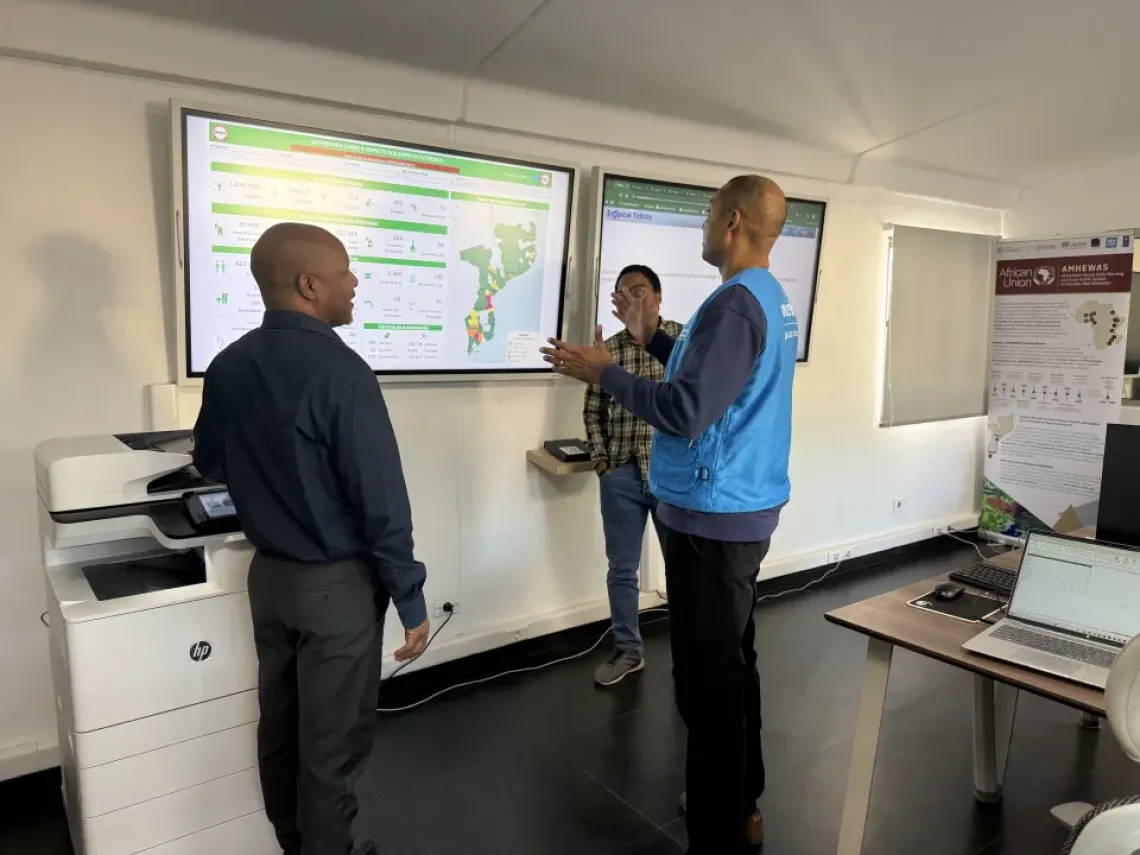
One of the critical gaps was the availability of information, but also the speed and frequency with which it was being provided and the access people had to it.
A long road from idea to reality
Turning that vision into reality would take nearly six years.
Working closely with Mozambique's National Disaster Management Agency (INGD), Claudio and the Mozambique Country Office helped launch an effort to modernize emergency information management systems. The goal was to create a centralized digital platform capable of tracking the human and infrastructure impacts of disasters as they unfolded.
The path forward was anything but straightforward.
Early efforts relied on a private technology provider. While the system showed promise, maintaining it proved expensive. Funding constraints emerged. Technology changes increased costs further. Questions about sustainability and long-term government ownership remained unresolved.
Many projects might have stalled at that point, but instead, the team adapted.
"We had to change our approach completely," Claudio says.
Rather than relying on an external contractor, UNICEF Mozambique supported a different model – one built around local capacity, government ownership and long-term sustainability. Colleagues from across the Country Office worked alongside government counterparts to identify solutions that could be maintained and strengthened over time.
Jose Cumbe, a young UN Volunteer IT specialist, was seconded directly to INGD where he worked side by side with government counterparts and UNICEF colleagues. The objective was not simply to build a platform, but to understand how government teams worked, identify bottlenecks and develop solutions together.
"His role was absolutely critical," Claudio says. "These kinds of initiatives require constant engagement. You need someone there every day helping solve challenges, demonstrating what is possible and building confidence in the system."
That close collaboration would become one of the initiative's greatest strengths.
Building trust before building technology
For Claudio and the broader UNICEF team, the project's success had less to do with software than with relationships.
"I think the strategy of working very closely with government and embedding capacity within their structures was critical," he says. "The trust came from demonstrating that the work added value and made their operations easier."
As disasters continued to affect Mozambique, government counterparts began to see the practical benefits of the new approach.
The platform helped consolidate large volumes of information quickly and generate reports that previously would have taken significant time and effort to produce manually.
Just as importantly, it reduced the risk of inconsistent data.
"We showed that this initiative could facilitate their work," Claudio explains. "If they continued using traditional methods, it would have been much more time-consuming and there would have been a much higher risk of inconsistent information."
Over time, the partnership deepened. Government ownership grew. The system was incorporated into national workplans. What began as a UNICEF Mozambique-supported initiative increasingly became a government-led priority.
For Claudio, that shift represented one of the project's most significant achievements.
"Seeing the ownership develop and seeing improved data systems become part of the government's own plans – that's remarkable," he says.
When the next emergencies came
In 2024 and 2025, Mozambique was struck by three cyclones in rapid succession, followed by severe flooding in 2026 affecting millions of people.
This time, however, responders had a new tool at their disposal – the result of years of collaboration between the Mozambique Country Office, INGD, the embedded UN Volunteer and humanitarian partners.
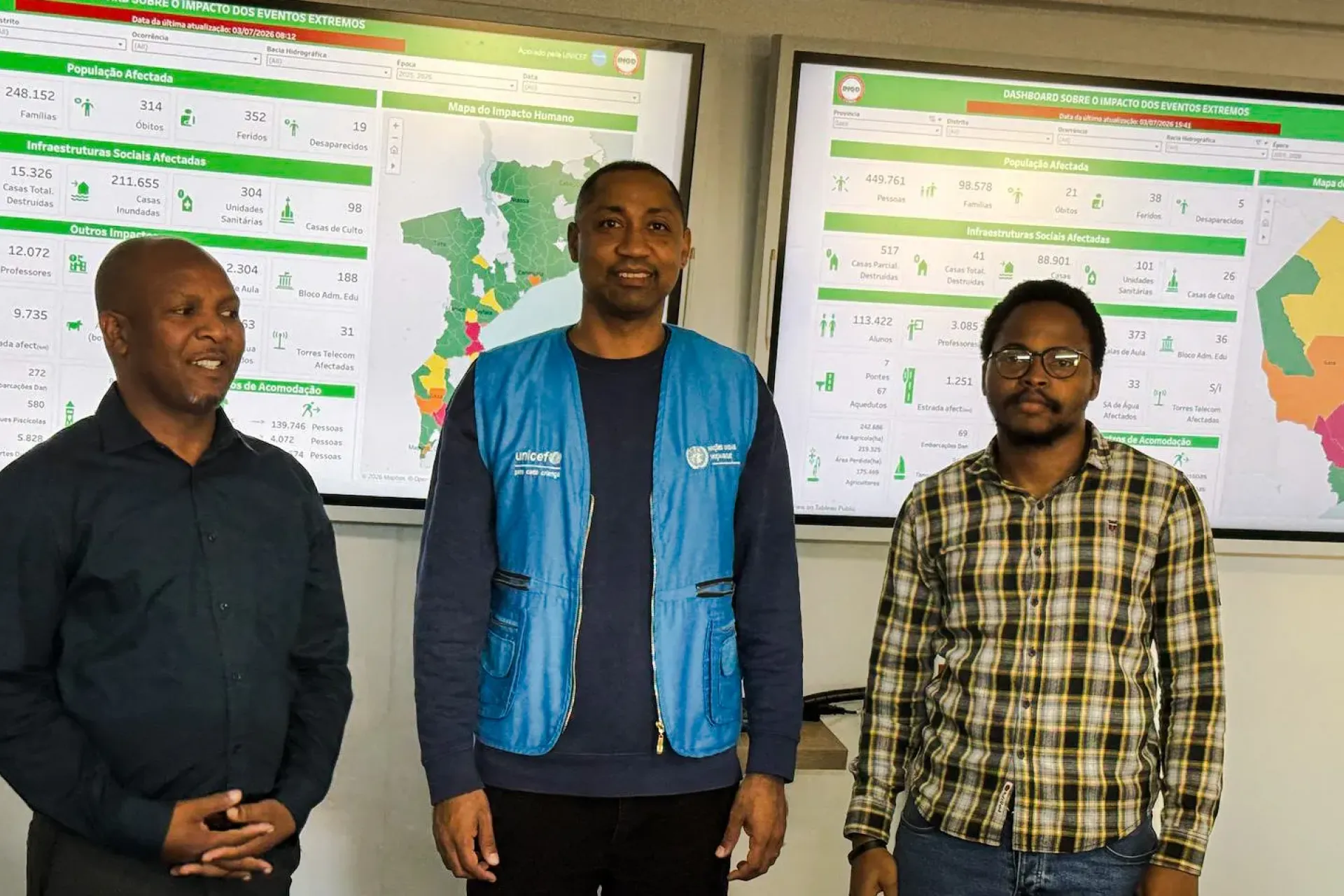
The centralized platform provided government officials, humanitarian partners and decision-makers – including the President's emergency operations room – with access to timely, verified and disaggregated information as events unfolded.
Instead of waiting days for reports to circulate, users could quickly identify affected areas, understand emerging needs, launch funding appeals and coordinate responses more effectively.
During the emergency responses, the platform recorded nearly 12,000 views.
For Claudio, one of the clearest signs of success was not what happened – but what stopped happening.
"We were no longer receiving constant requests for information," he says. "The predictability was there. People knew where to go to access the data they needed."
At the same time, users began requesting more detailed analysis and additional information layers. It was a sign that the system had become embedded in operational decision-making.
"They were asking for more because they were using it," Claudio says. "That helped inform the next improvements."
The invisible work behind every response
In humanitarian emergencies, visibility often goes to the trucks delivering supplies, the health workers treating patients or the teams restoring water systems.
Data systems rarely attract the same attention.
Yet Claudio believes they are just as essential.
"Strong information systems are really the starting point for any operation," he says. "They help improve efficiency, help us understand gaps, mobilise support and help us measure what we have achieved."
The impact extends far beyond numbers on a dashboard.
Better information means faster decisions. Faster decisions mean resources reach communities sooner. And sooner often means lives saved.
For Claudio, that connection is what continues to drive his work.
"What motivates me is the level of vulnerability and suffering that many people face," he says. "I feel that through my work I can help, even in a small way."
While frontline response remains critical, he sees equal value in strengthening the systems that enable entire humanitarian operations to function more effectively.
"This type of work can have a multiplier effect," he says. "It helps many partners come together more quickly to support the same people who need assistance."
A lesson in persistence
For Claudio, the project was a powerful reminder that meaningful change rarely follows a straight path. Along the way, the team faced funding constraints, technical setbacks, questions about long-term sustainability, and moments that demanded difficult decisions and course corrections.
He is especially grateful for the guidance and unwavering support of his supervisor at the time, Jane Strachan, who believed in the project's potential from the outset. Together, they were able to navigate many of these challenges, find practical solutions, and keep the initiative moving forward – and persistence and partnership made the difference.
"If we understand the problem clearly from the beginning, build trust with our partners and stay open to adapting along the way, we can achieve a lot," he says.
Today, the platform stands as more than a digital tool.
It represents years of collaboration between the Mozambique Country Office, government counterparts, a dedicated UN Volunteer and humanitarian partners who shared a common goal: ensuring that when disaster strikes, decisions are guided by timely, reliable information.
For Claudio, seeing the system in use is deeply rewarding.
"To see something that we worked on for so many years, despite all the challenges, and then see it being used to inform decisions across the humanitarian community – that is incredibly satisfying," he says.
Because behind every data point is a child, needing help.
And in emergencies, being able to see those needs clearly can make all the difference.
"Better data is not just about numbers," Claudio says. “It's about making sure every child and every family affected by crisis is seen, counted and reached in time.”