A head start for Laurinda
“I like to come to school and learn new things, like numbers and shapes. My favourite number is three, and my favourite shape is a circle.”

Montepuez, Cabo Delgado - Five-year-old Laurinda Ernesto stands at the blackboard with a piece of white chalk in her hand and a wide smile on her face.
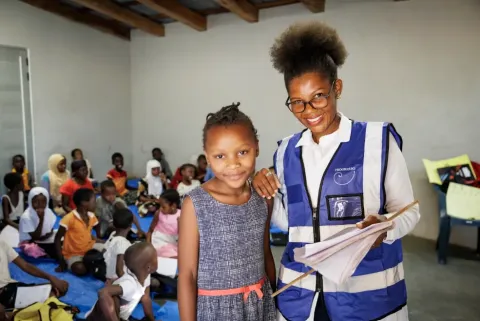
Behind her, other children sit cross-legged on the classroom floor, watching as she carefully draws shapes on the board. Outside, the white classroom walls and corrugated iron roofs of Mahipa Primary School stand on a dusty field surrounded by tall palm trees.
“I like to come to school and learn new things, like numbers and shapes,” Laurinda says. “My favourite number is three, and my favourite shape is a circle.”
Laurinda is one of 180 children enrolled in the Accelerated School Readiness programme at Mahipa Primary School in Montepuez. The eight-week programme takes place during the school holidays and helps young children prepare for Grade 1 by introducing them to counting, reading, writing, Portuguese language skills, social and emotional skills, and school routines.
For many children in this part of Cabo Delgado, it is their first experience of school.

This programme is the only opportunity in this region for children to gain pre-school experience.
“This programme is the only opportunity in this region for children to gain pre-school experience,” says Ramadan Faquihi, 43, the school director. “Most children go straight into primary school with no education experience at all.”
At Mahipa, the programme runs across six classrooms, with two facilitators supporting each class of 30 children aged five and six. They learn through songs, games, drawing, repetition and play. They also begin to build confidence in Portuguese, the language of instruction in primary school, which is unfamiliar for many children who speak a local language at home. Alongside early literacy and numeracy, they practise raising their hands, listening to instructions, taking turns and speaking in front of the class.
“The focus is to prepare children under the age of six to enter primary school,” Faquihi says. “At this age, they soak up the information.”
For Laurinda, the classroom is already becoming a familiar and happy place. She says she is looking forward to starting primary school and has made friends who will begin Grade 1 with her.
In Montepuez, education is especially important for children whose families have faced disruption and uncertainty. The community has grown as families displaced by violence in other parts of Cabo Delgado have arrived in search of safety. Some children in the programme have only recently come to the area.
When children from the programme start school, nothing is new to them. They are prepared.

“When children from the programme start school, nothing is new to them,” says Fernando Joaquin, 34, a facilitator at Mahipa Primary School. “They are prepared. Other children can feel anxious or scared because they do not yet know the alphabet, shapes or numbers, so they may not progress as well.”
Fernando says he enjoys helping children take their first steps in education and seeing how quickly they grow in confidence.
“I love working with children, playing with them and teaching them,” he says. “What I like most is seeing them get good results. I see children from last year’s programme now doing very well in school.”
According to Faquihi, the change after eight weeks is clear. Children who were once shy or unfamiliar with the classroom begin to write letters, count, follow lessons and concentrate for longer periods of time.
“At the end of the eight weeks, there is a big difference,” he says. “They are able to stay in the classroom and focus on learning.”
The programme also helps parents understand the importance of enrolling children in school and keeping them there. In some communities, children may drop out to help with farming or because displaced families return to their places of origin. For Faquihi, early learning is one way to strengthen children’s connection to school from the beginning.
“My message to parents is that it is very important for children to get a head start,” he says. “It supports their development and their results.”
In 2025, 13,212 children in Mozambique were reached through the Accelerated School Readiness programme, with all participating children transitioning to Grade 1. UNICEF supports the Government of Mozambique to implement the programme with the generous support of the European Union.
Back at the blackboard, Laurinda turns to face the class, smiling. Her next step is Grade 1, where she will begin with confidence, friends beside her and the first building blocks of learning already in place.