From Water Resilience to Resilience for Children
At COP17, UNICEF Mongolia helped put children at the centre of the water and climate agenda—highlighting how resilient water and sanitation services can protect children’s health, education and well-being.

For children, water insecurity is not an abstract environmental challenge. It can mean a community water point running dry, unsafe water increasing the risk of disease, or time spent collecting water instead of learning.
That is why, during the 17th Conference of the Parties to the United Nations Convention to Combat Desertification (UNCCD COP17), UNICEF Mongolia placed child water security and resilient WASH services at the centre of discussions on climate change, land degradation and water resources.
Throughout the 12-day conference, UNICEF worked with Mongolia’s Water Agency and Sanitation and Water for All (SWA) to bring together government, private-sector partners, international organizations, children and young people to explore how water, sanitation and hygiene can become more resilient to climate and environmental pressures.

Turning political commitment into action
A major opportunity emerged at the opening of the High-Level Segment, when President of Mongolia U. Khurelsukh expressed strong support for the SWA Heads of State Initiatives on Water and Sanitation.
This commitment can help elevate water supply, sanitation and hygiene as national priorities while strengthening political leadership, cross-sectoral cooperation and investment in resilient WASH services.
For children, the significance is clear.
As UNICEF Representative in Mongolia Beate Dastel emphasized, children contribute the least to environmental degradation but often carry the greatest burden when water sources disappear or become contaminated.
The challenge now is to translate high-level commitments into services that children can rely on every day—in their homes, schools and health facilities.

Making resilience visible where children live and learn
UNICEF Deputy Regional Director for Asia and the Pacific Julianna Lindsey captured this child-centred approach during the COP17 Water Day session “Water as a Connector.”
For a child, drought is not measured in rainfall or hectares of degraded land. Its impact is felt when a water point fails, when unsafe water increases the risk of illness and malnutrition, or when collecting water keeps a child away from school.
This is why resilient landscapes alone are not enough. Climate and environmental action must ultimately deliver safe and reliable services to households, schools and health facilities.
For UNICEF, this means embedding child water security and climate- and drought-resilient WASH services into resilience planning.

From commitment to a spring that can serve communities
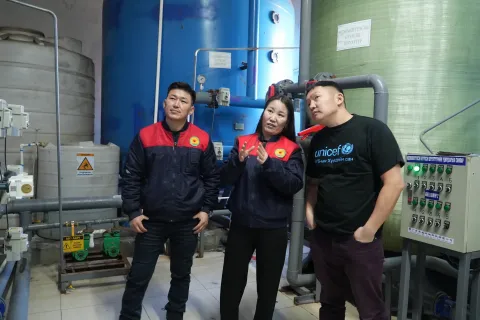
One example of this approach is the rehabilitation and improvement of Dambadarjaa Spring, undertaken by UNICEF together with the Water Agency in support of the President’s Blue Gold Programme and the 333 Lakes National Initiative.
The work provides a practical starting point for protecting a local water resource while building a longer-term approach to water security. The next phase will involve further research, assessments and restoration, with government and private-sector partners working together towards the spring’s long-term protection.
The partnership is also expanding. On Water Day, UNICEF Mongolia and Golomt Bank signed a Memorandum of Understanding to collaborate on protecting water resources, including the rehabilitation and long-term protection of Dambadarjaa Spring.
These efforts demonstrate how political commitments can begin translating into practical investments in water security and resilient services.
Keeping children at the centre
Children and young people were also active participants in UNICEF’s COP17 engagement. Young people from more than 10 countries gathered at the UNICEF Mongolia Pavilion to discuss how youth voices can be strengthened in climate negotiations and how COP17 commitments can translate into meaningful action at international, national and local levels.
Their participation reinforces a fundamental principle: climate and water solutions should reflect the experiences of those most affected by climate and environmental pressures.
As Mongolia moves from COP17 towards the 2026 UN Water Conference, UNICEF will continue to advocate for an approach in which water resilience is measured not only by restored landscapes or protected water resources, but by what changes in children’s lives.
A resilient water system is ultimately one that keeps water flowing safely to communities, schools and health facilities—and helps children stay healthy, protected and in school.
As Beate Dastel concluded: “By placing children at the centre of climate and environmental action, we can restore not only land, but also hope—for today’s children and for generations to come.”
I would recommend using “From Water Resilience to Resilience for Children” rather than the original COP-focused title. It makes the piece feel more like a WASH bulletin story and puts the impact on children at the centre rather than the event itself.