Students in remote areas are taking digital classes and studying independently
Digital Adventure continues...
- English
- Mongolian
Herdsman Ochirbat’s family are spending the winter in a place called Argalyin Zaysan in Rashaant soum, Bulgan province. Ochirbat has set up the winter shelter for his livestock on the slope of several layers of mountains to keep them warm. A herd of sheep covers the foot of the mountain in the north, while a few goats can be seen on the nearby cliff. I hear a burst of hearty laughter and look in that direction to find three children sliding down the slope of the mountain to the east on a blue sled.

There is someone climbing down carefully behind them. It is their grandfather, Mr. Ochirbat. He is apparently trying to walk faster when he saw the unexpected guests. He was holding something black in his chest with great care, which caught my eye and made me curious: it looked like a folder or something.
As the elderly man approaches us, the children, who were standing far away, come closer, too. We greet them, introduce ourselves and tell them what brought us there. Ochirbat invites us to come into his home. As he goes in, he pulls out that folder-like thing on the table. It was a notebook. What an amazing thing it is that an elderly herdsman living far away from the hustle and bustle of the city in a remote, rural area is using a laptop! Now that I have this thought stuck in my head, I can’t wait to ask about it. I wait until it was the right time to ask.
Reporter: What do you use this notebook for?
Elderly man Ochirbat: Oh, I don’t really know how to use it. My grandchildren bring it when they come from the city to visit and stay with us so that they can continue their digital learning. They turn it on once or twice a day just to engage in their digital learning. I have four grandchildren. Three of them are here to spend their winter break.
Reporter: I see, that’s what it is for. Why do you take it to the mountain in this cold winter day ?
Mr. Ochirbat: On top of all the work, I have the task of getting two of my grandsons do their homework. Oh my, this digital learning is a serious thing. This year, this boy here had learned something new when he came from the city: it takes watching cartoons and playing games. He claims they are for learning. After they watch them, the three of them engage in discussions and practice. I don't really get it all, but kids these days are too smart. They show me how they do it; they turn it on and watch the lessons. Our winter place is in a low-lying place. We don’t have a good internet connection here. But if we go higher to the mountain, the signal is better. So, when it is a sunny, warm day, we take it to the mountain and stay there a while. But before that, we must make sure that its battery is full.


Meanwhile, the kids join our conversation.
Boy: Sis, check this out!
Reporter: Ok, what lesson is it?
Boy: It’s called “Digital Adventure”. Today, we had this one (Let’s learn how to refer to extended family members and relatives). I learned the words “grandfather, grandmother, uncle, and cousin”.
Reporter: Ok, shall we first get to know each other ?
Boy: My name is Dashnyam Baljinnyam. I go to school in Rashaant soum, Bulgan province. I am in Grade 2. This is Margad and this is Battsetseg (points to them).
Margad: My name is Margad-Erdene. I come from Ulaanbaatar city. Now I am in the countryside (giggles). I go to school No. 68. I am in Grade 2, Group C. Battsetseg here hasn’t enrolled in school yet.
Reporter: Are you enjoying your winter break here? How helpful are you three to your grandparents?
Children: We take care of sheep and goats. In the evenings, we gather our cows from its pasture. We also go to bring chunks of snow.
Reporter: Do you find time to play then ?
Children: We do. In the mornings, we slide. We play with a knucklebone dice set. We also play games on the laptop when we study.
Reporter: Can you show me the games that you play on the laptop, please? I want to see it, too. Will you?
Margad: I’ll show you. First you type 3 w’s. Then you type medle.mn and go to the website for learning. Then you click on Grade 2. Then scroll down until you see the series titled “Digital Adventure”. Then you select the topic you like.
Reporter: What was the topic you studied today?
Margad: It’s titled, “Let’s learn how to refer to extended family members and relatives”. Namuunaa, a 7 years old girl who joined the class in “Digital Adventure”, introduced her family. That one you can watch in the cartoon.
Reporter: What did you learn from the cartoon?
Margad: I learned how to refer to the ones in your family and your relatives.
Reporter: Wow, that’s cool. You said there were games, too. Right?
Mmm. There are many kinds of games. For some, you answer the questions. To do so, you drag the words and put them in the right places. You can also rearrange jumbled words. When it asked, “Do you refer to someone from your father’s side as “uncle?”, I clicked on the answer that said “Yes”. If your answer is correct, then you go to the next round. If you get it wrong, you play it again until you get it right.
Reporter: I see. So do you turn on your laptop and study independently without requiring an adult to help you?
Dashnyam: When we are at grandpa’s place, we all play together. Our grandparents also play with us.
Margad-Erdene: In my home in UB, I can do it alone. I think we will almost go over all the lessons during this break.
Reporter: Wow looks like your grandpa will have to climb the mountain quite frequently.
Ochirbat: If it is cold, we stay in. If it is warm, we climb the mountain and start a few and leave them open. If the white line on the video progresses well, then you can watch it without having issues of interruption (laughs).
Reporter: You are awesome grandparents helping your grandchildren study. Kids, you guys are also doing well. Keep up the good work. Thank you for showing me these beautiful lessons.

Reporter’s Note: I notice something I feel happy about from what these kids have told me. Here is what… When I was small, a severe respiratory virus called SARS broke out, and suddenly, one day, we were prevented from going to school to study. The quarantine lasted all winter, I remember. Also, a few years ago, the whole world was on lockdown due to the outbreak of the COVID-19 pandemic. It is true that Mongolian children's right to education was seriously violated at that time, they fell behind, and we still suffer from the aftermath of poor quality, inaccessible education services...
What about today then? It was only recently, about a month ago, I think, the country adopted remote teaching/learning strategy to prevent from the spread of flu infection in relation to abrupt drop in temperature. Previously, all children's learning activities came to a halt due to the lockdowns and quarantines; but now it is commendable that a relatively large number of children can still pursue digital learning. Students in rural, remote soums have equal access to education. It is a joy to see them to be able to choose their favorite subjects and learn independently. I consider that this is a good result of development and digital transformation of education sector and I feel grateful for that.
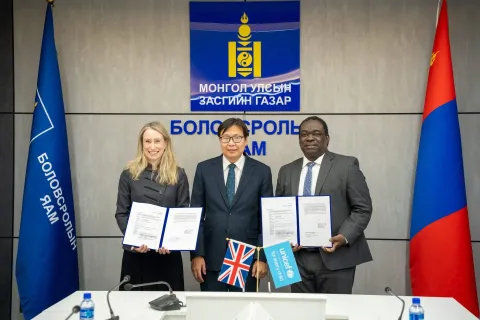
I encourage our readers to look at these “Digital Adventure” interactive series and try them with your children. These contents were developed jointly by the Ministry of Education and Science and UNICEF. You can access more than 180 interactive lessons for pre-school and general education students for free anytime, anywhere on www.medle.mn platform.
Written by: Mungunshuuder B