Empowering rural adolescents through STEM and WASH clubs
Nurturing young minds in rural Mongolia
- English
- Mongolian
More than a 1000 kilometers away from the capital of Mongolia, 13 year old Oyun-Erdene Orgilsaikhan engages in water, sanitation, and hygiene (WASH) action. She was born and raised in Tsetsen-Uul soum of Zavkhan province. Surrounded by mountains, it takes a whole day’s drive just to reach the provincial center.
Tsetsen-Uul soum is one of 10 soums from Zavkhan, Gobi-Altai, and Bayankhongor provinces selected by UNICEF to pilot an innovative approach to WASH education and training through establishing science, technology, engineering, mathematics (STEM) clubs. In partnership with the Scout Association of Mongolia, the STEM and WASH for youth project enables students to promote and uphold healthy hygiene practices through club activities, online knowledge sharing sessions and small projects.

Oyun-Erdene has been actively participating in the soum secondary school’s STEM club since last year. There, she met many friends, including Davaabayar and Orgilbayar, who are students from different grades. Through the club, Oyun-Erdene attended training sessions on project management, which was held online due to the heavy snowfall. The online training, according to Oyun-Erdene, was very engaging and “felt like the facilitators were right beside me in the room”.
The STEM club members formed three groups to design and implement small projects with the help of mentors and seed funding. Oyun-Erdene actively took part in the mobile pharmacy initiative, which is a small traveling box that includes toiletries, band-aids, sanitation items, and vitamins. Students take turns looking after the pharmacy, refilling it as the need arises. The idea stemmed from a need to provide simple healthcare services in the absence of a school doctor, whom the school hasn't had for the past few years. The project is successfully continuing to this day and has reached more than 100 students in the school.

Through the training sessions and project implementation, Oyun-Erdene not only learned about project management, but also improved her communication skills. “A while after the training, the soum governor came to the school to conduct an interview with us to gain our perspective on improving the school environment. I was able to express my thoughts and ideas very well, since this was something I had already learned to do, whereas before I rarely spoke up,” Oyun-Erdene said happily.
STEM club students also learned how to make soaps, using basic ingridients. For example, Oyun-Erdene's friend Davaabayar who took part in the soap making training, enjoyed learning about the science behind it and felt proud of herself for creating something with her own hands. She then went on to teach her classmates how to make soap, contributing to WASH action and advocacy. “Sharing what I learned with my peers and teaching them what I know was very empowering,” said Davaabayar. Due to the remote location of the town, regularly sourcing certain soap-making ingredients was a challenge. Mrs.Tsegmed, the STEM club teacher said, “The training sessions made us realize that we self-impose barriers regarding our location and resources. The facilitators reassured us that it is important to start small and continuously work together to achieve our goals”. Actively involved in this project since its inception 2021, she saw 703 youths in 10 remote soums engage with STEM and WASH activities. The newfound enthusiasm among teachers and students to explore additional areas of WASH implementation in their schools is a testament to the transformative power of collective action, proving that with genuine desire, solutions can be found, regardless of distance or limited resources.
The second phase of the project continued to engage students and teachers in improving their capacity to lead the school clubs. “Due to the novelty of the initiative, we learned that it was essential to provide continuous support in order to help schools in creating and maintaining the clubs and building a culture of ensuring hygiene and safe drinking water in the community,” explains Bolorchimeg Dagva, UNICEF Adolescent Development Specialist. Peer trainers (including 37 girls) and teachers took part in further training focused on WASH as well as leadership, club management, and project management, in preparation for enhancing club activities in their schools. A series of handbooks for club leaders and members was also developed, with practical guidance on the club activities.

Oyun-Erdene's friend Orgilbayar is one of the boys who attended the peer capacity building training, facilitated by the Scout Association of Mongolia this year. He noted the new and interesting content as well as the “positive vibes” he felt from the training facilitators and his peers. As Orgilbayar was the youngest participant, he particularly welcomed the opportunity to learn from and exchange experiences with the older students from different soums.
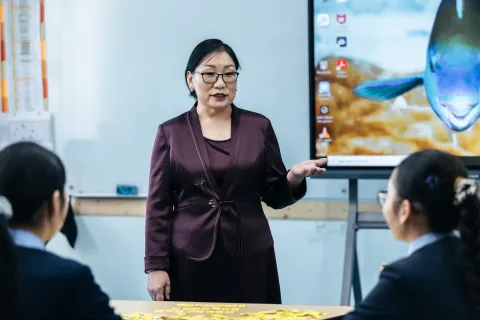
Their school implements a “one teacher - one club” policy, where each teacher is responsible for managing an after school club. The teachers noted how most clubs are related to sports or music, while the STEM and WASH clubs are uniquely designed to teach 21st century skills effectively.

“Not only did the project provide the necessary knowledge and tools related to WASH and club management, it has helped our students become more independent in their thinking and their activities, improving their communication and teamwork skills, especially when working together on project planning and implementation,” Mrs. Tsegmed said. “These are lifelong skills that the students will take with them even after they become adults.”
-----
The STEM and WASH for Youth project is supported by The Fondation de Luxembourg.