Children and adolescents from Chișinău planted the “Young Environmentalists’ Alley” in Dendrarium
marking the completion of a large-scale recycling and environmental education project

Chișinău, 9 April 2026 – Students from 63 schools in Chișinău turned more than 130 tonnes of recycled paper into 400 trees and shrubs, which they planted in Dendrarium Park in the Buiucani sector of the capital. Through this event, young people marked the completion of the “Eco-Logica – sustainable youth-led recycling interventions” project, carried out in 2025-2026.
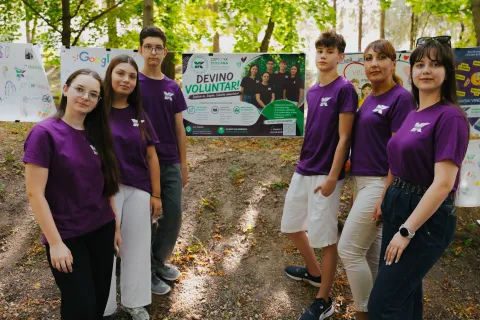
The initiative, implemented by the Intellectual Games Association of the Republic of Moldova and UNICEF, promoted the active involvement of children and adolescents in environmental protection through education and concrete action. With the support of Chișinău City Hall and the administration of Dendrarium Park, more than 200 students and teachers from the capital created the “Young environmentalists’ alley” - a tangible result of students’ engagement in recycling and environmental protection.
The joint efforts of students, teachers, parents and the community led to the collection of more than 130 tonnes of used paper, which generated total revenues of 137,061.80 MDL.


These funds were fully reinvested in the project and used to purchase the trees and shrubs planted by the very students who had spent weeks collecting used books, notebooks, boxes, and paper packaging. In this way, students’ recycling efforts were directly transformed into an urban greening intervention, offering a concrete example of a circular economy applied at the local level.
The 400 trees and shrubs planted will help improve air quality, expand urban green spaces, and strengthen the city’s climate resilience.
In addition, the project contributed to strengthening institutional and community capacities by training 159 teachers and 306 student council members, as well as by involving an estimated 60,000 parents and caregivers.

Representatives of Chișinău City Hall, UNICEF and implementing partners also attended the planting activity.
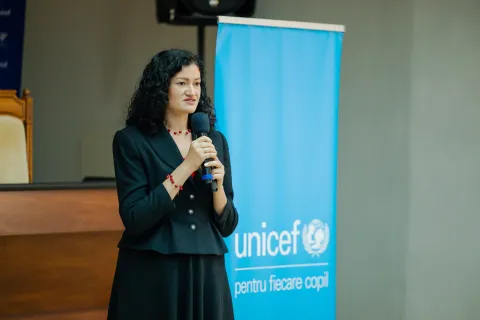
Corina Andronic, UNICEF Water, Sanitation and Hygiene Specialist, noted during the event: “This project demonstrates that involving children in concrete actions not only develops knowledge, but also contributes to changing behaviours and shaping sustainable practices in the community.
For UNICEF, such initiatives are essential not only from an educational perspective, but also in promoting policies and models that support youth participation and the transition towards a healthier and more resilient environment.”


Ion Ceban, Mayor of Chișinău, added: “The results of this project confirm the essential role of schools in shaping responsible environmental behaviours. Through the active involvement of students and teachers, we are building not only knowledge, but also a culture of responsibility and civic engagement in the community.”

Evgheni Poleacov, President of the Intellectual Games Association of the Republic of Moldova, noted: “We set out to transform recycling from a theoretical activity into a process in which students are involved and motivated over the long term. The fact that this initiative ends with the planting of an alley created through their own efforts proves that young people can generate real change when they are given the right context and support.”

The activity took place in the context of environmental initiatives marked in March and April - International Day of Forests, on 21 March; Earth Day, on 22 April; and the national afforestation campaign “Spring 2026” - a period dedicated to environmental protection and civic engagement for a sustainable future.
A project built on participation and behaviour change
The “Eco-Logica” project was implemented by the Intellectual Games Association of the Republic of Moldova and UNICEF, with the support of Chișinău City Hall, as part of efforts to promote sustainable behaviours among children and adolescents.
The intervention addressed an important gap in environmental education, where knowledge often remains at a theoretical level. Through a model based on active participation, gamification and experiential learning, the project aimed to encourage students to become actors of change, supporting UNICEF’s priorities related to changing attitudes and behaviours in schools, meaningful youth engagement in community life, and advocacy efforts in environmental protection and climate change.

Project stages: education, mobilization and action
In the first stage, the project focused on strengthening environmental knowledge and attitudes. In the 63 participating educational institutions, 1,264 thematic lessons were organized by 159 trained teachers, who helped students understand concepts related to recycling, the circular economy, and environmental protection.
The project then included a practical component, involving students in collecting used paper at the school level. Student Council members played a central role in organizing and coordinating these activities, facilitating collection initiatives, encouraging their peers to participate, and helping strengthen leadership and civic responsibility.
In total, 34,846 students participated in the project activities, significantly exceeding the initial target. Participation was inclusive, bringing together 17,771 girls and 17,075 boys, as well as children from various underrepresented groups: 2,155 students from at-risk groups, 429 children with special educational needs and/or disabilities, 737 refugee students and 4,309 representatives of ethnic minorities.
Involvement also extended beyond schools, with the active participation of parents and caregivers, contributing to the transfer of sustainable behaviours to families and communities.


Sustainability prospects
The project results have created opportunities for continuity and expansion. The models developed - including the gamification-based methodology, the involvement of Student Councils, and the mechanism for reinvesting funds generated through recycling - can be replicated and adapted in other educational institutions across the country.
The collaboration infrastructure created between schools, local public authorities and economic operators also provides a solid basis for maintaining and expanding collection and recycling practices.
The “Eco-Logica” project demonstrated that the active involvement of young people, supported by the community and strategic partnerships between UNICEF, authorities and local organizations, can generate tangible results both in terms of behaviour change and environmental impact.
The initiative also contributes to achieving the Sustainable Development Goals, particularly those related to quality education, sustainable cities, responsible consumption and climate action.
The “Young Environmentalists’ Alley” remains not only a symbol of this collective effort, but also concrete proof that change can be initiated and sustained by young people when they are given the tools and the right context.
The list of educational institutions participating in the project and the amount of paper collected is available below.
Educational institution | Amount of used paper collected, kg | |
| 1 | Liceul Teoretic „Mihai Eminescu” | 16040 |
| 2 | Liceul Teoretic „Anton Cehov” | 8928 |
| 3 | Liceul Teoretic „Petru Movilă” | 8160 |
| 4 | Liceul Teoretic „Liviu Rebreanu” | 6615 |
| 5 | Liceul Teoretic „Vasile Alecsandri” | 8012 |
| 6 | Liceul de Limbi Moderne și Management | 5780 |
| 7 | Liceul Teoretic „Mircea cel Bătrân” | 7370 |
| 8 | Liceul Teoretic „Onisifor Ghibu” | 4298 |
| 9 | Liceul Teoretic „Grătieşti” | 4558 |
| 10 | Liceul Teoretic „Toader Bubuiog” | 3127 |
| 11 | IP Școala Profesională nr.6 | 2100 |
| 12 | Gimnaziul „Durleşti” | 3424 |
| 13 | Liceul Teoretic „Miguel de Cervantes Saavedra” | 2742 |
| 14 | Liceul Teoretic „Spiru.Haret” | 6514 |
| 15 | Liceul Teoretic „Titu Maiorescu” | 1034 |
| 16 | Liceul Teoretic cu Profil Arte „Elena Alistar” | 880 |
| 17 | Liceul cu Profil Sportiv „Gloria” | 1920 |
| 18 | Şcoala primară nr.95 | 1550 |
| 19 | Lceul Teoretic „Mihai Viteazul” | 1426 |
| 20 | Gimnaziul nr.49 | 900 |
| 21 | Instituția Privată Liceul ,,Da Vinci” | 920 |
| 22 | Liceul Teoretic „Natalia Gheorghiu” | 2060 |
| 23 | Școala auxiliară nr.7 | 620 |
| 24 | Şcoala primară nr.82 | 0 |
| 25 | Gimnaziul Ion Luca Caragiale | 4300 |
| 26 | Liceul Teoretic „Beniamin Zeev Herţli” | 2360 |
| 27 | Gimnaziul nr.45 , com.Ciorescu | 820 |
| 28 | LIceul Teoretic ,,Bogdan Petriceicu Hașdeu” | 1340 |
| 29 | Liceul Teoretic „Rambam” | 305,5 |
| 30 | Liceul Teoretic „Ginta Latină” | 1160 |
| 31 | Liceul Teoretic „I.S.Neciui-Levițchi” | 1100 |
| 32 | Școala specială nr.12 pentru copii hipoacuzici cu surditate dardivă | 320 |
| 33 | Complexul Educațional Liceu-grădiniță „Kiril și Metodii” | 1400 |
| 34 | Liceul Teoretic „Tudor Vladimirescu” | 690 |
| 35 | Gimnaziul nr.42, Codru | 150 |
| 36 | Gimnaziul nr.31 | 426 |
| 37 | Liceul Teoretic „Academia Copiilor” | 0 |
| 38 | Liceul Teoretic cu Profil Arte "Mihai Grecu" | 668 |
| 39 | Gimnaziul „Decebal” | 220 |
| 40 | Liceul Teoretic „Dimitrie Cantemir” | 1318 |
| 41 | Liceul Teoretic „Princesa Natalia Dadiani” | 2900 |
| 42 | Liceul Teoretic „Costantin Sibirschi” | 1244 |
| 43 | Liceul Teoretic „Petru Rareş” | 926 |
| 44 | Liceul Teoretic „Gheorghe Asachi” | 3898 |
| 45 | Gimnaziul Steliana Grama | 0 |
| 46 | Liceul Teoretic „Grigore Vieru” com. Băcioi | 1020 |
| 47 | Liceul Teoretic „Petru Zadnipru” | 640 |
| 48 | Liceul cu Profil Arte „Iurii Harmelin” | 494 |
| 49 | IPLT „Alexandru cel Bun” | 0 |
| 50 | Liceul Teoretic Republican Aristotel | 280 |
| 51 | Școala auxiliară Nr.5 | 0 |
| 52 | Liceul Teoretic „Nicolae Milescu Spătaru” | 140 |
| 53 | Liceul Teoretic „Olimp” | 1098 |
| 54 | Gimnaziul „Ion T.Costin” com.Ghidighici | 0 |
| 55 | Liceul Teoretic „N.V.Gogol” | 960 |
| 56 | Liceul Teoretic „Dragoş Vodă” com. Stăuceni | 540 |
| 57 | Gimnaziu 86 | 464 |
| 58 | Gimnaziul „Galata” | 620 |
| 59 | Liceul de Creativitate și Inventică ,,Prometeu-Protalent” | 0 |
| 60 | Liceul Teoretic „Orizont”, Durlești | 0 |
| 61 | Gimnaziul Taras Șevcenco | 220 |
| 62 | Liceul Teoretic „Hyperion”, or. Durleşti | 0 |
| 63 | Liceul Teoretic „Iulia Hașdeu” | 150 |