More resilient education with psychosocial support
With training in Psychosocial Support and Mental Health, teachers are better equipped to support students in difficulty.

- Français
- English
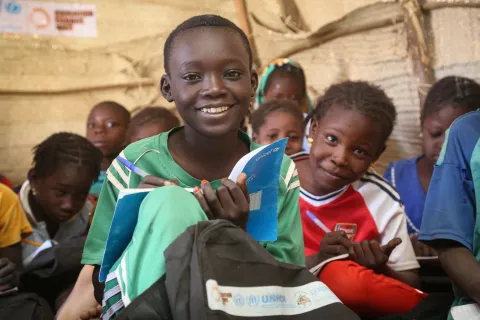
The Yirimadio A Primary school, in Bamako's commune VI, welcomed 578 pupils at the start of the 2023-2024 school year. Girls and boys, aged between 6 and 15, are divided into nine classes of approximately 50 pupils each, covering grades 1 through 6. Idrissa Lahaye Coulibaly, who has been running the school for eight years, has motivated his 19 teachers, males and females combined, to train in mental health and psychosocial support to enhance their learners’ well-being: "Psychosocial support is actually a very, very important theme. Our school is on the outskirts of Bamako, and we have several children who experience distress. This training has enabled us to strengthen our skills so that we can assist them."
Before taking part in the training, Aminata Koné, who teaches 4th graders at Yirimadio A, had already dealt with students in distress. "A young girl asked me to go and see her parents to help her. I called in the mother, and together with the principal, we were able to find a solution to her problem ". In addition to learning how to identify pupils in situation of distress, Ms. Koné and her colleagues studied different support techniques, including adapting lessons and asking probing questions to listen to students’ concerns. The principle of psychosocial support in schools is to infuse notions and approaches of socio-emotional learning into daily classroom practice.
UNICEF is working with the Malian Ministry of Education to address crisis-related issues and to make the education system more resilient. The first psychosocial support module for primary and pre-primary school staff was integrated 10 years ago into the in-service training offered by the Ministry. "With the 2012 crisis, children witnessed situations that caused stress, trauma, psychosocial and psychological distress" explains Ismaila Touré, Deputy Director of the National Directorate of Teacher Training.

"Affected children may behave in ways that may be out of character," continues Mr. Touré, and this could disrupt their learning. The training courses are designed not only to equip school staff in crisis regions, but they are also useful for school staff throughout Mali, including the teaching staff at the Yirimadio primary school. He adds: "Psycho-social support is beneficial for all children given that it also strengthens their resilience."
The 2012 module, which focuses on theory and children's rights, was supplemented in 2015 by a practical module designed by UNICEF, with activities that encourage the expression of emotions. "This module has been well received," confirms Mr. Touré.
The Ministry of National Education has just launched the third generation of continuing education module on psychosocial support, which was designed with a clinical psychologist, enabling the integration of the mental health component and the harmonization of several approaches. The training consists of three main elements: a theoretical module explaining the key concepts of mental health and psychosocial support, a guide for trainers, and a toolbox for teachers. The new toolbox contains classroom activity sheets to help students express their emotions, develop empathy and collaboration, while making the link with the theoretical contributions.

The module also informs staff about how to deal with the most serious cases. Once a situation of distress is detected, the teaching staff, who can support the child via a helpful interaction, but who do not have the skills to provide medical care, must refer the child to health services, with the parents' agreement, or directly, in case of an emergency.
Psychosocial support trainers from the academies of Timbuktu and Bamako Rive Droite have already been trained to train teachers in their regions. The next step is to disseminate the new tools in all regions and with implementing partners. At the same time, the Ministry of Education, with UNICEF support, is developing a peer-help approach to equip teachers and to create support groups for teachers within schools. Strengthening the psychosocial well-being of teachers is essential if they are to support the well-being of children.
UNICEF and the Education Cluster are working with the Ministry of Education to design and disseminate the new in-service training module on psychosocial support through a partner NGO, Humanity and Inclusion. The project is funded by the German Development Cooperation (BMZ) through the regional project "Building Resilience in Sahel", implemented in Mali, Mauritania and Niger and thematic funds.