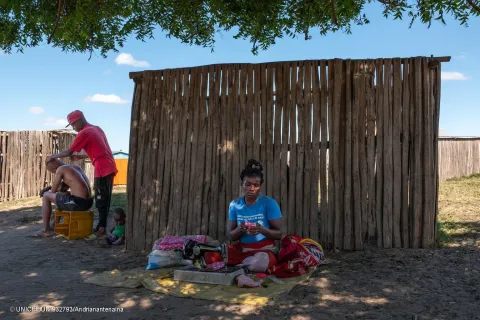
Thanks to the emergency allowance, an improvement in living conditions has been observed
The emergency allowance programme is part of the Cash Working Group's joint response to the humanitarian crisis in Southern Madagascar

Anja Rasoa, farmer, lives in the village of Tanambao, rural commune of Ifotaka, District of Amboasary Atsimo, Androy Region. She is a 27-year-old single mother with five dependent children.
All three of her children were victims of severe acute malnutrition at the start of the crisis in 2020.
The distribution of 100,000Ar (USD 25) per month by UNICEF, with the Intervention Funds for Development, saved the life of this family. “When we received this Toseke (meaning support), our lives really improved. We can now eat twice a day. And I put 50% of the allowance into feeding my little family. I was able to pay school fees and buy school supplies for my children. They are healthy now and very clean as never before; I am very happy to see them clean. And I can even save a little money in case my children get sick.

Nety Sailambo, 47 years old, has eight dependent children, including her grand-children. Her husband who had worked in the field of tourism (tourist guide in a hotel in Ifotaka) became unemployed following the COVID-19 pandemic. He is currently ill.
"I was able to set up my little gargotte thanks to the monthly allowance I got from UNICEF," she says. “I no longer borrow from people as before, but even if I am in difficulty, I borrow from our community group ‘Firaisan-kina’ or solidarity which is a Village Savings and Loan Association. As a farmer, I really needed seeds and with that money, I could buy sweet potato cuttings and got a harvest bag that supplemented our food ration for a month and a half. In addition, the most important thing is that my husband who is not in good health at the moment can undergo medical treatment."

Fanomezana Philomène, a 67 year old grandmother with 6 grandchildren to support as the children's father is no longer there.
Not only has she been able to meet the basic needs of her grand-children, including food, education and health, but she is also gradually beginning to buy kitchen utensils, as well as poultry and small ruminants. “I’ve acquired new pots and I also now have chickens and a small goat that I have bought little by little thanks to the allowance I receive every month,” she said.

Delphine, 32, mother of four children,
“Not only do we receive money each month to survive, but we also benefit from several awareness-raising services through mother leaders. What interested me most was the use of the contraceptive method because I already have four children. I have been using a contraceptive implant since last year” (pointing to the internal face of his arm).

The emergency allowance programme is part of the Cash Working Group's joint response to the humanitarian crisis in Southern Madagascar. The programme is funded by the Joint SDG Fund, Norad, KOICA and FCDO until the end of January 2022.
UNICEF is urgently seeking additional funding to continue the humanitarian response programme.