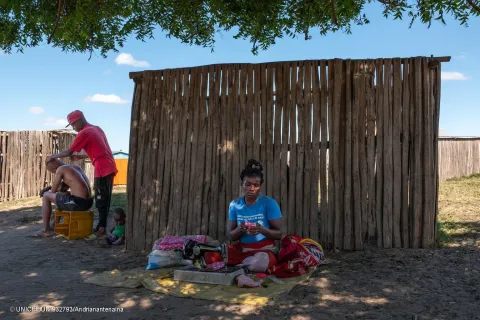
Solidarity and hope: how a village builds its future
In the village of Aloalo II, in the heart of the Anosy region, families are joining forces to offer a better future for their children.

The sun's warmth is becoming more apparent on this dazzling morning, heralding the end of the winter. The 25 members of the community savings group are convening for their weekly meeting in the village of Aloalo II, which is situated two kilometers from the capital of the commune of Ifotaka in the Anosy region of southern Madagascar. It is customary to maintain silence in this context; money is a significant issue.
Among the participants, Haovasoa, 40, mother of 11 children, follows the meeting attentively. Married to Mahasolo, she has been a member of this savings group for several years.
"I joined this group because it allows me to save and borrow when I need to. It helps me a lot to support my family and make progress little by little".
Thanks to her loans and financial support from the Zara Mira cash transfer program, Haovasoa has been able to develop a small business, improve her crops in the community field, and buy three goats—which have already given birth to six kids.
On this day, five women wearing blue vests emblazoned with the logos of the program and its partners are present. They are parent leaders, committed members who support families on their journey toward resilience. Mary Florine is one of them, and she is also responsible for taking notes during group meetings. “Model parents raise awareness of good practices in nutrition, health, education, water, hygiene and sanitation, gender equality, citizenship, and the law.
They also work on financial and productive inclusion within the wellness space to strengthen household autonomy,” she says. In addition, in the well-being spaces, these women benefit from support that includes the promotion of Essential Family Practices (EFP) and activities to stimulate children through play and parent-child interactions.


An ongoing multisectoral program
In accordance with the eligibility criteria defined by the program, which targets children under the age of 15, pregnant women, and people with disabilities, four of their children receive a monthly allowance under the Zara Mira program.
Although the cash transfer program has ended, the social services office that was set up continues to operate. This is where Haovasoa and her family went, armed with copies of the birth certificate and other administrative documents, to register their youngest child, Tanjona, aged nine months. In addition, an exit strategy, developed with beneficiaries by the Ministry of Population and the Development Intervention Fund, promotes the empowerment of families.
At the social services office, agents handle complaints and follow up on cases, register beneficiary households, and organize awareness-raising sessions on various topics.
In Madagascar, approximately 500,000 children are covered by a social protection program.
Social protection programs such as Zara Mira offer much more than just financial assistance. They provide families with comprehensive support, including: good parenting practices, adopting cooking methods that are suitable for children's nutrition, promoting community savings, financial education, supporting families in income-generating activities, and many other areas. This support strengthens their ability to plan for the future and cope with daily challenges. Thanks to this multisectoral support, parents can envision a better future for their children, while strengthening the cohesion of their community.


Note: These actions were made possible thanks to the project to strengthen resilience for food and nutrition security in Madagascar, funded by BMZ through KfW Development Bank. This project is being implemented jointly by WFP and UNICEF in the municipalities of Itampolo (Ampanihy district), Sihanamaro (Ambovombe district), Tsivory and Ifotaka (Amboasary district). It will run for 60 months, from December 2022 to December 2027, and will benefit 105,650 people, including the Notsimbininiavo family.