Soafiny: 11 years of commitment to her community
Although she is a volunteer, Soafiny, a community worker, continues to be fully committed to ensuring that the children in her village grow up in an environment conducive to their development.

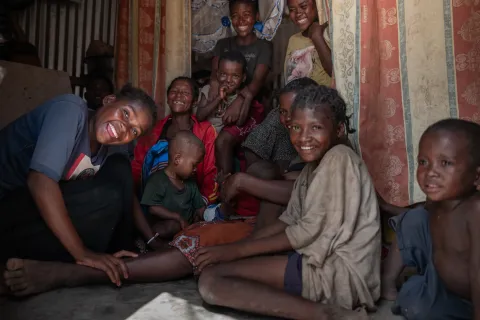
“Children are the future of this village. I want the village to become a model where everyone can grow to their full potential.” With these words, Soafiny Marie Olga, 45, a community worker, concludes our conversation.
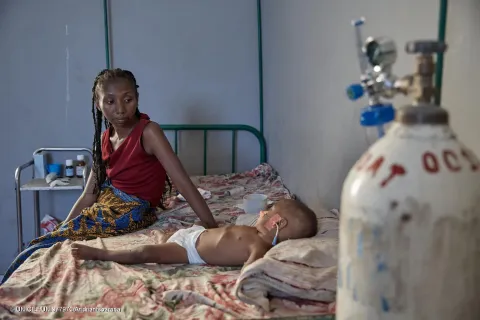
Earlier that morning, we met her at the community nutrition center set up by the Regional Nutrition Office. She was kindly advising Angeline, the mother of nine-month-old twins, Florida and Florina. Angeline was worried and had come to see Soafiny after noticing that her daughters had lost weight. Without delay, Soafiny carried out a screening test: by measuring the upper arm circumference, she found that one of the twins was in the yellow zone, confirming moderate acute malnutrition. She also noted that the child was underweight. Soafiny then entrusted the little girl to her colleague at the site, who will take charge of her treatment with ready-to-use therapeutic foods.
This scene, which occurs almost daily, takes place in Terabovo, in the municipality of Sihanamaro, in southern Madagascar. For 11 years, Soafiny has been working there as a dedicated community worker. Her main tasks include screening cases of malnutrition and educating parents about good practices in health, nutrition, and hygiene, among other things.
“My greatest satisfaction is seeing these mothers follow my advice and have children who grow up healthy,”


In Madagascar, 46% of children under the age of 5 suffer from at least one form of malnutrition. This precarious situation is particularly acute in the southern regions, which are regularly affected by drought and bad weather.
After the consultation, Soafiny goes to the Learning Center for Nutritional Rehabilitation and Early Childhood Development (FARNE), where other children suffering from moderate acute malnutrition are treated differently, using local foods cooked according to different practices. This is her daily routine. Every day, she meets women from the village who help her prepare lunch. On the menu: cassava, lentils, corn, pistachios, a little iodized salt... all transformed into a nutritious paste. The children enjoy their meals. FARNE also provides a continuum of early learning opportunities. During their stay at the center, the children receive optimal care, including psychosocial support through early learning activities using local toys.
In principle, after 18 days of nutritional monitoring, these malnourished children return to good nutritional status. Soafiny has also trained mothers to screen their children for malnutrition. Using an upper arm circumference measuring bracelet, she teaches them how to spot the signs of malnutrition so that they can replicate these simple but essential actions at home.
“I also work closely with health workers, who are qualified professionals to whom I refer more serious cases requiring medical attention. I make a living from farming and sewing. But this mission is my calling: it allows me to contribute to the development of my community.”
Her actions and those of her colleagues are supported by the Project to Strengthen Resilience for Food and Nutritional Security in Madagascar, funded by BMZ through KfW Development Bank. Implemented jointly by WFP and UNICEF, this project benefits 105,650 people in four municipalities in the Greater South. The project is distinguished by its integrated approach, which allows for complementarity between activities. This creates a powerful synergy that offers a package of integrated services to address acute malnutrition in these vulnerable communities.