Resilient couple, thriving family
This article highlights how a young couple is empowering themselves thanks to the multisectoral support provided to their community by local actors and international development organizations.

The cool winter wind still blows through the village of Terabovo, in the municipality of Sihanamaro, in southern Madagascar. Amidst the calm, messages about good nutrition practices echo repeatedly through a loudspeaker installed in the courtyard of Notsimbininiavo L-Adina, a 31-year-old farmer.
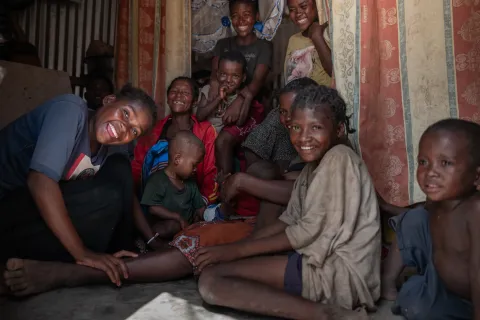
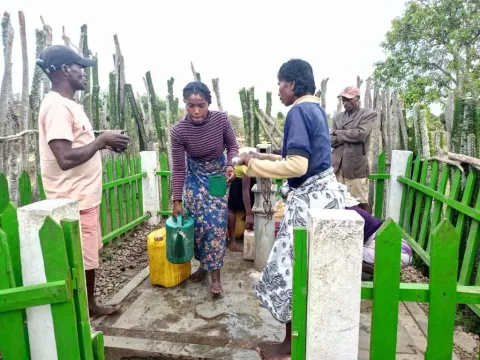
“I work with a local NGO, and they installed this listening station at my house,” he says, keeping an eye on his five-year-old daughter, Hortense, who is playing tea party with her friends. His wife, Cynthia, is busy in the kitchen: today's menu features a hearty vegetable stew with rice and lentils, prepared with produce she picked that morning from the community garden. Cynthia took the time to wash her vegetables thoroughly with diluted bleach, as she learned during the awareness sessions. She doesn't hesitate to use as much water as necessary, especially since the water source is close by thanks to a drinking water supply system built by UNICEF and its partners.
The couple, who have two children—Hortense and Urbain, aged seven months—live mainly off agriculture. Since 2021, they have been actively involved in a community vegetable garden, which brings together 25 households. Together, they grow zucchini, beets, greens, carrots, pumpkins, tomatoes, onions, peppers, and chili peppers. When it's time to sow, everyone helps each other. The families take turns in small groups to water the plants. The harvests are shared among the members, and the surplus is sold to finance the purchase of new seeds, in addition to those already provided by another NGO that implements this activity initiated by the WFP.
“Before, we only ate cassava at every meal. Since we started participating in the community vegetable garden, we have been growing a wide variety of vegetables. At the same time, we rent land to plant cassava, sweet potatoes, corn, and lentils.”


Community resilience
Before taking part in this community vegetable garden initiative, the family attended training courses at farmer training centers, where they learned the basics of agriculture. Tema Colette, a female leader, leads these field training sessions. At the same time, UNICEF, through one of its partners, also provided them with training on agricultural techniques to improve yields.
Lunchtime has arrived. The whole family gathers around the delicious meal prepared by mom. Even little Urbain, after receiving his ration of breast milk, joins in this convivial moment. “It's important for my children to eat a varied and diverse diet, as this contributes to their healthy development,” explains Cynthia.
“I learned all these practices thanks to the awareness-raising actors, and especially the support group where we exchange ideas and learn together. Thanks to this support, my children have never suffered from malnutrition.”
In regions often affected by drought, all these actions were made possible thanks to the project to strengthen resilience for food and nutrition security in Madagascar, funded by BMZ through KfW Development Bank. This project is being implemented jointly by WFP and UNICEF in the municipalities of Itampolo (Ampanihy district), Sihanamaro (Ambovombe district), Tsivory and Ifotaka (Amboasary district). It will run for 60 months, from December 2022 to December 2027, and will benefit 105,650 people, including the Notsimbininiavo family.


A happy family
This family exemplifies a wonderful dynamic of resilience and self-reliance. Cynthia is also an active member of a community savings group. Thanks to the credit she obtained through this group, she was able to start a small business, buy household utensils, as well as zebu cattle and carts that they rent out to supplement their income. The family enjoys satisfactory sanitary conditions: they have a latrine, their children have always been well fed and are up to date with their vaccinations. Cynthia gave birth in a health center, ensuring she received appropriate care.
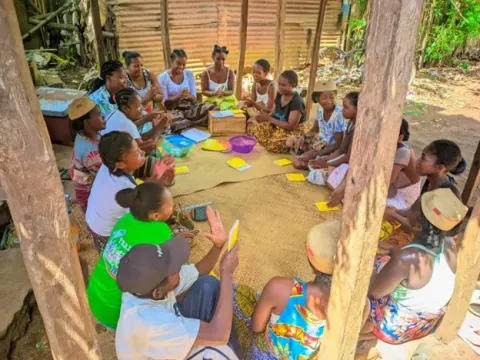
UNICEF established the "Mandady space" playground in the village to ensure the safety and development of young children. The couple brings their children there after lunch. At this location, community worker Masy Sahazesoa facilitates early stimulation sessions and allows the children to play with items that have been crafted by scouts from recycled, cleaned, and repurposed objects, thereby reviving these material.
“It is important for children to play and develop fully, because play is essential to their physical and mental development.”