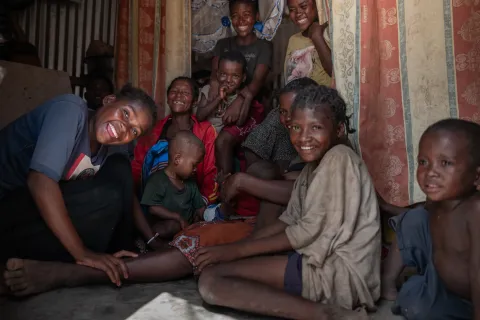
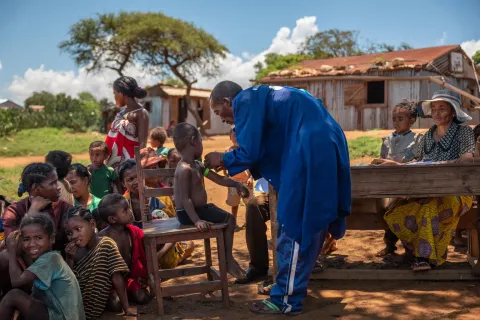
Elio and the long road to recovery, a fragile lifeline after the cyclone.
Two months after Cyclone Gezani, healthcare services are operating again, but remain fragile despite emergency assistance.

- Français
- English
For more than a month now, one‑year‑old Elio has been hospitalized at the Intensive Nutrition Rehabilitation Centre of the University Hospital of Toamasina. He is suffering from severe acute malnutrition, compounded by complications related to tuberculosis. A serious diagnosis for such a young patient, being treated amid a protracted emergency.
“After the cyclone, he started having a fever and convulsions. He also lost a lot of weight, so I took him to the hospital,” explains his mother, Voavonjy Jocilène.
In the ward, Elio receives medical treatment and therapeutic food to stabilize his nutritional status and strengthen his immune system. With UNICEF support, oxygen can also be administered directly in the unit during seizure episodes, avoiding the need to transfer him to intensive care. Sitting by his bedside, his mother tries to hold on to hope despite the daily hardships.
“The financial situation is very difficult, but I receive some help from my family. At the same time, I also have to take care of my eldest son, Alan, who is five years old.”
Beyond Elio’s illness, the family is also dealing with the aftermath of the cyclone, which destroyed their home. The situation becomes even more complex, as Elio will soon need to be transferred to the capital for further medical examinations.


Strained Health Services
In the hospital corridors, the flow of people never stops. The facility is struggling to maintain services despite infrastructure severely damaged by the cyclone: cracked walls, damaged doors, and weakened roofing.
To respond to the surge in patients, UNICEF support has helped strengthen medical teams through the recruitment of healthcare workers and social workers, particularly in the pediatric ward.
“I did my internship here in 2023. I returned three weeks ago, and I can feel just how exhausting the work is. Even with reinforcements, the workload remains extremely heavy,” confides one of the newly recruited doctors. At the nutrition centre, more than thirty children have now been hospitalized each month since the cyclone, illustrating the constant pressure on the service.
The hospital has suffered significant material damage, affecting its daily operations. A drinking water supply system has been installed, but it remains unreliable due to technical issues. To make up for the lack of space, UNICEF also provided a large tent to accommodate women after childbirth.
It is in this temporary space that we meet five families, including that of Zorelle Edwige. Lying on her bed, she gave birth two days earlier to twins, Willane and Winot. She is now the mother of five children.
“It was difficult to go through my pregnancy while dealing with the cyclone. Fortunately, we were warmly welcomed at this hospital.”
In a context still deeply marked by the cyclone’s impact, healthcare workers and families continue to cope, balancing resilience with uncertainty. Elio and his mother will remain at the centre until he is able to feed himself after the removal of the gastric tube.
Note: These UNICEF interventions were made possible thanks to financial contributions from the United Nations Central Emergency Response Fund (CERF), the Swiss Agency for Development and Cooperation, and the United Kingdom’s Foreign, Commonwealth & Development Office (FCDO) through the “Today and Tomorrow” initiative.