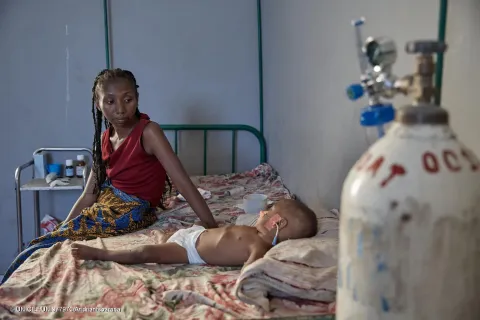
Humanitarian crisis: UNICEF and its partners are on the front line
This photo essay highlights the efforts of UNICEF and its partners to carry out mass screening for malnutrition in regions facing a humanitarian crisis.

Ninety-eight percent of people identified as being in a crisis phase – that is, 1.5 million people – are concentrated in the Great South and Great South-East. 70,000 people are in a situation of cute crisis, according to the results of the ‘Integrated Food Security Phase Classification (IPC)’ analysis conducted in July 2025 and confirmed by the December 2025 assessment, an analytical tool used in Madagascar since 2016.
In response to this situation, the Government of Madagascar, the United Nations system, including UNICEF, and the humanitarian community, are appealing for international assistance to strengthen the humanitarian response in the districts affected by the food and nutrition crisis.

In the village of Maropia, in southern Madagascar, two community health workers are going door-to-door to raise awareness about malnutrition screening and the distribution of vitamin A.

Sandaniaina Raherijaona, a nutrition specialist with UNICEF, is filling in the forms to track inputs and activities.

At 22 months old, Angela was screened using an upper arm circumference tape measure. Her measurement, which fell between the red and yellow zones, indicated that prompt intervention was required.

In the municipality of Tanandava-Sud, these agents use CommCare, an app that makes it easier to monitor the nutrition and social protection of children through a database and a unique identifier, thereby improving their identification, regular monitoring and screening.

Like Angela, children with confirmed malnutrition receive a ration of therapeutic food, supplied by UNICEF, to help them gain weight and recover.

Children identified as being in a state of malnutrition through screening, such as Angela, are also given vitamin A supplements in capsule form: blue capsules for children aged 6 to 11 months, and red capsules for those aged 12 to 59 months, to boost their immunity.

Eliana, aged 24 months, is also given this vitamin orally. Her older sister, Florentine, aged 16, explains: “We lost our mother four months ago and no longer have a father. With no financial resources, we are surviving thanks to the support of other members of our family.”

Fidanantsoa (in the middle), who is also a community worker, takes this opportunity to have her two children – Gustina and Fildina – screened.

As the morning drew to a close, once the activity was over, the community workers, satisfied and proud of their work, posed for a group photo with the community.
Note: The vitamin A supplementation programme is funded by the Government of Canada.
Therapeutic foods are provided by UNICEF, with funding from its partners: Irish Aid (Irish Development Agency), ECHO (European Commission for Humanitarian Aid), BMZ via KfW – German Development Bank, BHA (United States Bureau for Humanitarian Assistance), the Principality of Monaco, the Axian Foundation and the Child Nutrition Fund.