In Madagascar, a fresh start for children thanks to the Zara Mira social protection programme
Berthin, 13, wants to become a doctor. Thanks to the Zara Mira programme, he can go to school and forge himself to someday practice this promising profession

In Ifotaka, in Southern Madagascar, 13-year-old Jean Berthin dreams of one day becoming a doctor. As he becomes aware of the limits of his physical handicap, he puts all his hope in his studies to achieve his goal. But with Berthin and his 3 siblings, balancing the expenses is a real headache for his parents. The children, for example, missed the entire 2020-2021 school year because the family's priority was to find food. There was no budget for school supplies and school fees.
Berthin and his family migrated to Ilakaka to mine quarries, but they finally returned to Ifotaka where his father's work as a butcher suited them better. The family earns there between Ariary 2,000 (0.49 dollars) and Ariary 3,000 (0.78 dollars) per day for at least one meal during the day. This monetary poverty is the real obstacle to the development of Berthin and his family. Living on less than $1.90 a day, it is a complex task for her mother to think about his well-being. “I want my children to succeed in their lives. For Berthin, in particular, I want him to acquire knowledge because his capacity for physical work is very limited,” says his mother Berthine Maho. Indeed, Berthin gets exhausted very easily even for simple tasks like taking a shower or even getting dressed. Besides, his condition does not improve despite physiotherapy treatment both at the Basic Health Centre and with the village doctor.
But there is hope! Berthin is one of the 20,000 children from the 48 fokontany of Ifotaka to benefit from the universal child allowance and equal opportunities through the Zara Mira social protection programme. Financed by the Norwegian Education Fund "Global-Education Fund" and the Findel Foundation, this is a budget allocation for 24 months for children from 0 to 15 years old. This is an additional cash transfer for people with disability as well as a set of accompanying measures meant for maximizing the impact of the allowance on the well-being of children and bringing about changes in the behaviour of parents, including the economic empowerment of women.
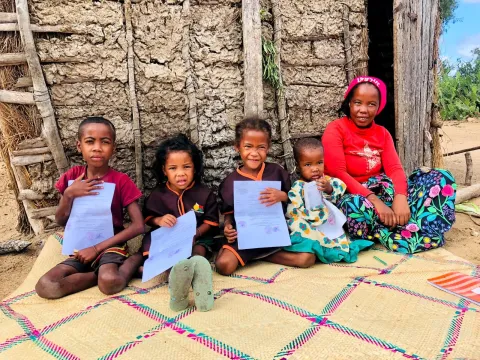
The receipt of this monthly allowance is a glimmer of hope for the whole family. Initially, the sum received made it possible to ensure the return to school. Berthin studies in Amboasary, 40 km from his village where his whole family lives. “Our income has increased since we benefited from this programme. We are thinking of renting him a house closer to his school as well as paying for his daily needs: sending him food, buying him coal…” says his mother.
Furthermore, the universal allowance has made it possible to reorient the financial management of the small family. The school fees of his two younger brothers are also paid regularly and they have returned to school with adequate school supplies.