In Madagascar, children enjoy their rights thanks to the social protection program
The grandchildren of Lignesoa have new motivation to face their future through the Zara Mira social protection program

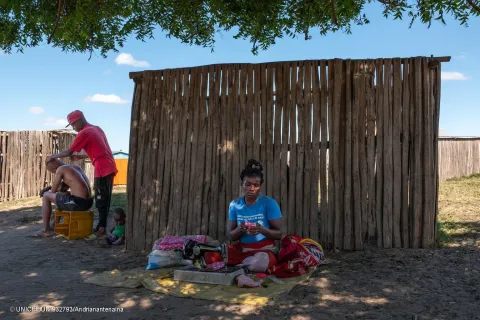
Lignesoa, 54, is a farmer and weaver. She is married to fisherman Emahavahy, aged 63. Together, they are in charge of taking care of their 22 grandchildren. This situation arises because the grandchildren's parents work outside the village where the couple lives. Some of their daughters are single-mother and employed somewhere else as housekeepers. As a farmer, Lignesoa notes that the harvest in southern Madagascar, more specifically in Atsimo Andrefana, is highly dependent on climatic conditions. Unfortunately, in recent times, the climate has been steadily deteriorating, and this has had a considerable impact on her family's income. Being old, Lignesoa and her husband find it hard to make ends meet and provide for the whole family. Indeed, this shortage is felt in their grandchildren's growth. They don't enjoy their full rights. "A ration of food is shared by many. Although our grandchildren go to school, they don't have all the necessary school supplies, and sometimes they use school materials that are in poor condition. Sometimes they miss classes because we can't afford to pay their school fees. And if they do fall ill, we have to use traditional treatments because they're cheaper".
The Zara Mira program, or Universal Child Allowance program, is a social protection program designed by the Ministry of Population, Social Protection and Promotion of Women (MPPSPF) in collaboration with UNICEF and implemented by the “Fonds d'Intervention pour le Développement” (FID). As a universal and inclusive program, it aims to provide equal and sensitive social protection for pregnant women and children aged between zero and 15, it also supports households in investing in their family's well-being. Beneficiaries receive an unconditional monthly transfer of 10,000 MGA. The program includes a strong component of supportive measures adopting the SBC (Social Behavior Change) approach, aimed at maximizing the transfer's impact on children's well-being and generating behavioral change among parents. It also strengthens the national social protection system through the implementation of the "guichet unique" (one-stop shop) system, to give program beneficiaries easier access to better services through a single point of contact.
Currently, the Zara Mira program in the two communes of Tsivory and Itampolo is financed by the German government (KFW) and by the German Committee, Findel and UNICEF's own funds for the communes of Tataho and Ifotaka.
This program has improved the financial situation of many families. During May 2023, 18,240 children and 201 pregnant women from 5,689 families in the commune of Itampolo, Ampanihy district in the Atsimo Andrefana region, benefited from the Zara Mira Universal Child Allowance program.
Thanks to this program, Lignesoa and Emahavahy's nine grandchildren under the age of 15 benefit from MGA 10,000 monthly, giving them MGA 180,000 every two months. "Previously, my grandchildren didn't eat healthily and regularly, but now I firmly believe that they can focus better at school thanks to the Zara Mira program. They're eating better and getting their fill. As a result, we are able to provide them with adequate school supplies and they no longer miss school because their school fees are also paid".
The funds Lignesoa receives through the Zara Mira program enable her to better manage her family's day-to-day needs, ensure her grandchildren's schooling and, above all, take care of their health. "I hope that my grandchildren will have a better future and will be the pride of our family, so that they in turn can contribute to the development of our region".