


Artificial intelligence and childhood: opportunities, risks, and how to support children in using it
Answers and guidelines for tackling a pressing challenge
- Español
- English
👉 Follow us on our WhatsApp channel: UNICEF Parenting Portal for more tips.
To return to the portal hub, click here: Children |
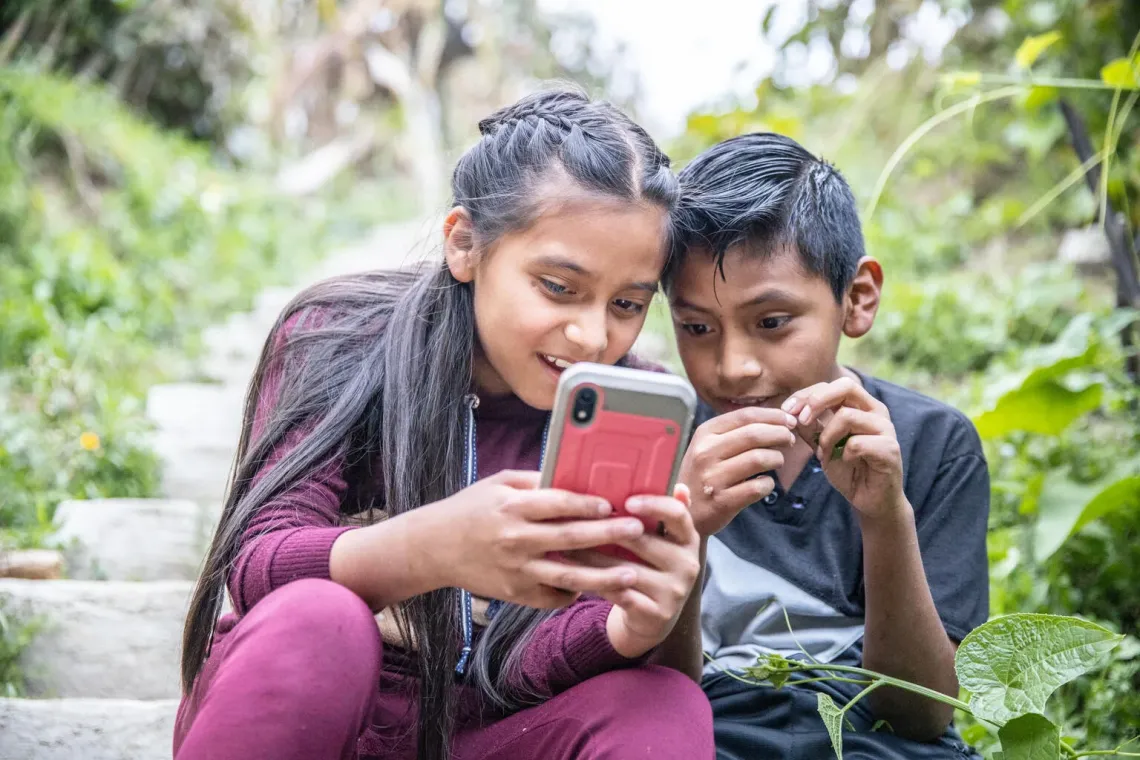
Artificial Intelligence (AI) is already part of the daily lives of children and adolescents in Latin America and the Caribbean. They use it for learning, entertainment and interacting with friends.
In Argentina, for example, more than half of children aged 9 to 17 use AI. Of those, two out of three do so for educational purposes, according to the Kids Online Argentina study carried out by UNICEF and UNESCO. In Brazil, the equivalent figure exceeds 65 per cent.
Although children are at the forefront of adopting AI tools, including for schoolwork, very little is still known about the medium- and long-term effects this technology has on them. These effects range from the cognitive and psychological impact on their learning to the social, economic, and professional consequences of AI for the societies in which they live.
Furthermore, children continue to be excluded from the development of AI systems, which are often created without taking their rights or views into account. This issue is particularly pronounced for children in the Global South, where difficulties related to their place of residence, internet access or lack of real opportunity to influence public policy processes can mean they are subject to further exclusion.
In this second installment of our guide, we share resources, tips and information about AI to help mothers, fathers, guardians and educators support children's digital skills and protect their rights.
Related reading: Is it a good idea to ban children and adolescents from social media?
Opportunities and Risks
AI is used in practically all the apps and platforms used by children and adolescents, from tools like ChatGPT to social networks like Instagram or TikTok.
AI-powered algorithms recommend which videos to watch, what news to read and who to connect with. To add to that, generative AI systems like Claude, ChatGPT, Grok and others are increasingly creating the content children consume and even positioning themselves as their "friends."
Opportunities
Among the benefits that AI can bring to children are better learning toolsand new ways to access information. It can also promote inclusion and access to education for people with disabilities.
As part of the project entitled The Best Interests of the Child in a Digital World, UNICEF spoke to children between the ages of 10 and 17 years old in seven countries, including Brazil, about their rights in the digital world. The topic of AI came up frequently.
Children reported that they already use tools like ChatGPT to summarise their school assignments, to break down complex concepts, and even as a guide on what to post or not to post on social media.
AI can also help children develop new skills and prepare for a digital environment and labour market that are changing at an ever-increasing pace.
Risks
However, new risks are emerging to which families often feel unable to respond, and whose effects are not yet sufficiently understood:
Riesgos
AI can sometimes reproduce or amplify false information circulating online. Without guidance, children and adolescents may access unreliable profiles, content or data.
AI systems can provide results based on prejudices or errors in the data with which they were designed or trained. This can lead to incomplete information, stereotypes or recommendations that lack diversity.
If an AI tool is poorly designed or lacks adequate regulations, it can expose personal data, compromise privacy or lead to a loss of control over shared information. Furthermore, chatbots that respond or behave like people often give users advice about their personal and private lives.
In these interactions, children are more susceptible to manipulation and exploitation, as they are more prone to developing dependent relationships with these "friends" and sharing private information with them. That is why it is so important for chatbots to be designed, regulated and marketed with children's interests and safety in mind.
One of the risks to which more and more children and adolescents are exposed is that of deepfakes.
These are images, videos, or voice recordings generated or manipulated by artificial intelligence (AI) that appear real and are increasingly being used to create sexualized content of children. This includes 'nudification,' which refers to the use of AI tools to remove or modify clothing in photographs to create sexualized images or fake nudes.
In a study conducted by UNICEF, ECPAT and INTERPOL in 11 countries, at least 1.2 million children said they had been affected in the last year by the manipulation of their images through deepfakes with explicit sexual content. In some countries, 1 in 25 children said they had been affected, which is the equivalent of one child in every typical classroom.
Tips for Families
AI is not only changing the way children learn and interact. AI also gives rise to new debates about the role of mothers, fathers and guardians. However, not all families have the time or resources to learn about daily new developments thrown up by this advanced technology.
Below are some tips on what families can do to support children:
Consejos sobre el uso de la inteligencia artificial
Understanding the basics of AI and how these technologies can positively or negatively impact children is a fundamental first step in helping them to use AI. A good initial approach is to ask and observe what they use it for, such as studying, creating, entertainment and answering questions, before talking about limits or risks.
Talking about AI and the opportunities and risks related to AI allows for agreements to be reached and promotes responsible use. Dialogue is key for children to understand that using these tools involves both rights and responsibilities. One recommendation is to use real-life situations to start a conversation. Examples could be an assignment carried out using AI, recommended content, or an automated response. Agree on when, why and how to use AI.
Ying Xu, Assistant Professor of AI in Learning and Education at Harvard University, explains that for younger children, an effective startegy can be to relate AI to examples of everyday tools used at home that run on this technology, such as robot vacuums or smart speakers.
A good starting point can be explaining that these tools follow instructions, recognize patterns or respond to our voices, but they do not "think" or "feel" like people do.
Reflecting on how these tools work, what data they collect and for what purposes they are used helps children and adolescents develop a more conscious perspective on technology. For example, when using an AI tool, families can suggest asking simple questions together, such as: Where might this information have come from? What might be missing? Why do you think the tool is responding in this way?
According to Ying Xu, it is important to explain to children that many AI systems are, by design, always agreeable and encouraging, which does not reflect the reality of interpersonal relationships, which often involve disagreements and compromises and help us develop the ability to manage conflict.
If children spend a lot of time with such systems, they may develop unrealistic ideas about how friendships and relationships work.
“There are longer-term concerns that should be considered. One of them is that children may start to rely on AI instead of turning to other people. In our research with adolescents, some shared that talking to AI is easier than talking to their peers or adults,” Xu explains.
Reading about the subject, listening to podcasts or watching videos from reliable sources helps develop a better understanding of how AI works. The more information available, the lower the risks associated with its use. Talking with their friends can help children reflect on AI use.
These are some questions they could ask:
How does AI influence my daily life?
How much do I use it and for what?
What do I like most about using AI?
What are my questions or concerns?
How to Develop AI for the Benefit of Children
Designing technology that works safely for the most vulnerable will lead to better AI for everyone.
Designing technology that is safe for the most vulnerable will result in better AI for everyone.
The responsibility for making children's experiences with AI safe and positive cannot rest solely with their families. Children's rights must be taken into account straight from the technology development phase, as well as in the drafting of laws and regulations by governments.
UNICEF has published an update to its recommendations for governments and the AI industry to put children at the heart of this technology.
Companies and governments must have a children's rights-based approach to AI, which includes systematic risk assessment, transparency, accountability, inclusive design, child participation from the outset and investment in literacy.
In this document (you can access it here), UNICEF proposes 10 conditions for the development of AI for the benefit of children:
- Ensure regulatory frameworks, oversight and enforcement for child-centred AI
- Ensure the safety of children
- Protect children's data and privacy
- Ensure non-discrimination and equality for children
- Provide transparency, appropriate explanations and accountability for children
- Respect human and children's rights through responsible AI practices
- Support the best interests, development and well-being of children
- Ensure inclusion of and for children
- Prepare and empower children for current and future developments in AI
- Create an enabling environment for child-centred AI

How young people in the region see AI
The design and development of AI technologies must involve the active and inclusive participation of children and young people. Young leaders from the region, who are part of UNICEF's Adolescent and Youth Action Council, participated in a consultation where they shared experiences and opinions on its use and made recommendations and suggestions on how safer spaces could be created for children, adolescents and young people.
These are some of their requests:
- Stop AI from inventing data or information, and develop tools to help it learn better from its mistakes.
- Improve the protection of personal data and privacy, with terms and conditions that are easier to understand.
- Stop the creation of deepfakes and teach users how to use AI safely.
- Develop AI versions for children and adolescents, with features designed to develop skills.
- Reduce the environmental impact and the amount of resources consumed by AI tools.
Additional Resources
This guide is intended to be a starting point for better understanding how to put technology at the service of children's rights. But AI is changing every day.
Here are some extra resources developed by UNICEF that can help you tackle this topic at home or at school.
Children and the Use of Artificial Intelligence: UNICEF Uruguay's key points for families
AI Guide for Parents (UNICEF Innocenti, 2021)
AI Guide for Adolescents (UNICEF Innocenti, 2021)
Tips on Parenting in the Age of AI
UNICEF's Position on Deepfakes
If you found this information useful, share it with other parents, your family and your children. Let's help take care of each other.


