Together we are stronger!
How mutual support helps parents of children with disabilities to overcome daily challenges

“People are sometimes embarrassed by children like mine. They think it will be difficult for us to be around children who don’t have disabilities. We’re no longer invited anywhere. No one visits our home. So, we basically live in isolation. Because of this, I often fall into depression – it feels like I might soon forget how to talk to people,” says Nushenbayeva Nazgul. Her six-year-old daughter Emilia was born with microcephaly and cerebral palsy.
Their family lives in the remote village of Kyzyl-Tuu in Suzak district, Jalal-Abad region.
When Emilia was younger, her mother tried to take her to weddings, birthdays, and other gatherings – so the girl could hear people, voices, and music. But now Emilia has grown, and it is difficult to carry her. To walk outside with a wheelchair is almost impossible: the wheels don’t move, and the frame gets damaged.

“My dream is to have a good road. So that we could simply go for a walk. Meet people. Play with other children. But instead we sit at home from morning till night,” says Nazgul.
It is actually music, human voices, and the sound of busy surroundings that calm the girl. At home, in silence, she often screams as if she wants someone outside to hear her, to know that she exists. But when surrounded by people she behaves very differently: she observes everyone curiously, listens and tries to sing together in her own way, even though she has been unable to speak properly since birth.
This is why Nazgul tries not to miss the support group meetings in their village. There are around 50 families with children with disabilities living in Kyzyl-Tuu. These groups were established two years ago with the support of UNICEF and the Aymira Public Foundation. Parents and children meet, support each other, discuss common problems, and seek solutions together.
This project was created particularly for them, explains Islambek Riskulov, the Aymira Foundation’s community mobilizer.

Support groups
Nazgul is part of one of these support groups. They gather once or twice a month: attend workshops, learn basic massage techniques and listen to psychologists.
For example, a single massage session for a child with a disability costs an average of 1,800 soms – an expense most families cannot afford. To ease this burden, parents are taught to provide massage themselves during free workshops. This brings significant financial relief to households that have already spent thousands of soms on medication, to those living on modest disability pensions, unable to earn more because they are raising children alone. For many, having a job or running a business remains an unattainable dream.
“We use everything we learn, and it really makes a difference,” says Nazgul.

We are like a family here
These group meetings are the only space where mothers do not feel ashamed of their children’s diagnoses. They can talk freely, ask for advice, and not fear being rejected. For many children, this is the only chance to play with others.
“This is a rare space where no one stares and no one looks away,” says Nazakat. Her six-year-old daughter, Saliha, has multiple severe conditions and needs daily exercises, therapy, and massage.
Saliha behaves more calmly at these meetings than at home. Here she sees other children, and hears voices, music and laughter.

“We’re like friends here – or like family. All the parents are united. We have a WhatsApp group where we discuss everything and share advice. Even if you just write ‘hello’ and someone replies ‘hello’ it starts feeling better,” says Nazakat.
These groups have brought many parents together despite their different diagnoses, ages, and life stories. They have become a source of knowledge, support, and most importantly – a reminder that they are not alone.
A project that became a “window”
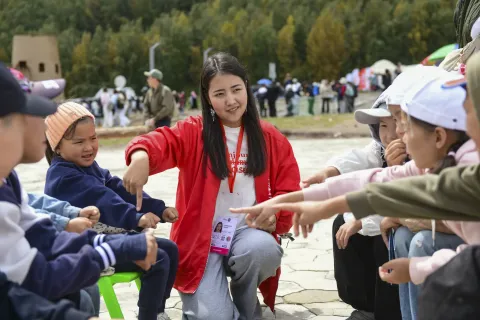
On 20 November, the support groups organised a gathering not just for themselves but for the entire village. With UNICEF support, parents joined mini workshops, children took part in developmental activities, specialists offered short consultations, and families finally had a chance to socialize.
Emilia seemed to come alive among the other children. She listened intently to the music, responded to melodies, calmed down and became more focused. Her mother says Emilia’s favourite activities are always linked to sound – lullabies, children’s songs, or the rustle of toys. She catches every movement of the air, every sound, and seems to find her rhythm in the presence of people.

UNICEF’s support
From 2018 to 2020, UNICEF in Kyrgyzstan implemented a pilot project on early detection and intervention for children with disabilities and developmental delays. The initiative brought together specialists in health care, education and social protection to form transdisciplinary teams.
The project was intended to develop an intersectoral approach and test mechanisms that support children’s smooth transition from preschool to primary school. Suzak district was chosen as the pilot area because it has the highest number of children with disabilities in the country. This made it possible to evaluate comprehensive measures for social inclusion and family support.
The project followed an integrated approach, working on two levels: improving national policies and regulatory frameworks, and providing services for children and their families. A key component of this approach is the Family Empowerment Programme, implemented through the creation of support groups, involving parents in decision-making and promoting inclusion in society.