STEM in Schools of Kyrgyzstan
How the "Girls in Science" Project is Changing the Approach to Education

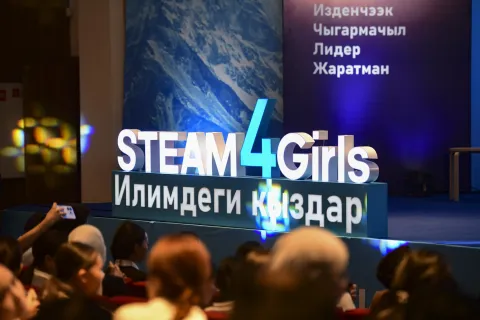
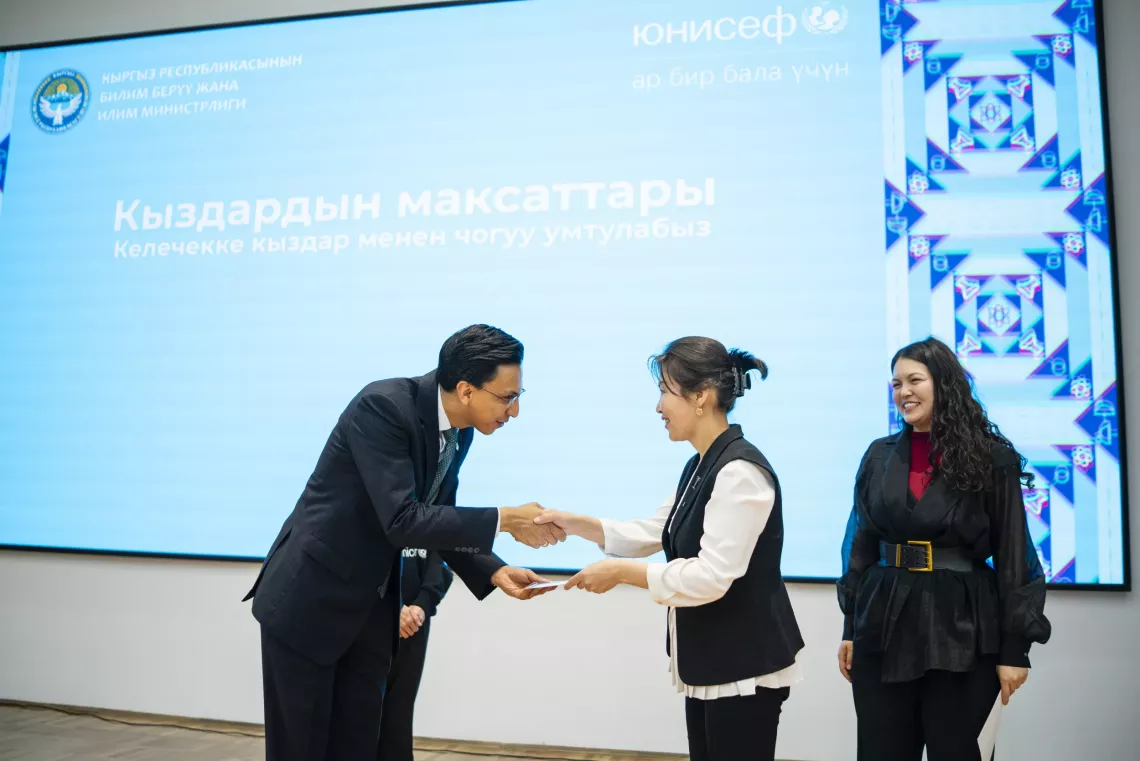
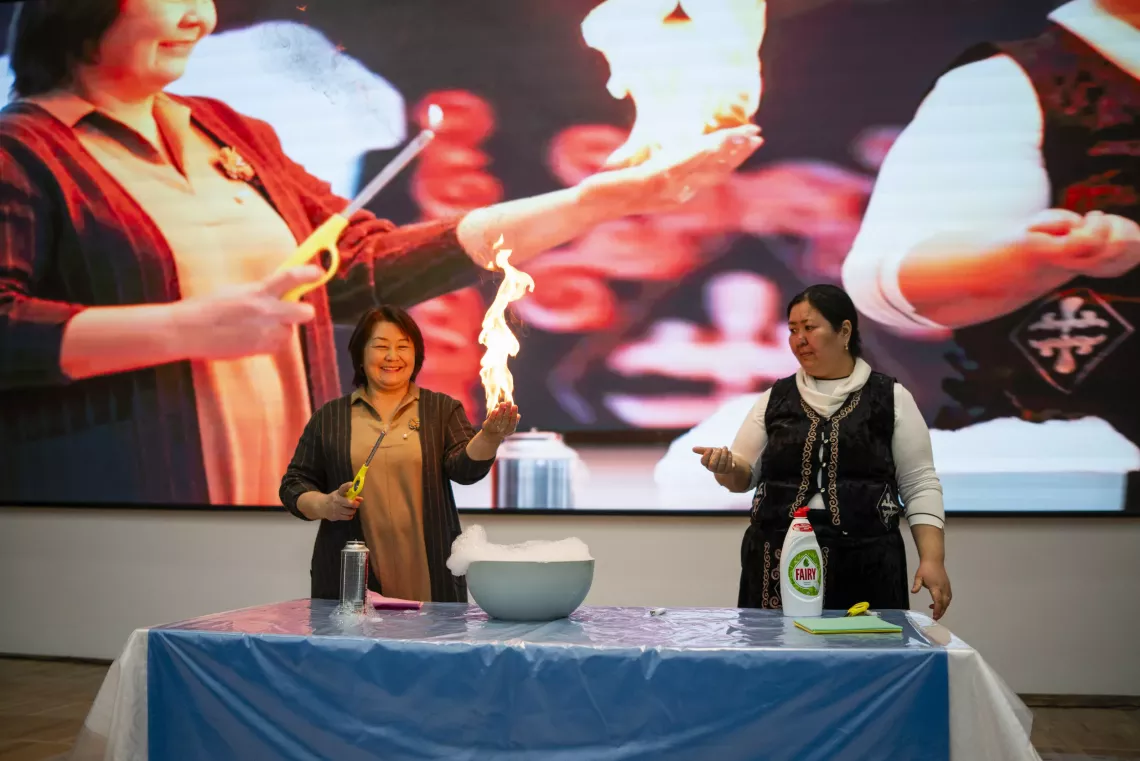
Today, two teachers – Akdana Egemberdieva and Aida Asranbekova – are on stage at the “Girls’ Goals: Opening the future with girls event. In honour of 8 March, they are conducting a science show for girls, demonstrating chemical reactions with fire and nitrogen, and talking about experiments that change perceptions of science. The audience is thrilled. Many are seeing for the first time how interesting chemistry can be, and how fascinating the world of experiments is. But it wasn't always this way. Their journey to this day began with doubts, a lack of resources, and fear of the unknown.
In the small town of Kyzyl-Kiya, located in Batken region of Kyrgyzstan, significant changes related to women’s participation in science have begun in recent years. One of the key people contributing to these changes is Akdana Egemberdieva, a chemistry teacher at School No. 6.
Path to science
Akdana has always aspired to research and scientific discoveries. When UNICEF announced a competition for projects, she chose a topic close to every resident of Kyzyl-Kiya – the quality of its drinking water. In the town, water is supplied intermittently, and its quality is a concern. Akdana decided not just to talk about the problem but to involve her students in studying it.
With UNICEF support, the reagents, microscopes, and laboratory equipment the team needed were acquired. The students, together with their teacher, conducted water analysis, created filters, and visited city laboratories to see the water purification process. This practical approach not only enriched their knowledge but also showed that science is a tool for solving real problems.
Overcoming stereotypes
In a society where women are often expected to take on traditional roles, girls’ participation in science becomes an act of overcoming stereotypes. The UNICEF and Ministry of Education “Girls in Science” programme is intended to expand opportunities for girls in science, technology, engineering, and mathematics (STEM).
Akdana notes that thanks to participation in the project, her students have become more confident and bolder. They realized that they could contribute to science and society, rather than being limited by traditional expectations. This change in mindset opens new horizons and opportunities for them.
The changes happening in the school are also reflected throughout the town. Students involved in scientific projects share their knowledge with families and neighbours. They become agents of change, inspiring others to participate in addressing local problems. This fosters the development of critical thinking and active citizenship among the youth.
UNICEF's support has played a key role in these transformations. The organization not only provided the schools with their equipment but also trained teachers, to help them implement new teaching methods. They also provided guidance on how to conduct project-based learning. This investment in the future is already bearing fruit today.
Personal growth of teachers
Participation in the programme has changed not only the students but also the teachers themselves. Akdana admits that she was scared and uncomfortable at first, but the support of trainers and colleagues helped her overcome her fears. Now she feels more confident and ready for new challenges.
The “Girls in Science” initiative not only expands opportunities for girls in STEM but also contributes to the overall development of society, breaking stereotypes and inspiring positive change, says the teacher.
How unique insect collections appeared at school
In Kochkor, biology teacher Aida Asranbekova also decided to go beyond ordinary lessons and show her students that science is not just textbooks but the environment around us.
Thanks to “Girls in Science”, she, with her students, engaged in studying ecology and local fauna, as well as waste disposal issues.
Aida chose two important topics for her project: the problem of waste in the region and the study of insects. During the work, her students from grades 9 and 11 began conducting their own research, making observations, and seeking solutions.
“I didn’t expect the children to be so interested. They proposed ideas themselves, collected waste, and analysed how it could be recycled. Those who started observing insects created entire collections for other students, involved the whole village in the work, and spent a lot of time in the mountains and on expeditions,” shares Aida.
According to the teacher, the project gave students not only knowledge but also confidence in themselves. Some even decided to pursue science in their future professions.
“My graduates now want to enter universities to continue studying ecology and biology,” she says.
She adds that during this work, the children became friendlier, those who previously lagged behind caught up, even in other lessons, because they made friends with stronger students. Younger students had the opportunity to ask questions to older students, and graduates were proud to share knowledge that no one knew before them.
The children are especially proud of the collection they brought together, which other students will be able to learn from for decades.
But the path to such changes was not easy. At first, Aida herself had to learn a lot.
“I was scared because it was new to me. I had to gather a lot of information, working with trainers 24/7. At first, I was afraid to ask them anything. But thanks to mentoring meetings with project trainers, I constantly called them and asked questions, overcame my complexes, we came up with lessons together. Before, I used to give lectures, but now every lesson is a performance, many colleagues started watching and adopting the methodology," she says.
The project affected not only the students but the entire school. According to Aida, there is more mutual understanding among the students, and they are working more cohesively.
“At the end of the school year, many students supported each other, even in everyday tasks. It was nice to see,” she notes. Now her students not only study biology but also apply their knowledge in practice. They organized clean-up events, and told classmates about proper waste disposal and the importance of preserving the environment.

STEM: The path to change
Aida is confident that projects like this help girls and boys not only learn more about science but also become braver and more confident in themselves. “Previously, they were afraid to propose ideas, but now they speak, propose solutions and act boldly,” she says, and concludes that the UNICEF project gave teachers and students the opportunity to expand their horizons. Now they know that science is not just theory but also a tool capable of changing the world around them.
Since 2020, the Ministry of Education and Science of Kyrgyzstan, in cooperation with UNICEF, has been actively promoting STEM education for girls and boys in the most vulnerable communities. This partnership challenges traditional social norms and breaks gender stereotypes. As a result, more than 60,000 adolescents, including 48,000 girls, have received STEM education with their peers and have been inspired to prepare for careers in these fields.