11,000 Home Visits. Thousands of Heartbeats. One Mission.
How Nurse Mirnije’s words and actions make breastfeeding become everyone’s business.

In Fushe Kosovo, four home-visiting nurses bring skilled care, confidence and trusted advice to new mothers and make breastfeeding a responsibility shared by the whole family.
Nurse Mirnije knows how to reach families others may struggle to find.
She steers confidently through the narrow streets and tight rural lanes of Fushe Kosovo, carrying a scale, measuring tools, health guidance and the calm authority that comes from more than a decade of entering homes at some of the most important moments in a family’s life.
Since becoming a home-visiting nurse in 2014, nurse Mirnije was part of more than 11,000 visits. Behind that number are thousands of babies whose heartbeats she has checked, mothers she has reassured, and families she has guided on breastfeeding, full immunization, regular health check-ups, nutrition and responsive care during the earliest years of a child’s life.
She does not work alone. At the Main Family Medicine Centre in Fushe Kosovo, she is part of a team with nurses Nerxhivane, Aleksandrina and Nita, four experienced health workers who divide the tasks during each visit but share one purpose: to ensure that every newborn, including those in the most marginalized communities, receives a healthy start in life.

WHY THIS SUPPORT MATTERS
In the latest published Kosovo MICS, only 29 per cent of infants under six months were exclusively breastfed, and only 32 per cent began breastfeeding within the first hour after birth. Skilled, practical counselling inside health facilities, communities and homes is one of the proven approaches highlighted during World Breastfeeding Week 2026.
The moment confidence arrives
During World Breastfeeding Week, the team visits Ardita, a 25-year-old mother who gave birth to a baby boy three weeks earlier. Her son is being exclusively breastfed. For Ardita, one small moment after the birth carried enormous meaning: she noticed that her T-shirt was wet with breastmilk.

“I was so happy when I saw that the milk had come. I knew I could breastfeed my baby and give him his first and most important nourishment.”
— Ardita, mother of a three-week-old boy
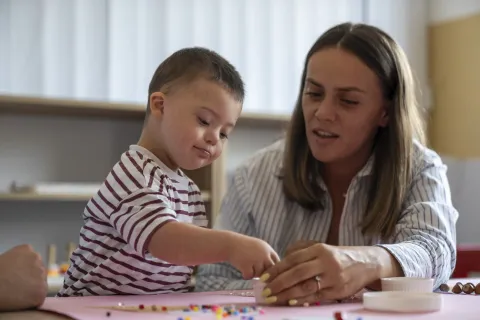
The nurses listen first. Then they observe the baby, check growth and physical development, answer questions and explain what the mother can expect. Their advice is practical: how to position the baby, how to recognize effective feeding, when to seek help and why breastmilk provides the nutrition and protection a newborn needs.
The reassurance matters as much as the clinical check. In the first weeks after birth, uncertainty can quickly become fear. A trusted nurse at the doorstep can prevent a mother from feeling alone with a problem and can help her continue breastfeeding when doubts, discomfort or conflicting advice might otherwise lead her to stop.
Four nurses, one coordinated visit
The team then continues to visit two other young mothers from Roma, Ashkali and Egyptian communities. One is caring for Ubejt, only one week old. The other is the mother of Liana, three weeks old. For both mothers living under the same roof, the nurses are more than health workers. They are reliable people whom the mothers can speak to openly, who listen without judgement and whose advice is trusted.

Each nurse has a role. Nurse Mirnije leads the discussion and responds to the mother’s concerns. Nurse Nerxhivane carefully checks and measures the baby’s body and extremities. Aleksandrina and Nita speak with other family members, including a mother-in-law who sits nearby, listening closely and occasionally offering guidance of her own to her son’s wife.

The scene reveals a central lesson from the nurses’ work: supporting breastfeeding cannot stop with the mother. In extended families, grandparents, fathers and other relatives influence daily decisions. They can protect a mother’s time to rest and feed her baby, encourage her when breastfeeding becomes difficult, help with household work and ensure that outside pressure or misinformation does not undermine her confidence.
That is why the nurses make space for everyone. They explain the importance of breastfeeding to the whole household including the person regarded as the family’s main decision-maker. They align the family around the mother and baby. In nurse Mirnije’s words and actions, breastfeeding becomes everyone’s business.
Trust built one doorstep at a time
Under the leadership of the Ministry of Health, the Home Visiting Programme was established in Kosovo in 2014 with the support of UNICEF and the Grand Duchy of Luxembourg and is implemented by primary health care teams. Today, it is fully integrated into the primary health care system and operates across all municipalities.
By the end of 2025, nurses had conducted 252,296 home visits, including 215,180 visits for children under the age of three and 37,116 visits for pregnant women allover Kosovo, providing guidance on breastfeeding, immunization, nutrition, parenting, child development, and family well-being directly in families' homes.

The 2026 World Breastfeeding Week theme — “Breastfeeding for a Sustainable Start in Life: Strengthen What Works” — describes what can be seen in Fushë Kosovë. What works is not advice delivered once and forgotten. It is skilled support that starts early, returns when needed, includes the family and reaches mothers where they live.
Nurse Mirnije’s work extends beyond scheduled visits. She speaks with people in the community, recognizes families on the street and is recognized in return. Parents greet her warmly. Her professional judgement carries weight because it has been earned through years of presence, consistency and care. When she tells a family why breastfeeding, vaccination or a medical check matters, they listen.
For Nurse Mirnije, every day is breastfeeding day. Every day means driving another narrow road, carrying equipment into another home, answering another worried question and helping another family see that a child’s healthy beginning is built through many small, informed decisions.
At the end of the day, she returns home tired but fulfilled, her heart, she says, filled with joy and pride. The greetings she receives in the streets of Fushë Kosovë are evidence of an impact that cannot be captured only in visit numbers: the trust of a community. That is the power of a nurse.