Nearly a quarter of a billion children’s schooling was disrupted by climate crises in 2024
Education in Afghanistan, Bangladesh, Mozambique, Pakistan, the Philippines, and Kazakhstan most severely affected by heatwaves, cyclones, floods, and storms

NEW YORK, 24 January 2025 – At least 242 million students in 85 countries had their schooling disrupted by extreme climate events in 2024, including heatwaves, tropical cyclones, storms, floods, and droughts, exacerbating an existing learning crisis, according to a new UNICEF analysis released today.
For the first time, Learning Interrupted: Global Snapshot of Climate-Related School Disruptions in 2024 – released on International Day of Education – examines climate hazards that resulted in either school closures or significant interruption of school timetables and the subsequent impact on children from pre-primary to upper secondary level.
Globally, South Asia was the most affected region, with 128 million students facing climate-related school disruptions last year. In East Asia and the Pacific, 50 million students were impacted, while torrential rains in Europe disrupted schooling for nearly one million students in Italy and Spain.
“Children are more vulnerable to the impacts of weather-related crises, including stronger and more frequent heatwaves, storms, droughts, and flooding,” said UNICEF Executive Director Catherine Russell. “Children cannot concentrate in classrooms that offer no respite from sweltering heat, and they cannot get to school if the path is flooded, or if schools are washed away. Last year, severe weather kept one in seven students out of class, threatening their health and safety, and impacting their long-term education.”
In Kazakhstan, floods in 2024 affected over 832,000 school students. The national response to these events demonstrated strong coordination and responsive support mechanisms for immediate assistance to the affected population and recovery. It also emphasized the importance of investing in emergency preparedness with a focus on child rights, climate and disaster risk reduction in education, and education continuity.
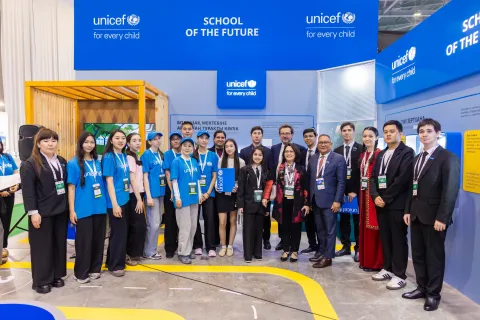
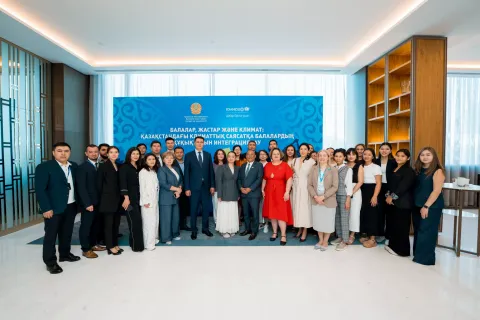
UNICEF is working with the Government of Kazakhstan to better integrate climate and disaster resilience into education, with reference to the international Comprehensive School Safety Framework.
With UNICEF’s support, in 2024, topics such as climate change, environmental protection, and disaster risk reduction (DRR) were incorporated into online youth skills-building programmes. Over 35,000 young people were consulted on the integration of green skills into education. In 2023, more than 3 million people had accessed information on DRR and Climate Action (CA), and 28,000 children and 3,600 teachers through the UNICEF-supported #BeSafe and #Volunteers4Climate programmes, had enhanced their capacities for disaster risks reduction and climate adaptation, in regions prone to disasters.
“Education is one of the services most frequently disrupted due to climate hazards. Yet it is often overlooked in policy discussions, despite its role in preparing children for climate adaptation,” said Russell. “Children’s futures must be at the forefront of all climate-related plans and actions.”
In Kazakhstan, UNICEF is working with the Center on Emergency Situations and Disaster Risk Reduction (CESDRR) to roll out the Children’s Climate Risk Index at sub-national level to better inform local decision making for DRR and child-centered emergency preparedness and response including in education.
UNICEF is calling on world leaders and the private sector to act urgently to protect children from increasing climate impacts by:
- Ensuring national climate plans strengthen child-critical social services, including education, to be more climate-smart and disaster-resilient.
- Investing in disaster-resilient and climate-smart learning facilities for safer education.
- Accelerating financing to improve climate and disaster resiliency in the education sector, including investing in proven and promising solutions.
- Explicitly integrating climate change education and child-responsive commitments across all sectors.
These measures are crucial to ensuring that education systems worldwide, including in Kazakhstan, can withstand future climate challenges and equip children with the skills they need to adapt to a changing world.#####
Media contacts
Additional resources

About UNICEF
UNICEF, the United Nations agency for children, works to protect the rights of every child, everywhere, especially the most disadvantaged children and in the toughest places to reach. Across more than 190 countries and territories, we do whatever it takes to help children survive, thrive, and fulfil their potential.