UNICEF presents the ‘School of the Future’ at RES 2026 EXPO, bringing climate-resilient education to life

ASTANA, 22 April 2026 — UNICEF unveiled an interactive ‘School of the Future’” pavilion at the International Exhibition of Green Technologies and Sustainable Solutions "RES 2026 EXPO" today. The pavilion showcases climate-responsive education that can improve children’s learning environments and support climate action across Central Asia.
Children in the region face increasing climate pressures, including heatwaves, water scarcity and air pollution, while many schools are struggling to cope with extreme weather events and the long-term impact of climate change. The “School of the Future” pavilion, developed as part of the Regional Green School Platform, presents a child-centred vision of how schools can become safe, resilient and sustainable spaces, while equipping children and young people with the knowledge and skills they need for the green transition.

Designed as an immersive learning environment, the pavilion translates complex policy approaches into practical, real-life solutions that can be taken to scale. It demonstrates how everyday school spaces — from classrooms to schoolyards — can make an active contribution to climate resilience, environmental awareness and sustainability.
Visitors are guided through a series of thematic zones that reflect the key components of climate-responsive schools. These include energy efficient solutions such as solar panels and smart lighting systems, water-saving technologies, improved indoor air quality and climate-adaptive infrastructure, as well as practical approaches to improve waste management and recycling.
The pavilion also highlights the role of schools as ‘living laboratories’,” where children learn not only through textbooks but through the environment around them. Interactive elements demonstrate how sustainable practices — such as waste sorting, energy use, and resource conservation — can be embedded into daily school life and shape lifelong behaviour.
A dedicated section focuses on safe and sustainable mobility, illustrating how school transport systems, safe routes and reduced emissions contribute to healthier environments for children. Electric school buses, for example, can reduce carbon emissions, while safe pedestrian and cycling infrastructure improves children’s safety and well-being.

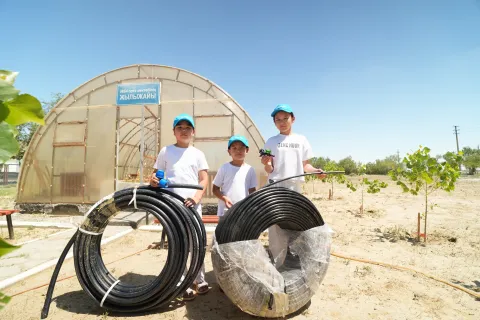
The pavilion also highlights the importance of green spaces and biodiversity, including demonstration school gardens and nature-based solutions that support both learning and climate adaptation. These demonstrate how schools can become community hubs for environmental action and resilience.
“The solutions we see here are not abstract concepts — they are practical, scalable approaches that can transform how schools operate and how children learn,” said Octavian Bivol, UNICEF Regional Director OIC for Europe and Central Asia. “By bringing these elements together, the School of the Future demonstrates how education systems can both respond to climate risks and empower children to become agents of change.”
The pavilion is linked to the Regional Green School Platform (RGSP), a regional cooperation mechanism to support Central Asian countries as they accelerate the greening of their education systems. The RGSP promotes climate change education, climate-resilient infrastructure, youth engagement and stronger governance and financing systems across the region.
Through initiatives such as the RGSP, UNICEF continues to support governments as they translate their climate commitments into practical action, aiming to ensure that every child learns in a safe, healthy and sustainable environment.
Media contacts
About UNICEF
UNICEF promotes the rights and wellbeing of every child in everything we do. Together with our partners, we work in 190 countries and territories to translate that commitment into practical action, focusing special effort on reaching the most vulnerable and excluded children, to the benefit of all children, everywhere.
For more information about UNICEF and its work for children, visit https://www.unicef.org/eca/.