Children and youth take center stage in urban climate action at Regional Ecological Summit
UNDRR and UNICEF launch special report on protecting children from intensifying urban heat across Europe and Central Asia

Astana, Kazakhstan, 23 April 2026 — On the sidelines of the Regional Ecological Summit, the United Nations Office for Disaster Risk Reduction (UNDRR) and UNICEF Europe and Central Asia today officially launched Flames of Change II Special Report: Children and Youth at the Forefront of Tackling Urban Heat, a special report examining the critical and often overlooked role of children and young people in building urban resilience to heat risk.
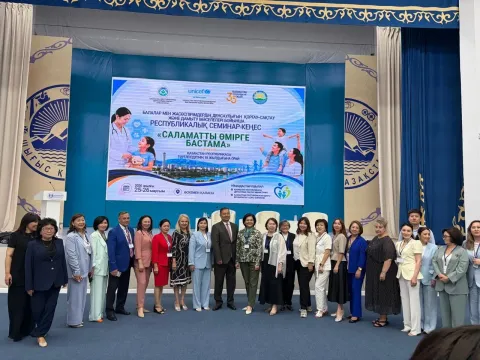
The launch event, hosted at the UNICEF Pavilion, brought together senior UN leaders, national and local government representatives, youth delegates, and media. It underscored a shared conviction: that protecting children from the escalating impacts of urban heat is not only a matter of public health, but of climate justice.
Urban Heat — A Growing Risk for Children Across the Region
Across Europe and Central Asia, cities face intensifying heatwaves that pose acute risks to children's health, education, and well-being. Children are physiologically more vulnerable to heat than adults, yet they are frequently absent from urban resilience planning and heat action frameworks. The second edition of Flames of Change Special Report addresses this gap directly, drawing on diverse case studies and policy examples from across the region to show how local governments, schools, health systems, and communities can act together.
The report builds on the momentum of the Flames of Change II main report, published in October 2025, which showcased how cities across Europe and Central Asia are moving from awareness to action on extreme heat. This special report focuses specifically on children and youth — both as those most at risk, and as powerful agents of change. This series of reports also contributes to the United Nations Secretary-General’s Call to Action on Extreme Heat.
Voices from the Highest Levels
Addressing the audience at the UNICEF Pavilion, Kamal Kishore, UN Special Representative of the Secretary-General for Disaster Risk Reduction, highlighted the urgency of integrating child-sensitive approaches into climate and disaster risk planning at every level.
“This Special Report is a call to invest early, collaborate across sectors, and empower youth. If we want cities that are resilient to extreme heat, we must design them for and with young people.”
Octavian Bivol, UNICEF Regional Director OIC for Europe and Central Asia, emphasized the essential partnership between UNDRR and UNICEF in advancing child-centered resilience across the region.
"The climate crisis is already reshaping the lives of children across our region. Urban heat is one of the most pervasive and underestimated risks children face — disrupting their health, their learning, and their futures. But this report shows that solutions exist, and they work when governments act early and act together. If we design cities and systems that work for children in a hotter world, we build societies that are safer and more resilient for everyone. UNICEF stands ready to continue working with governments, cities and partners to turn evidence into action — and to ensure that no child is left behind in the heatwave agenda."

From Policy to Practice: Country-Level Contributions
Representatives from UNICEF Uzbekistan and UNICEF Turkmenistan shared concrete examples of how the report's approaches are being put into practice at the country level, illustrating how national and local actors are integrating child-sensitive measures into heat preparedness and urban planning.
Regina Castillo, UNICEF Representative in Uzbekistan, pointed out that in Uzbekistan, more than 90 percent of children are regularly exposed to extreme heat, necessitating the integration of heat risks into early warning systems and social protection. “Sustainable economic growth depends on healthy, educated, and protected children. By addressing urban heat now, we can transform a growing climate risk into an opportunity for stronger, fairer, and more competitive cities,” Castillo stated.
Jalpa Ratna, UNICEF Representative in Turkmenistan, noted that the climate crisis is, first and foremost, a child rights crisis. She emphasized that extreme heat in Turkmenistan, where the risk score reaches a critical 8.87 out of 10, demands immediate action to build heat-resilient urban environments and schools. According to the Representative, young people must be seen not merely as beneficiaries of support, but as full partners in designing and implementing climate solutions.
Youth Speak, and the World Must Listen
The event gave the floor to young people themselves. Youth representatives Hallynyyaz Babayev from Turkmenistan and Daniya Rakhimova from Kazakhstan shared personal reflections on experiencing urban heat and issued a direct call to action to governments and decision-makers to place young people at the heart of climate resilience planning.
"We are no longer just those who need protection. We are full partners and a real force for change. We want to be not spectators, but full participants in the decision-making process on equal terms," they declared.
In her closing remarks, Natalia Alonso Cano, Chief of the UNDRR Regional Office for Europe and Central Asia, invited all participants — and the wider public — to engage with, share, and act on the findings of the report.
“This report is a call to action — not just for cities, but for every level of government. Local authorities must integrate extreme heat into their resilience strategies, health systems must be equipped to protect children from the outset, and urban planning must prioritize green spaces and climate-resilient infrastructure in the communities that need it most. Through the MCR2030 network, we have seen what is possible when governments, communities and young people work together. I invite everyone here today to read this report, share it widely, and use it to advocate for the resources and policies that children across our region urgently need.”

Key Findings of the Report
The Flames of Change special report identifies five core messages for governments and partners:
- Children must be at the center of resilience planning. Heatwaves affect children differently and more severely than adults, requiring child-sensitive measures across health care, education, and social protection systems.
- Prevention is more effective than response. Early investment in heat action plans, school protocols, and resilient infrastructure — including shaded spaces, green areas, and reliable water supply — reduces risks before they become emergencies.
- Empowered youth are powerful partners. When engaged in awareness campaigns and decision-making, young people contribute innovative solutions and foster community-wide preparedness.
- Collaboration drives results. Partnerships across municipal authorities, schools, health providers, civil protection, and social services are essential for building systemic resilience.
- Evidence and data matter. Vulnerability assessments and climate risk analyses help governments design targeted interventions and advocate for resources.
Media contacts
About the Report
Flames of Change II Special Report: Children and Youth at the Forefront of Tackling Urban Heat was produced by UNDRR in collaboration with UNICEF Europe and Central Asia and partners of the MCR2030 network, including Build Your Future, LINKS Foundation, Save the Children Italy, and UNMGCY. The report is available at: https://mcr2030.undrr.org/publication/documents-and-publications/flames-change-ii-special-report-children-and-youth-forefront
About MCR2030
Making Cities Resilient 2030 (MCR2030) is a United Nations-led global initiative supporting local governments to strengthen disaster resilience through advocacy, knowledge-sharing, peer learning, and partnership. UNDRR serves as the Secretariat of MCR2030 in the Europe and Central Asia region.
About UNDRR
The United Nations Office for Disaster Risk Reduction (UNDRR) is the custodian of the Sendai Framework for Disaster Risk Reduction 2015–2030. UNDRR's Regional Office for Europe and Central Asia covers 55 countries, supporting policies and actions towards a more resilient future.
About UNICEF Europe and Central Asia
UNICEF works in some of the world's toughest places to reach the world's most disadvantaged children. UNICEF's Regional Office for Europe and Central Asia supports countries in the region to advance children's rights, well-being, and resilience.