In the south of Jordan, UNICEF improves water access for climate-affected populations
“Water is life, but it is also dignity.”

- English
- العربية
For as long as Khetam has lived in Mreighah district in Ma’an governorate, water has been a huge issue for the residents. “I moved here 12 years ago and, since that day, water to different parts of the village has been very inconsistent,” explains the mother of ten.
Jordan is among the top most water-scarce countries in the world. The effects of climate change, combined with population growth, threaten to further exacerbate the situation and stretch Jordan’s natural resources and social institutions to the limit.
The water crisis is a risk particularly to the most vulnerable groups, including low-income households, those facing food insecurity, and children, threatening their well-being and livelihood.

Life amid a worsening water crisis
Khetam explains what life amid a worsening water scarcity has meant for the community in Mreighah: “Running out of water feels like the world has ended.”
With increasing summer temperatures and more frequent heatwaves, water scarcity has been felt even more painfully among the residents. “The toughest time we had was last summer. We couldn’t get enough water and for a whole month we had to survive with a very small amount and it gave us such anxiety.”
Additionally, due to the increasing summer heat, Khetam explains how in the last few years families in the community had to start buying air conditioning units. “I bought one last year when the heat became unbearable”.
Khetam and her family had often resolved to costly water trucking - an unsustainable and often unaffordable solution to many in the district. “I know families who cannot afford to buy water from trucks and so had to reduce the amount they use for hygiene. This means they cannot clean their house or have a shower. The children have to live with dirty hair and faces, and they can’t even wash their hands. As a mother, it was very hard to see people living this way.”
Furthermore, inadequate water access can disproportionately affect women and girls due to their role in domestic activities and the importance of sanitation for dealing with menstruation, pregnancy, and infant care. As a result, Khetam observes, “many girls dropped out of school and were at risk of early marriage simply because they didn’t have enough water to keep them or their clothes clean.”
For years, water has been a point of tension in the district - between the community and the local water authorities, among the community itself, and even at times at the household level. “The overall situation has repeatedly led to tensions. In some cases, water pipes have been vandalized,” Khetam recounts. “The UNICEF water project came at just the right time.”

Ensuring equal access for climate-affected populations
UNICEF works to ensure that climate-affected populations have equitable access to safe water through improved water network that can adapt to the different potential impacts of climate change. Part of this work includes the construction and rehabilitation of small to medium-sized water and wastewater infrastructures in climate-vulnerable areas in the south of Jordan.
One of the areas identified, in close coordination with the Jordanian Ministry of Water and irrigation and the Aqaba Water Company, was the district of Mreighah.
Here, UNICEF worked with the Aqaba Water Company - the body responsible for the provision of water to this population – on the construction of a water transmission pipeline to alleviate the water crisis faced by the district’s 17,500 residents and reduce non-revenue water, or water lost due to leakages or theft.
Community Water Committees for community-led solutions
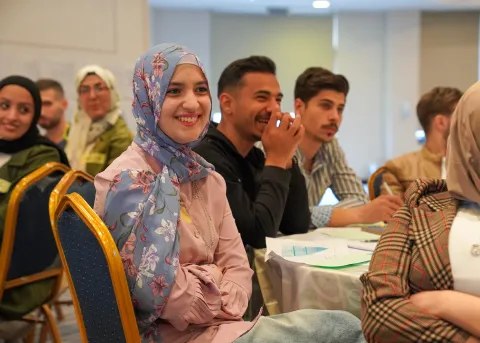
In the planning stage of the project, a Community Water Committee consisting of 10 community volunteers was established. This ensured the community’s inclusion in the project’s design and implementation. The committee facilitated the dialogue between the community, government and utility providers.
“Our job has been to relay the complaints and suggestions to the authorities responsible for water in the area, with the support of UNICEF,” says Khetam, who also served as the head of the committee.
“We worked to represent the entire community. Significantly, we helped defuse tensions between the residents and the operators of the water network.”

“Water is life, but it is also dignity.”
In Mreighah, the construction of the 2.7 KM long water transmission pipeline has led not only to increasing the water allocation per family, but also to minimizing previous water leakages within the system and reducing the energy consumption related to extensive water pumping periods.
The new sustainable water access has transformed the lives of many families in the district.
“My heart leapt to see such a positive change in so many families’ lives [following the completion of the upgrade]. Children looked happy, their clothes, faces and hair clean. There are girls who have recently returned to school, thanks to the improved water situation and the school staff who also continued their efforts to ask these girls to come back to school. Previously, we would see water just leaking and run on the ground because the network was so old. We no longer see this tragic waste and it is amazing how much clean water is being saved!”
Khetam’s youngest child, 7-year-old Balqees is very happy about the positive developments. She says: “I remember when our school didn’t always have water. My mom would give me a bottle of water to use in the school for the bathroom. But now that our school always has water, I don’t have to carry heavy bottles with me and I’m so happy. I’m also happy because the bathrooms look much cleaner now!”
Khetam concludes: “Water is life, but it is also dignity.”
UNICEF’s programme to provide improved, climate-smart water and wastewater public services and infrastructure for climate-affected populations living in the south of Jordan is generously supported from the Korea International Cooperation Agency (KOICA).