Knowledge, Dignity, and a Chance to Keep Learning
How menstrual health education and clean facilities help keep girls in classrooms in Za’atari refugee camp

- English
- العربية
The first time Amal got her period, she was in Grade 6, at home. Frightened and confused, she ran to her mother. "I told her I was scared because I didn't know anything about it," she recalls. Her mother reassured her that it was natural, it happened to every girl. But the fear of it happening somewhere else, somewhere public, like school, stayed with her for a long time.
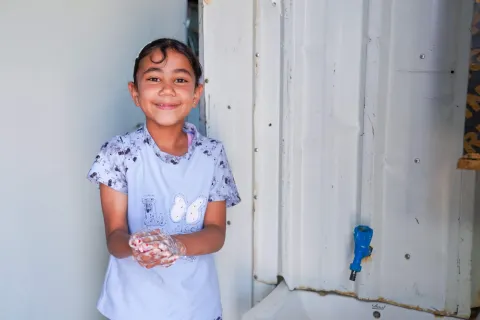
Amal, now a Grade 7 student, lives , in Za'atari camp, where tens of thousands of Syrian refugees have built a semblance of life after displacement. For girls in the camp, adolescence carries pressures that go beyond the ordinary: cramped living conditions, poverty, and the quiet weight of growing up far from home. Something as universal as a menstrual cycle can become a source of real anxiety.
"In the past, when I had my period, I sometimes did not come to school," Amal says simply.
She is not alone. Hiba and Sham, both 13, describe the same quiet dread; the worry about not having a pad, about leaking, about other students noticing, about teachers asking why they needed to leave the classroom. For many girls, the easier choice was to stay home. Recent research conducted across Jordan found that nearly three-fifths of adolescent girls and young adult women say their normal daily activities are disrupted by menstruation, and one in three young females also admits to feeling too afraid or embarrassed to ask for support from family when managing their period.
That is beginning to change. Thanks to a programme supported by UNICEF and funded by the United Kingdom's Foreign, Commonwealth and Development Office, schools in Za'atari are delivering structured menstrual health and hygiene sessions to adolescent girls, filling knowledge gaps, dismantling myths, and giving girls the language and confidence to ask for help.

Buthayna, the school counsellor, who received specialized training to lead the sessions at Amal’s school, describes what she sees in the room. "Many girls were afraid that something might happen that would embarrass them in front of others. Some didn't even know how to dispose of a sanitary pad." The sessions cover practical hygiene, how to use and dispose of pads correctly, how to manage pain, and how to seek support from a trusted adult.
For 12-year-old Asma'a, one detail stood out above the rest. "The counsellor told us that if we ever need a pad and don't have one, we can go to the principal's office and ask for one." She pauses. "That was a big relief."
But education alone can only go so far. What makes these sessions meaningful, the girls say, is that the school has the infrastructure to back them up: clean toilets, running water, soap, and privacy. Hiba puts it directly: "If the bathrooms were not clean, or if there was no water, I would not feel comfortable coming to school while on my period." These facilities and water supply, also supported through the United Kingdom's Foreign, Commonwealth and Development Office, among other donors, are a stepping stone to providing a safe and healthy environment for girls.

Amal, who once feared leaving the house during her period, now comes to school without hesitation. "Having a period does not stop me from coming to school," says Hiba, echoing what all the girls, in their own words, have come to believe.
The sessions, the supply of menstrual hygiene kits, the clean bathrooms, and the understanding teachers, have together built something harder to measure but easy to see in the girls' faces: the quiet confidence of knowing that when their period comes, they will have access to the environment and support they need.