A Door That Locks: Private Latrines Restoring Dignity in Azraq Camp
What a Locked Door Gave Back

For years, Khadija and her seven children, living in Azraq refugee camp, faced the daily challenge of communal bathrooms. Shared with few other families, these facilities lacked adequate lighting, creating significant difficulties, especially for women and children.
Khadija remembers how hard those years were. "I used to cry," she says, thinking back to when she was pregnant and had to walk outside to the shared bathrooms. Going to the toilet at night was especially difficult because there was no light. "Sharing a toilet with so many other families made it very hard to maintain hygiene, and keeping my children healthy was more challenging than anyone knows."
Everything changed when UNICEF built a private, household-level latrine for her family and connected their shelter to a drainage and sewage network. This critical intervention, part of a broader effort to replace communal toilets with individual ones for thousands of families across the camp, has made an immeasurable difference for Khadija and her loved ones.
"Since UNICEF built us new latrines, everything changed for the best," Khadija says with a smile. "It is one of my top priorities to keep clean; it gives me peace knowing that my children are healthy, and it boosts their confidence."

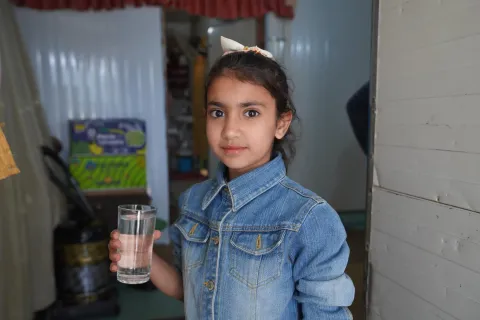
Her youngest daughters, Eleen, 6, and Aya, 7, find it much easier to stay clean now. Having their own bathroom has made a big difference. "I like washing up," Eleen says. "I can do it on my own now." Aya has learned from her mother. "Mom says we should keep clean, so we don’t get sick," she says.

The older children feel the change too. Rimas, 12, plays football at the Makani centre, and Mohammad, 16, is glad he can take better care of himself. "You have to look and smell good when you’re around people," Mohammad says. "It makes me feel better about myself."
For this family, who fled the war in Syria in 2014, the journey was a matter of life and death. Khadija reflects, "fleeing the war was a matter of life and death." In comparison, a locking door and a private toilet might seem like a small detail to many. Yet, after years of relying on shared facilities, it has restored something invaluable: control over their own space, and the ability to protect their children’s health and dignity without dependence on others. This vital sanitation work, which also enables UNICEF to manage the entire wastewater and sanitation operation in Jordan’s Syrian refugee camps, would not have been possible without the generous support of the United States Government and the Swiss Agency for Development and Cooperation –SDC.
"It has helped me provide a healthier environment for my children," Khadija concludes, "and given us comfort, privacy, and dignity "