

Education
Inclusive and quality education for children in Jordan.
- English
- العربية
Situation
Jordan has long recognised education as the cornerstone of national progress.
Today, more than 97% of children are enrolled in primary school, and boys and girls have enjoyed equal access to education since 1979 — a testament to the country’s enduring commitment to learning and social stability.
While progress has been made, the quality of education across Jordan continues to require sustained attention and investment. Learning outcomes in both primary and secondary education have significant potential for improvement, with many children struggling to learn how to read, write, and do basic maths — the foundation for lifelong learning and future job opportunities.
Despite progress, many vulnerable children are being left behind. Children from poorer families, those with disabilities, those engaged in child labour, and refugee children, continue to face major barriers to enrolling in and completing school. Boys are particularly at risk of dropping out — often because of poor performance, bullying, violence, or the pressures of child labour, while girls are impacted with harmful practices such as child marriage. .
Jordan hosts around 200,000 registered Syrian refugee children. Many struggle to access quality education due to financial hardship and other barriers. In refugee camps, access has improved over the past decade, yet fewer than half of students pass their Tawjihi exams. It is also estimated that nearly one in three Syrian refugee children have physical or learning difficulties that makes everyday life a bit harder for them.
Early childhood development opportunities remain limited. One in five pre-primary-aged children are not enrolled in kindergarten, and most of those who are enrolled attend private institutions — raising concerns about equity and affordability.
What does UNICEF do?
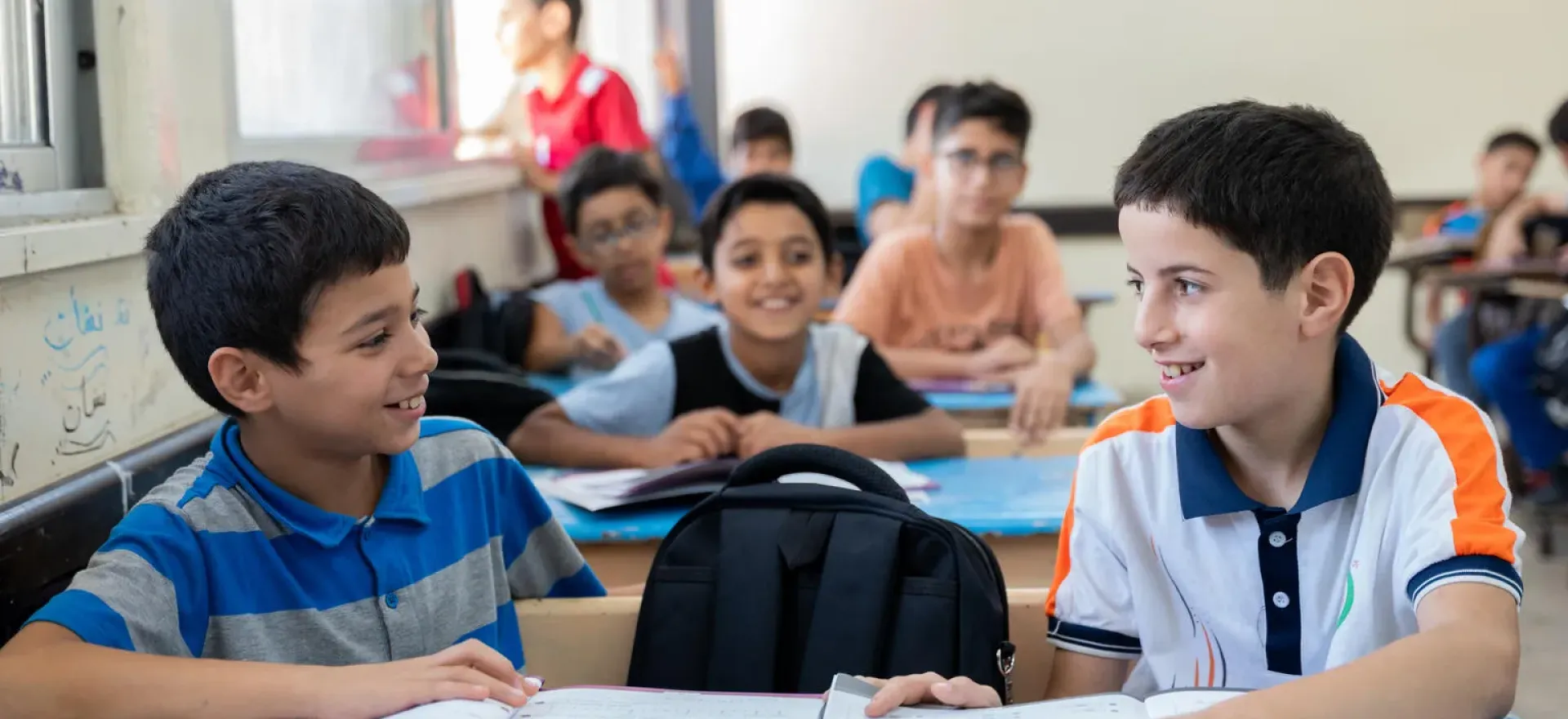
UNICEF/Al-Safadi
UNICEF works hand in hand with the Government of Jordan and other partners to enable vulnerable children — regardless of background or ability — to learn, grow, and thrive.
Our key areas of focus include:
Our key areas of focus include:
UNICEF helps vulnerable children stay in school and keep learning. We support early interventions and flexible pathways to reduce dropouts and promote inclusive education so that all children have a chance at a decent education.
UNICEF provides some of the most vulnerable children with tools and activities that make learning easier in reading and mathematics. This way, children have the best chance to succeed in school and in life.
UNICEF contributes to the Ministry of Education's teacher training programme, so that they can support children to learn better. UNICEF continues efforts to prevent violence against children in schools, and equips schools with tools to report and respond to cases as they arise.
With our partners, the results UNICEF achieved in Jordan in 2025 include:
- Strengthened the capacity of 326 Ministry of Education teachers and 133 Syrian assistant teachers through accredited professional development courses, enhancing their ability to deliver engaging, effective learning experiences.
- Supported the design and rollout of national reading and mathematics assessments, improving data for learning recovery and system planning.
- Provided extra learning in math and Arabic to 20,000 children in 114 Makani Centres. Recent assessments show a marked reduction in the number of students performing below grade level.
- Enabled 36,200 children in Syrian refugee camps to access education from kindergarten to Grade 12 — including 323 children with disabilities.
- Facilitated 4,617 children in Azraq and Za’atari camps to read through the Reading Recovery Programme.
- Supported the enrolment and retention of 1,372 children with disabilities in refugee camps, ensuring that education is accessible and inclusive for every child.