Reclaiming the right to literacy
Through the Reading Recovery Programme, Syrian assistant teachers are helping provide out-of-school children with a second chance at education.

The sun beats down on Za’atari Refugee Camp. It is the first week back to school and excitement fills the air as children stream into classrooms, their backpacks bouncing with every step. Yet for children who dropped out of school, it is not a moment to celebrate.
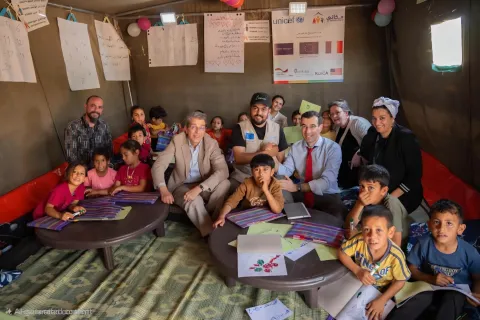
In the camp, poverty and displacement continue to push many children out of classrooms and leave them struggling to read or write. But at the Ministry of Education’s non-formal education centres, supported by UNICEF and partners, a second chance at education is being offered to them.
At those centres for more than three years now, our Reading Recovery Programme has been helping those children rebuild their literacy skills and rekindle their love for learning. By focusing on reading and spelling, the classes equip them with tools to re-engage with education and strengthen their prospects for the future.
Children finding their voice again

For Maher, now 16, returning to learning was a life-changing decision. He had dropped out during sixth grade and engaged in child labour in farms just outside the camp. When he heard about the NFE centre from his cousins, he was hesitant to return to education after such a long pause. But the environment turned out to be different: “School here is nice. I am happy here. And through the reading recovery classes I can now spell out words, billboards, menus, even phone messages. I am happy that I can finally read and I am determined to succeed.”

Ammar, 15, shares a similar story. He left school in fourth grade because he could not keep up with reading and writing. “All the children in my neighborhood were able to read and write but I wasn’t and they made fun of me.” After being out of school for four years, Ammar joined the centre and immediately felt the difference. “The teachers here take things slowly. I am now able to spell out words and that makes me so happy.” His dream now is to learn English and one day soon enough read fluently. The teachers and the new reading skills have helped him regain his confidence among his friends and colleagues again.
Syrian assistant teachers bridging the gap
Behind these personal transformations are dedicated teachers who go beyond the classroom. “We serve as the link between families and the centre,” explains teacher Mohammad Odeh. “We go door-to-door, explaining to parents the importance of giving their children this opportunity.”
The UNICEF Syrian Assistant Teachers programme continues to support community outreach and increase enrolment in the NFE programmes. Between July 2024 and June 2025, their efforts contributed to the enrolment of around 450 Syrian out-of-school children in NFE centres in both Azraq and Za’atari camps.

A pathway to brighter futures
For children, like Maher and Ammar, literacy is key to dignity, participation, and hope. With the encouragement of their families and the guidance of their teachers, they are slowly regaining the necessary skills needed.
Thanks to the generous support of the European Union and the Government of Ireland, 32 UNICEF-supported Syrian Assistant Teachers are helping out-of-school children in Za’atari and Azraq refugee camps have a second chance at their education.