The refugee volunteers enhancing children’s learning in Za’atari camp
These Syrian refugee volunteers play a critical role in the provision of quality education for children.

- English
- العربية
The clang of a bell rising over the excited chatter of students in one of Za’atari refugee camp’s 32 schools not only marks the traditional end of a school day, but also the beginning of a new one, as schools transition from the girls to the boys’ shift.
This significant logistical undertaking is essential to accommodate the over 23,000 Syrian refugee students enrolled in formal education provided by the Ministry of Education in the camp. At the heart ensuring that school run smoothly, as well as promoting regular student attendance and supporting Jordanian teachers in the classroom, are a group of 413 Syrian refugee volunteers (over 60 per cent are women).
This engagement is part of UNICEF’s incentive-based volunteer (IBV) scheme that aims to enhance refugees’ resilience and self-reliance by providing essential livelihood opportunities, while simultaneously helping to improve the quality of the learning environment for refugee children. Please meet some of the volunteers performing these critical tasks.

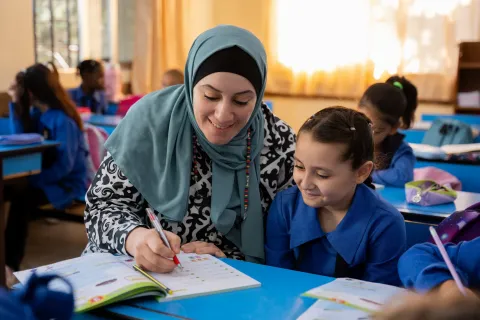
Weam, 35, has lived in Za’atari camp since it opened 12 years ago and is a Syrian Assistant Teacher in one of the camp’s Kindergartens.
“My role is to support the teacher,” explained Weam. “We work as a team where the teacher teaches, I help to take care of the logistics of running a classroom.”
At the start of every school year, Weam has a particularly important role to play: “I feel like it is my duty to take care of the little ones. They are used to the attention of their mothers and they need someone to help them transition to school life.”
She is proud of her role, citing positive reinforcement as an important tool she has learned to help young children grow their confidence and abilities. “When they graduate from my Kindergarten, they are ready to start a new chapter on their journey to become the educated adults of the future,” said Weam.
With increased hardship in the camp, due to reductions in the international funding available to the UN agencies and partners who work there, Weam is more grateful than ever to have this opportunity to support her family. “Having a good living standard is extremely challenging and costly for us refugees. Through this opportunity, I have been able to take care my children’s needs so, for that, I am grateful.”

When Mohammad, a Syrian Assistant Teacher, returned to the classroom after the COVID-19 pandemic, he noticed a concerning trend. “Almost every one of my students was experiencing some kind of learning loss,” he explained.
“The students were finding it hard to pay attention so they weren’t showing up to school every day,” he recalled. “We had to work even harder than usual to help them get used to school again and to support the Jordanian teachers to help them catch up with their learning.”
Mohammad was chosen to support the Ministry of Education and UNICEF’s new programme to help children recover lost learning.
Mohammad’s proudest moment as a volunteer happened during this time: “One of my students hated school because he couldn’t read and it was difficult to engage him. Only with a lot of work and follow up with his mother did I manage to convince him to attend the Reading Recovery programme and, with time, his reading skills improved. Now, instead of skipping school, he is one of the first to arrive to the classroom.”
The opportunity to be an Assistant Teacher has also transformed Mohammad’s personal life as he no longer needs to leave the camp for weeks at a time to earn an income.
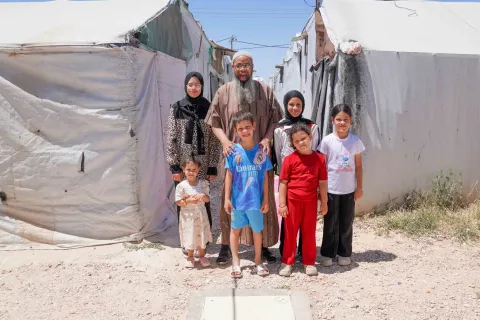
“When UNICEF gave me the opportunity to become a Syrian Assistant Teacher, I was able to be the father that I want to be. Now I can be always close to my children and take care of them. My children are young and they deserve to have me around. We are so much closer now.”

“I am very proud of what I do because I help save students from falling through the cracks of the system,” said Abdullah, a Syrian Assistant Teacher who performs outreach with the community on behalf of the school. “I believe that every student has the right to an education and it’s my job to try and help them exercise this right.”
During his four years in the role, he has brought fifty students at risk of dropping out back to the classroom.
He recalled one story of one child in particular: “I remember one fourth grade student who was out of school for two months because he had gone to work with his family to harvest olives. When I went to see him, he told me how much he disliked the work and that he wished he was back in school instead. I worked with his family to help him return and he was so happy. I made him promise to study hard. He did and his grades were excellent.”
Mohammad empathizes with the families that he deals on a daily basis as he knows how hard it is to make ends meet as a refugee in the camp. Without this IBV opportunity, he too would have no option but to go to work in the nearby farms.
“I am very grateful that UNICEF gave me the opportunity to do this role, especially because I am an educated person myself and my passion is supporting children’s learning.”
Support for UNICEF’s IBV programme in schools is generously provided by the European Union, the Government of Germany, through KfW, and the United States Government.