

Trading their future
How the climate-trade nexus impacts children
Global trade shapes the world children inherit in profound and often contradictory ways. While it drives economic growth and innovation, creates jobs, improves food security, and expands access to vital products and technologies, trade can also deepen inequalities, fuel exploitative labour practices, and cause environmental harm. Climate change, meanwhile, is already upending children’s lives: disrupting schools, spreading disease, and leaving families without safe food or water. When trade and climate collide, their intersection generates complex and underexplored opportunities and risks for children.
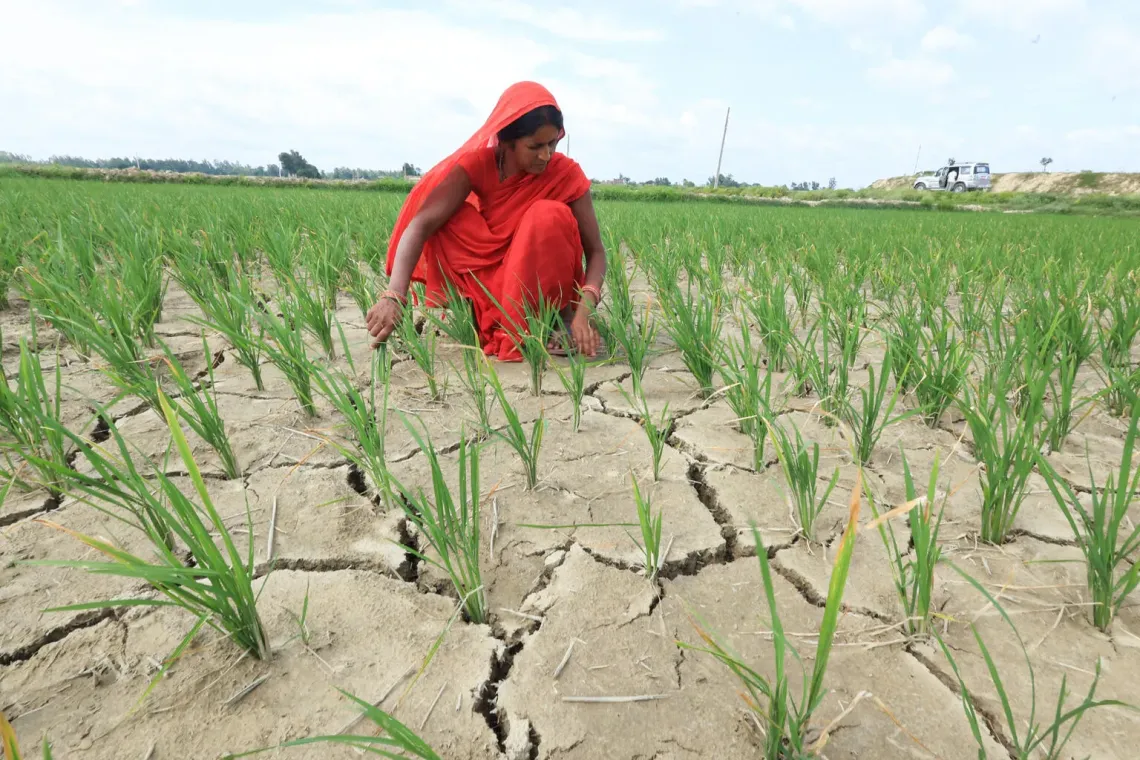
This article explores how the trade–climate nexus influences child outcomes — through health, food security, education, and economic stability. It also offers ways forward in areas like skills development, social protection, and sustainable trade, among others, to ensure climate-ensure that global trade and climate agendas uphold children’s rights and build resilience for future generations, rather than place their futures at risk.
As per projections, climate change could slash global food production by 11–24 percent by 2100 even with adaptation measures in place
How are trade and climate linked?
Trade and climate are deeply intertwined, with feedback loops that influence production, consumption, and human well-being. Climate change is already modifying agriculture, shifting what and how much countries can grow and produce. Some of today's primary food-exporting regions are projected to face significant losses while new production zones emerge elsewhere. Given that a large portion of the world relies on food imports, these shifts will alter trade flows and reconfigure dependencies. For children, this transition means heightened uncertainty about nutritional intake and dietary diversity.
Climate change also brings with it a higher incidence of extreme weather events that are disrupting global supply chains. In 2023, El Niño reduced crop yields, drove up volatility in agriculture commodity markets, and dried sections of the Panama Canal, temporarily choking off nearly 6 percent of global maritime commerce. Disruptions like these reverberate across supply chains, amplifying the costs of food, fuel, medicines, and household essentials, and often translating into fewer meals and deteriorating health outcomes for children.
Trade also contributes to climate change. Global trade is estimated to account for nearly 23 percent of global greenhouse gas emissions. The expansion of international markets for resource-intensive goods can accelerate deforestation, biodiversity loss, and unsustainable production practices. In the Democratic Republic of the Congo (DRC), cobalt mining for global supply chains has intensified deforestation, while exposing children to hazardous labour conditions.
At the same time, trade has been a powerful engine for expanding the global market for environmental goods and services, from clean energy to agricultural innovations. The fall in the price of solar technology is directly linked to global competition and investment. In countries such as Tanzania and Uganda, foreign direct investments have enabled off-grid solar markets to thrive, while giving children access to reliable electricity for lighting and study.
Climate and trade policy interactions
Governments are increasingly aligning trade policies with their decarbonization goals, but their design often overlooks child well-being. The most prominent examples are associated with the European Union’s (EU) Green Deal, which includes the Carbon Border Adjustment Mechanism (CBAM), the EU Deforestation Regulation (EUDR), among others. These green trade measures aim to accelerate the green transition by reshaping value chains and influencing supply and demand. However, they are also likely to squeeze economies in developing countries, especially Africa, that rely on exports of goods impacted by these measures (“green squeeze”). For example, the EUDR is expected to reconfigure supply chains for commodities like palm oil, soy, and cocoa, impacting major producers in Southeast Asia, South America, and West Africa. In particular, the EUDR could jeopardize incomes for smallholder families who are dependent on these exports, leading to higher risks of poverty and reduced child well-being.
“Green squeeze” refers to both the direct effects of green trade measures related to increased complexity and costs, and the indirect effects, which result from changes in prices and broader economic dynamics.
Meanwhile, new-generation regional trade agreements (RTAs) increasingly integrate climate provisions. Since 2012, the number and level of detail of environmental and climate provisions in RTAs has sharply increased. The 2022 EU-New Zealand Free Trade Agreement, for instance, includes explicit commitments to achieve net zero by 2050, provisions to lower barriers to trade in environmental goods, and mechanisms to cooperate on deforestation and the circular economy. Such approaches signal a shift in trade governance, embedding climate into trade frameworks, but they still rarely consider child-specific impacts.
Trade policies also play an important role in facilitating green technology transfer mechanisms and green investments. For instance, the ASEAN trade-in-goods agreement and investment facilitation framework were crucial drivers in raising sustainable investment in critical mineral resources in ASEAN states. Reducing tariff barriers and opening trade in energy-related environmental goods would result in net reduction in carbon dioxide (CO2) emissions while raising global Gross Domestic Product (GDP), generating positive spillovers for children’s well-being.
Environmental goods are products aiming at the protection of the environment and the management of natural resources, such as air pollution control, renewable energy, waste management and water treatment, environmental technologies, carbon capture and storage, etc.
However, trade fragmentation and protectionism can hinder the green transition. A hypothetical scenario of fragmented trade in critical minerals could lead to significant price swings and lower investment in renewable energy, thus making decarbonizing the global economy more difficult. Rising trade tensions and policy uncertainty could hit the solar, battery, wind and electric vehicle industries hard, disrupting supply chains and raising costs due to tariffs. The resulting uncertainty could indirectly impact families reliant on industries connected to global green supply chains. For instance, previous tariffs increases on solar cells and modules in the US led to the loss of more than 62,000 US jobs and $19 billion in new private sector investment.
Green policies themselves are reshaping trade dynamics. In India, a government push for renewable energy has made it one of the largest markets for solar power globally and a major exporter of solar PV modules. In the US, green economic incentives in the U.S. Inflation Reduction Act (IRA) of 2022 aim to promote competitiveness in clean energy technologies, which can reconfigure global supply chains. However, these domestic incentives can also escalate trade tensions, with critics arguing that certain IRA provisions violate WTO rules by giving domestic companies an unfair advantage. Establishing environmental regulations can also lead to adverse effects on export trade and employment in the short-term but they can encourage technological innovation and boost competitiveness in the long-run.
A persistent challenge comes from environmentally harmful subsidies. Agricultural incentives in developed countries that encourage overproduction of carbon-intensive crops not only contribute to global emissions but also skew international competition. These subsidies disadvantage small farmers in developing countries, threatening household resilience and reducing access to affordable, nutritious food for children.
Despite incremental progress, trade remains underrepresented in global climate governance. The Paris Agreement makes little reference to trade although parties to the Agreement have discussed trade as part of their cooperation in several technical bodies. Nationally Determined Contributions (NDCs) occasionally cite trade as part of adaptation or mitigation strategies, but the mention of direct trade measures (such as tariffs) is far less prevalent and rarely in ways that consider social equity or children’s needs. The lack of integration between child rights, trade rules, and climate commitments represents a critical gap in global governance.
Implications for Children’s Well-Being
The trade–climate nexus creates multiple pathways through which children’s lives are directly impacted. Four areas—health, food and nutrition, household economic security, and education—are particularly significant.
Children’s Health at Risk
Children are disproportionately affected by pollution and environmental degradation. Trade-driven industrialization and transport are major contributors to air and water pollution. Roughly 20-33 per cent of CO2 emissions and 30 per cent of inhalable particulate matter emissions are linked to international trade. The consequences include higher rates of respiratory illnesses, developmental issues and other long-term health problems in children.
Climate change is also amplifying health risks. As vectors of disease expand geographically and become more active, children face greater exposure to malaria, dengue, and waterborne illnesses. Trade policy plays a decisive role here. Africa currently imports more than 99 per cent of its vaccines and 95 per cent of its medicines. Efficient supply chains enable rapid responses to outbreaks, but disruptions—from trade barriers to logistical challenges—can slow vaccine distribution and expose children to preventable illness.
Nutritional Security in a Changing Climate
Food and nutrition are among the most immediate concerns for children in a warming world. Climate change is disrupting agri-food supply chains, making it harder to ensure a steady flow of nutritious food, especially in regions already facing food insecurity. By 2050, between 1.5 and 6 billion people may rely on international trade for basic food security. For children, disrupted flows of staple foods like wheat, maize, and rice mean greater risks of malnutrition, stunting, and impaired cognitive development.
Trade restrictions exacerbate the problem. While there are several reasons why governments may impose export restrictions on food and fertilizer, one rising factor is climate change. As extreme weather events and crop failures cause domestic shortages, it can prompt countries to limit exports to ensure food security. While politically understandable, such measures frequently drive up global food prices, disproportionately affecting poor households. Children are the first to feel the effects, as families shift to cheaper, less nutritious diets or skip meals altogether. Conversely, when trade policies prioritize open markets and climate-resilient supply chains, they can buffer families against climate impacts on food supply.
Household Economic Security
Parents’ economic security has a direct bearing on children’s well-being. The trade-climate nexus is reshaping labour markets, creating winners and losers across regions and sectors. For example, India’s rapid growth in solar panel export market is projected to create over 1.7 million new jobs in the next three years. These jobs bring income stability that supports children’s nutrition, education, and healthcare in households employed in them.
Yet the intersection of trade and climate can also undermine livelihoods. For instance, 2 per cent of employment is exposed to the impacts of CBAM in Moldova and Mozambique. These workers could face unemployment, lower wages, and unskilling. Without targeted transition support, families may be forced to cut education costs, rely on child labour, or reduce food intake, directly harming children.
Households in developing countries are particularly impacted by the green squeeze. The Africa region and least Developed Countries (LDCs) are especially susceptible because they lack the resources to comply. For households tied to such industries, the result may be job losses, lower wages, and heightened poverty.
In LDCs, the green squeeze could hurt an already constrained fiscal space, putting children's education and healthcare at risk. For instance, in Ethiopia, an increase in export requirements by 10 per cent under the EUDR could lead to a 0.7 per cent fall in GDP. Tax revenue could go down by more than 2 per cent, reducing in turn public expenditure. Wages would also go down, especially to workers without secondary education. Already, social sector spending in Ethiopia is under threat due to an extremely tight fiscal space, constrained by a declining tax-to-GDP ratio and high levels of debt distress. In this context, the EUDR could be double whammy for Ethiopia with negative impacts on poverty and child labour. At the same time, the EU will generate additional revenue from carbon taxes and other green trade measures. But there's no binding commitment yet to share these gains with the LDCs bearing the brunt of these policies.
Education and the Future of Work
The shift toward sustainable trade is reshaping skills demand, underscoring the need for education systems to prepare young people for the jobs of the future. On one hand, emerging green sectors are driving demand for skills in fields like renewable energy systems, green engineering, and sustainable logistics. On the other, the decline of carbon-intensive exporting sectors could lead to potential job displacement for youth. With appropriate investments, young people could thrive amid these labour market transitions. However, most education systems are not equipped to prepare today’s children for tomorrow’s green jobs. Few curricula emphasize green skills development, and financing and access to green skills development and entrepreneurship support programmes remain limited. Mismatches between labour market demand and what is being taught in schools, and lack of accessible retraining and upskilling programmes exacerbate the issue,
Meanwhile, rising demand for critical minerals like cobalt and lithium has intensified child labour in mining sectors. In the DRC, the demand for cobalt for batteries has been linked to a troubling rise in child labour and a drop in school attendance. Instead of acquiring skills for a green future, these children are exposed to toxic substances and hazardous labour, with lifelong consequences.
Policy pathways for child-sensitive trade and climate action
The trade–climate nexus is not only about emissions or GDP, but about childhood itself. If policies continue to neglect the impact of the trade-climate nexus on children, they risk embedding inequality into the global system for decades to come. Conversely, if trade and climate policies are designed with children in mind, they can become powerful tools for resilience, equity, and opportunity.
Children must no longer be an afterthought and be at the heart of how we design the future of trade and climate action. To address this, governments and multilateral institutions must embed children’s rights into trade and climate governance. Five pathways stand out:
- Promote Climate-Resilient Health and Nutrition in Trade Policies
Trade policies should lower tariff and non-tariff barriers to the flow of nutritious foods, vaccines, and medical supplies, particularly in the event of climate-induced shortages. Regional cooperation agreements can be designed to facilitate climate-sensitive food and pharmaceutical regional value chains and boost local production hubs. Prioritizing these flows ensures that children’s basic health and nutritional needs are met even during climate shocks.
- Incentivize Sustainable Trade Practices
Aligning trade with environmental standards is essential. Governments should phase out harmful subsidies that encourage unsustainable production, while fostering markets for eco-friendly goods and services. Implement clear labeling schemes and certifications for eco-friendly products to guide consumer choices and encourage companies to adopt sustainable practices. Governments can also offer financial incentives for businesses that meet high sustainability standards and enforce stricter regulations on pollution and hazardous waste to protect children's health.
- Invest in Green Skills Development
Education systems must be reoriented to prepare children for the green economy. This includes integrating green foundational skills in primary and secondary education curricula, offering market-relevant occupational training at vocational and higher education levels, and ensuring equitable access to girls and marginalized groups. Partnerships with the private sector and a focus on Science, Technology, Engineering and Math (STEM) fields are crucial to build a skilled workforce capable of tackling climate challenges and leverage innovation and entrepreneurship opportunities through trade.
- Strengthen Social Protection Systems
Families require safety nets to withstand trade and climate shocks. Scaling up cash transfers, food aid, and active labour market programmes for reskilling and livelihood diversification can shield children from poverty and child labour. Evidence shows that robust social protection reduces the intergenerational transmission of disadvantage, making it an essential component of climate-resilient trade policy.
Address research and evidence gaps
There is a need to develop comprehensive evaluation frameworks to analyse how the trade-climate nexus directly impacts children’s health, education, and nutrition. Filling these knowledge gaps will empower development partners to advocate for child-sensitive trade measures within climate action plans and NDCs, as well as trade negotiations and policy processes.
Akinyi J. Eurallyah is Research Associate & Program Manager at the Africa Research & Impact Network (ARIN)