A Midwife’s Mission to Close the Immunization Gap in Garut, West Java
Healthcare Workers Tackle Misinformation and Missed Immunization
- English
- Bahasa Indonesia
Every day, Susi hops on her motorcycle and winds through the narrow roadways of Margamulya village – a remote, hard-to-reach community tucked between dense jungle and steep hills in Garut West Java. Her purpose is always the same: to immunize as many children as possible.
Susi began her work as a midwife in the village over a decade ago. From the outset, she faced community resistance to immunization, largely driven by limited awareness of its health benefits. “The number of ‘zero-dose’ children (those not reached with any routine vaccination) was very high,” she recalls. “We were going door-to-door, really trying to catch up on missed immunization.”

Over the years, Susi and fellow health workers have intensified their efforts to improve immunization coverage. They still face barriers, including misinformation, fear of side effects and lack of family support.
“One major challenge is parents’ concern that their child might fall ill after immunization,” says Dr. Leli Yuliani, Head of the Garut District Health Office.

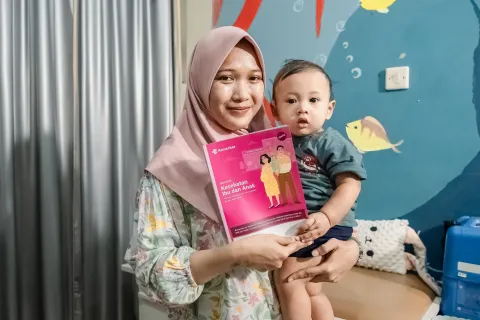
Nurjanah delayed her seven-month-old son Araska’s immunization, despite knowing its importance. “I told my husband we should pause the immunization, because I was worried our child might end up [sick] like the last time,” she recalls.

“There are hoaxes circulating in the community. Limited awareness of health matters causes many in the community to be reluctant to visit the health centre or the Posyandu, even when their child is sick,” says Dadang, Head of the Cisompet Community Health Centre.

Delays in immunization also happen when a child is unwell at the time of their scheduled vaccination, and caregivers are unaware of the importance of returning for catch-up immunization once the child has recovered.
Ai, a mother from the village, postponed her daughter Khalisa’s vaccination due to illness. But after Khalisa recovered, Ai did not return for the catch-up immunization. “At the time, Khalisa was sick, so she couldn’t go for immunization. She had a fever and a cough,” Ai explains, gently cradling her 10-month-old daughter.

Experiences like this contribute to many children missing their immunization. Not receiving any vaccines make zero-dose children significantly more vulnerable to infectious diseases and deadly outbreaks.
Garut Regency ranks among the top ten districts in West Java with the highest number of zero-dose children—totaling 5,882 (Ministry of Home Affairs). Nationally, the number of zero-dose children was halved from 1,162,000 in 2021 to 570,969 in 2022, but rose to 748,000 in 2024 (WUENIC).
Without urgent action, vaccination rates may further decline and vaccine-preventable diseases could re-emerge – reversing years of progress. UNICEF is supporting the Ministry of Health to reach zero-dose children in ten high-priority areas across Indonesia, with a target to reduce the zero-dose number by 25 per cent. This work is made possible through generous contributions from partners, including Gavi and the Vaccine Alliance.
“We strive to reduce morbidity rates and prevent outbreaks in Garut Regency caused by vaccine-preventable diseases. It is critical to reduce the number of zero-dose children. This must be addressed urgently, because if we fail to do so, the risk of outbreaks becomes significantly high,” explains Dr. Leli.

In 2024, to help ensure no children miss their immunization in Margamulya village, health workers at Puskesmas Cisompet launched BERAKSI (Berkabar Anak Kami Siap Imunisasi), an innovative approach that helps midwives like Susi track children who missed their immunization, often due to illness, using WhatsApp and text messages.
“Parents can easily inform health officers, including village midwives like Susi, when their child has recovered from illness, who will then immediately conduct the immunization,” explains Edwin, Immunization Coordinator of Puskesmas Cisompet.

UNICEF is strengthening these efforts by supporting the Government to train healthcare workers like Susi and Edwin. This includes training in vaccine management, outreach planning and communication – skills that health workers now apply daily in their communities.
Thanks to BERAKSI and targeted training for health workers, immunization coverage in the region has seen a marked improvement. In June 2025, the percentage of children receiving complete basic immunization rose by 10 per cent compared to June 2024.

Back in Kampung Cikadu, a hamlet of Margamulya village, crowds of parents line the steps of Posyandu Teratai, waiting for their names to be called by Susi. Among them is Nurjanah, watching with quiet relief as her son Araska receive his long-delayed vaccine.
Nurjanah hopes that her experience can offer hope for other anxious parents across the nation. “To all the mothers out there, don’t be afraid of immunization, because its benefits far outweigh any side effects. It helps keep children healthy,” she says proudly.

Ai also feels relieved that her child has been immunized, thanks to Susi’s proactive efforts and collaboration. “It feels good and went smoothly, because she [Susi] always shares information and updates, helping me understand that my daughter can now get immunized,” says Ai.

Susi knows her work is far from over. What motivates her most is seeing the community embrace immunization over time, learning that it is essential for their children’s health and future.
“In the past, people here were very afraid of immunization. Now, the community understands and appreciates its importance,” she says. “I sincerely thank everyone for welcoming us with enthusiasm and actively participating in our programme to improve the health of our children.”