Trained foot-soldiers of India’s healthcare system stir up a silent revolution
From assisting a high-risk pregnancy to guiding young mothers on exclusive breastfeeding, nutrition, and safe hygiene practices, the silent ranks of the healthcare system in India—the ASHAs, Anganwadi workers, ANMs—are pushing for a healthier tomorrow.

- English
- हिंदी
From assisting a high-risk pregnancy to guiding young mothers on exclusive breastfeeding, nutrition, and safe hygiene practices, the silent ranks of the healthcare system in India—the ASHAs, Anganwadi workers, ANMs—are pushing for a healthier tomorrow. UNICEF- IKEA partnership is playing a catalytic role in supporting these frontline health workers.
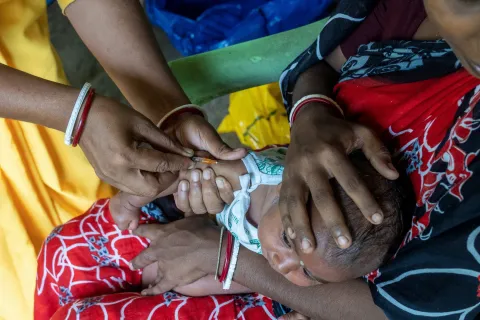
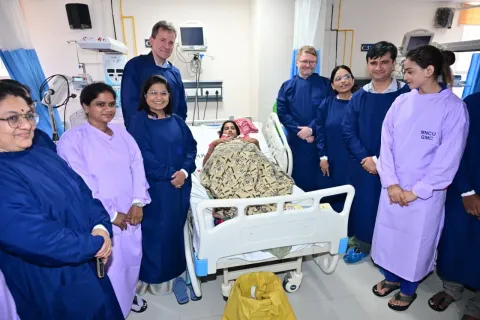
On one of her routine home visits to check on five-month-old Kartik and his mother, Sulakshana Devi, an ASHA, suspected something amiss. She checked the mother, Neelam Devi’s weight and pulse, and then did a pregnancy test. Her suspicion was confirmed. Neelam Devi was four months pregnant and was utterly unaware of it. As further medical tests revealed, hers was a high-risk pregnancy. Already a mother of four, including a newborn, this news weighed heavily upon her. However, with close support of the community health workers—who received capacity building through UNICEF- IKEA partnership support—her breech delivery went about without a hitch, and both mother and child are today healthy and happy.
ASHA, Anganwadi workers and Auxiliary Nurse Midwives (ANM), or the triple As of community health, as they are known, are the backbone of the healthcare system of India. Working with communities at the grassroots level and helping to give a happy ending to thousands of stories from as many homes, particularly in rural settings, their role is crucial in providing the health indices with an upward swing. UNICEF- IKEA partnership intervention of building capacities of these foot-soldiers is therefore vital because often they are the first in line to identify problems and aid access to healthcare services.
Aiding a high-risk pregnancy
In Neelam Devi’s case, the ASHA urged her to visit the health camp under the Pradhan Mantri Surakshit Matritva Abhiyan (PMSMY) that takes place on the ninth of every month and offers comprehensive antenatal care to all pregnant women, free of cost.
At her PMSMA check-up, an ultrasound revealed that Neelam Devi’s baby was in a breech position (abnormal positioning of the foetus in the uterus), making it a high-risk pregnancy. Thereafter, the ASHA, Sulakshana Devi, took over. She started taking iron and calcium tablets after the fifth month and was recommended to turn onto one side when getting up from bed due to the foetal position.
She also guided her through a nutritious diet and taught her the correct way to wash her hands.
Hygiene, Neelam Devi was told, is crucial to keep diseases at bay, particularly when the baby comes along.

Hygiene and nutrition: mantras to good health
For Manisha Devi of Beltoli too, learning to wash her hands with soap was an important lesson that the ASHA, Jameela Khatun, and Anganwadi worker, Mariam Ekka, reinforced with every visit. Manisha Devi is mother to a healthy seven-month-old baby boy, Ravi Kishan.
“Earlier it was a common practice to wash our hands with ash,” the mother said, “But now that is no longer the case.”
Whenever the ASHA or the AWW would come for a home visit, Manisha Devi said that she and her family—her mother-in-law and sister-in-law—would sit through the discussions on the importance of a proper diet for pregnant and lactating women, on the importance of exclusive breastfeeding for the first six months, and on proper hygiene practices.
The mother was also taught the correct posture during breastfeeding.
Now that he has completed six months of age, Manisha Devi said that she will start her baby on complementary feeding in accordance to the health workers’ recommendations.
Like her, 20-year-old Tabassum of the Alampur village too credits Jameela and Mariam—the ASHA and AWW—for helping her through her pregnancy comfortably and delivering a healthy baby.
Apart from the home visits, the Village Health and Nutrition Day (VHND) that is held on a designated date every month, also proved to be very helpful.
On this day, an umbrella of health services covering maternal health, child health, family planning, sanitation, and nutrition are offered through ANMs, AWWs, and ASHAs at one particular place.
It was during these meetings where Tabassum learnt that her baby had to be exclusively breastfed for the first six months, and that she needed to eat healthy—rice, dal, and green vegetables— in order to maintain her health and nourish her child.
A trained health workforce can push boundaries
Sitting in their homes far from each other, all the women—Neelam, Manisha, and Tabassum—had a common thread going through their stories—about the positive role of the ANM, ASHA and AWW in their lives. Sulakshana Devi, who started work as an ASHA in 2012, said, “Back then, there were a lot of home deliveries. After years of efforts, the number of institutional deliveries have gone up. Now women seek us out whenever they have any problem and ask us when their health check-up is due. They are more aware of health and hygiene.”
It’s a silent revolution sweeping over, one family at a time.