From Pilots to Policy: Institutionalizing innovation in India
The state of Tamil Nadu partners with UNICEF and OECD to embed innovation in public governance.
Across the public sector worldwide, innovation is often treated as an aspiration rather than an operating principle. While it’s not uncommon for governments launch pilots, establish labs, and test new tools, it’s rare to see innovation move from experimentation to planned integration into a state’s core governance machinery.
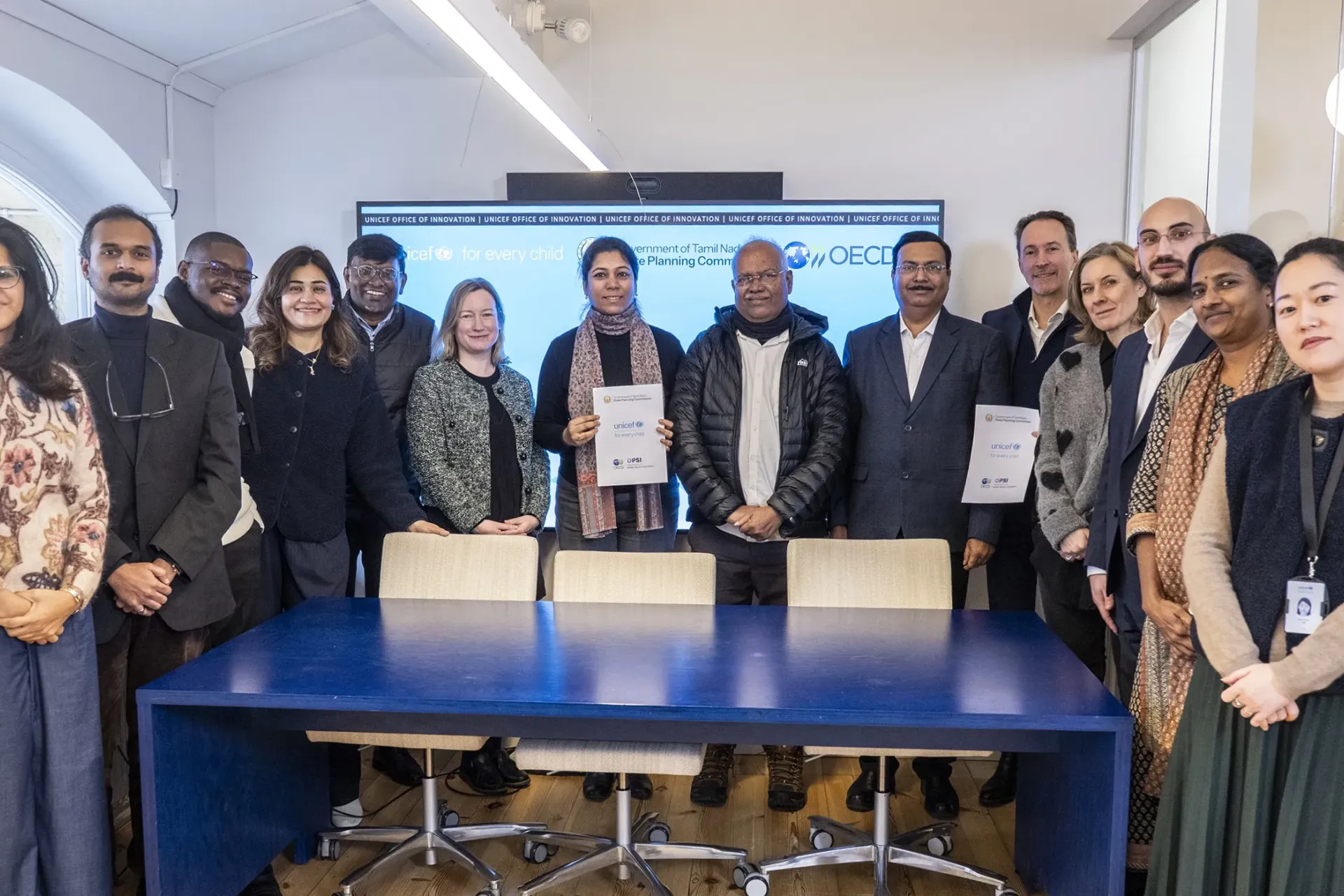
That shift is now taking shape in Tamil Nadu. In early 2026, the Tamil Nadu State Planning Commission entered a formal technical collaboration with UNICEF and the OECD Observatory of Public Sector Innovation (OPSI), marking the first time such a partnership has been established with a sub-national government.
Its intent is clear: to make evidence-informed innovation a core governance capability — embedded in planning, budgeting, implementation, and review — so the state can respond effectively to evolving challenges, especially those affecting women and children.
“Embedding innovation within government institutions strengthens how decisions are made, how evidence is used, and how services improve over time. This collaboration reflects our commitment to building long-term institutional capabilities.” Ms Sudha Ramen, Member – Secretary, Tamil Nadu State Planning Commission.
Working at the sub-national level is central to this ambition, as state governments operate at the critical interface between policy and delivery. Positioned closest to service implementation, they are uniquely equipped to translate innovation-driven policies into tangible social impact through services that people directly experience. Despite strong policy intent, institutional architecture, and financing in Tamil Nadu, the gap in embedding innovation in governance remains.
This partnership seeks to close this gap by nurturing a culture of innovation through the establishment of a public innovation policy framework and the strengthening of institutional capacities, enabling a sustainable innovation ecosystem that drives affirmative public action for children.
By institutionalizing innovation practices at this level, Tamil Nadu is addressing one of the most persistent challenges in public sector reform: how to move beyond isolated successes toward sustained, system-wide improvement at scale.
From the OECD perspective, this collaboration reflects a broader shift in how public sector innovation is understood. When innovation is treated as a public function that can be governed, strengthened, and improved over time through evidence-based policy frameworks, it evolves beyond a series of disconnected initiatives.

“State governments play a critical role in translating policy into practice. Strengthening innovation capacity at this level is essential for achieving system-wide reform. The significance of this partnership is enabling the ability to go beyond a single programme, and the way innovation is embedded into decision-making processes that can evolve and endure.” Nora O'Donnell, Senior Policy Analyst, OECD.
In Tamil Nadu, innovation is increasingly seen as a core capability of governance, shaping how policies are designed, services are delivered, and public systems learn and adapt over time.
Examples such as the Tamil Nadu Innovation Initiatives (TANII) and the Centre for Innovation in Governance (CIG), alongside the integration of UPSHIFT across all government secondary schools, reflect the state’s readiness to deliver impact at scale. Crucially, Tamil Nadu’s experience shows that scale is possible when innovation is embedded within public systems.
This matters because it shows that innovation can be mainstreamed without losing purpose or equity. When innovation is treated as a shared system responsibility, it can reach entire populations rather than a narrow set of beneficiaries. It can also evolve over time, shaped by evidence and lived experience rather than remaining fixed to initial assumptions.
For the UNICEF Office of Innovation, the collaboration deliberately aligns frontline service delivery with institutional reform. This is essential as innovation for children does not end with new tools or approaches, and impact at scale depends on public systems equipped to adopt, adapt, and sustain them.

“What’s powerful about this work is not only what it enables in one state, but what it makes possible nationally. When innovation is embedded within public systems, governments are better equipped to scale solutions that work and adapt them for diverse contexts across India. G Kumaresan, Chief a.i UNICEF Office for Tamil Nadu and Kerala, India.
Tamil Nadu’s experience is showcased through COMPASS, UNICEF’s global innovation platform, as a reference point for governments navigating similar challenges. Eight countries — Chile, Chad, Guatemala, Guinea-Bissau, Malawi, São Tomé and Príncipe, and South Africa — will engage in a knowledge exchange with the Government of Tamil Nadu, UNICEF India, UNICEF Office of Innovation, and the OECD Observatory of Public Sector Innovation to examine what it takes to institutionalize innovation across public systems. The emphasis is not on promoting a single model, but on illustrating the possibilities when governments invest in innovation as a long-term capability.
At a time when public institutions face increasing pressure to deliver inclusive, responsive, and resilient services, this collaboration offers a compelling example of innovation-driven governance in practice. It shows that innovation does not need to sit at the margins of government. When embedded with intention and evidence, it can become part of the infrastructure that enables public systems to serve people better, especially those most often left behind.
The question facing other governments is no longer whether innovation has a role to play. It is whether they are prepared to make it part of how government works.