Giving Girls Safe Spaces To Fly
Bihar Swachh Vidyalaya Puraskar (BSVP) is not just an award but a revolution, benchmarking over 60,000 schools across 50 indicators: water supply, toilets, handwashing, waste management, and safe spaces like Saheli Kaksh.

- English
- हिंदी
Fourteen-year-old Kritika oscillates between excitement and unease outside her classroom at Adarsh Ramanand Middle School in the eastern Indian state of Bihar. Her eyes sparkle at the thought of the new school, meeting new teachers, and making new friends.
But soon, her anxiety about leaving Adarsh Ramanand Middle School takes over. It is not about leaving her classmates, most of whom will join her, but about losing something special that she hesitates to put into words.
“This school gives me safety. I feel secure. My new school won’t provide me with that safety,” says Kritika as she strings her jumbled thoughts together. Her friends encourage her to initiate the conversation on a topic that continues to be discussed in hushed tones and behind closed doors.
“This school gives me safety,” she says, her voice firming up. “The new school doesn’t have a Saheli Kaksh, a room that gives us safety and security during our periods.”
The Saheli Kaksh, or “Friendly Corner,” is more than a room; it’s a safe space for girls at Adarsh Ramanand Middle School.
Equipped with a sanitary pad vending machine, an incinerator, a bed for rest, and spare uniforms, it offers comfort, dignity, and, more importantly, a safe and dignified space when menstruation arrives unexpectedly.

“I feel safe here, her voice soft but sure.”
Bihar Swachh Vidyalaya Puraskar- A Harbinger of Change
Kritika’s school owes its transformation to the Bihar Swachh Vidyalaya Puraskar (BSVP), or the Bihar Clean School Award. BSVP is not just an award but a revolution, benchmarking over 60,000 schools across 50 indicators: water supply, toilets, handwashing, waste management, and safe spaces like Saheli Kaksh.
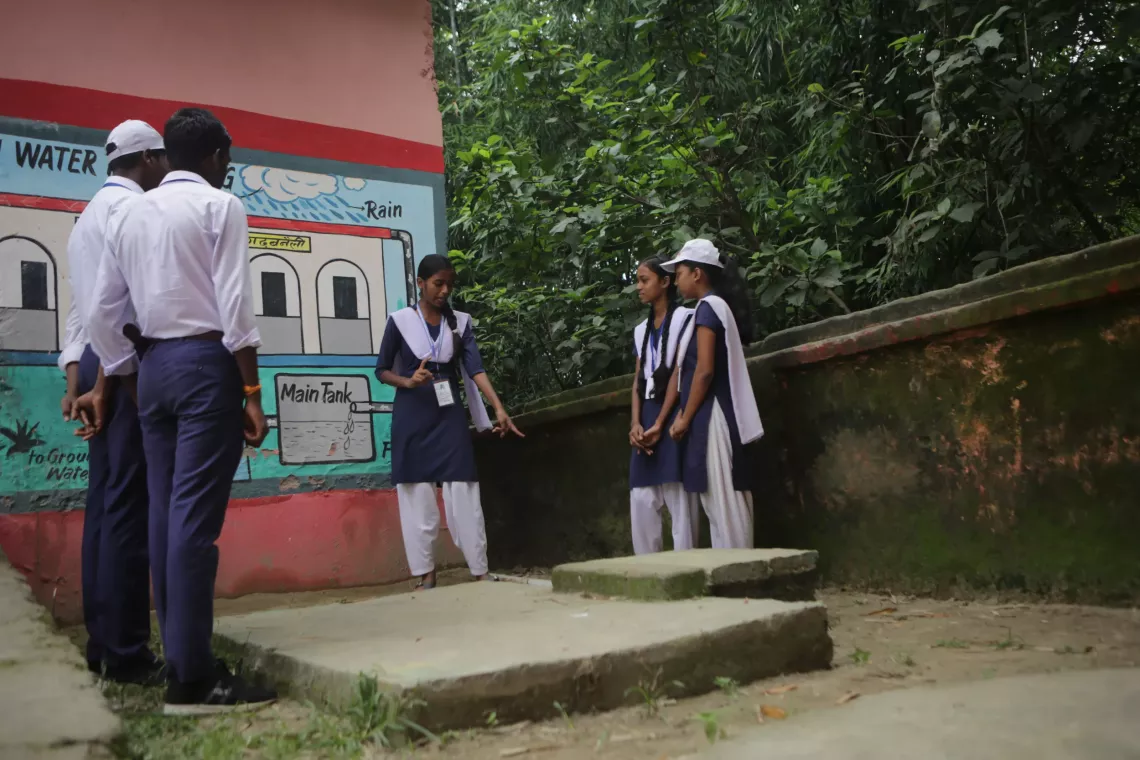
Collaborating with UNICEF, the Bihar Department of Education developed a state-specific WASH in Schools benchmarking system and award guidelines under BSVP. This state-wide initiative elevates school hygiene and safety.
With UNICEF, the Bihar Department of Education developed BSVP to benchmark schools on essentials like clean water, sanitation, handwashing facilities, and safe spaces like the Saheli Kaksh.
Kritika’s school, Adarsh Ramanand, shines as one of 54 award-winning schools, a beacon of dignity. It isn’t just the Saheli Kaksh that the students feel proud of and talk about with pride when visitors come to their school.
The number of girls’ toilets in the school has increased from one to eight, boys’ urinals to 17, and two group handwashing stations, one with 10 taps, another with six now serve the school. Clean water drums sit outside every classroom.
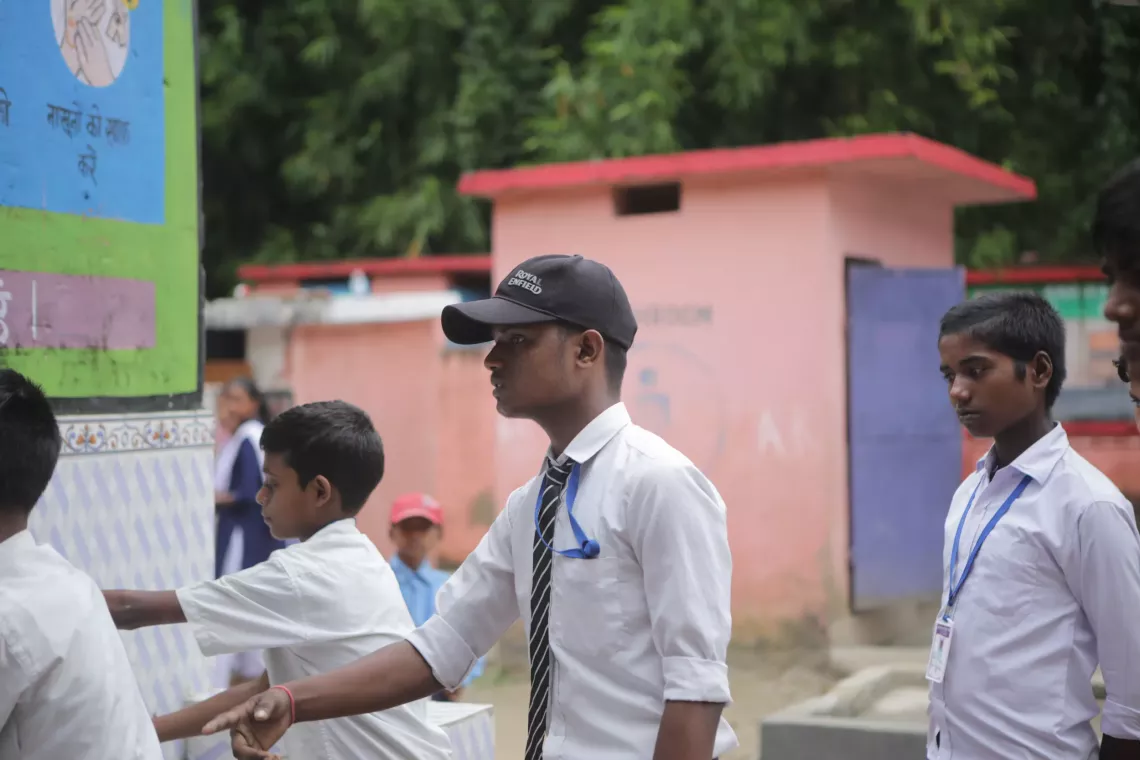
Hiradan Kumar, a boy with a shy grin, chimes in: “When UNICEF began their work in our school, we witnessed many changes. I feel very proud to be in this school. Where there were only two toilets before, we now have 15. It makes me happy to share that girls have a special toilet.”
Ankith Kumar adds, “We have a new handwashing station to wash our hands. We have set up a drum of clean drinking water in front of every class so that children can drink from it to quench their thirst during their classes.”

Shreya Suhani chimes in: “We have made many efforts in school to address climate change. Our school has set an example of how to harvest rainwater. We separate dry and wet waste. Wet waste is used to create compost for our school’s nutrient garden. The dry waste is collected and then handed over to the municipality.”
UNICEF has guided the development of a state-specific WASH benchmarking system, transforming schools like Adarsh Ramanand into models of hygiene and dignity.
“UNICEF has supported conceptualizing the Bihar Swachh Vidyalaya Puraskar, playing a critical role in the end-to-end implementation process of the Bihar Education Project Council,” says Ontario Sudhakar Reddy, a WASH Officer at UNICEF India. “BSVP is a movement.”

“The Bihar Swachh Vidyalaya Puraskar has helped increase awareness about health and hygiene in schools, improving the enrollment and attendance of children, especially girls. The Government of Bihar thanks UNICEF and its team for their help in raising awareness of the BSVP programme.”
“The Bihar Swachh Vidyalaya Puraskar has helped increase school awareness about health and hygiene. This has also helped to improve the enrolment and attendance of children in schools, especially girls,” says B Kartikey Dhanji, IAS State Project Director at Bihar Education Project.
“The Government of Bihar thanks UNICEF and its team for their help raising awareness of the BSVP programme,” adds Sunil Kumar, Minister, Department of Education, Government of Bihar.
“UNICEF’s partnership made this a success. We’re grateful,” adds Sunil Kumar.
Change Beyond the School
Back home, Kritika’s mother, Sita Devi, sees the change. A changemaker herself and a respected person in her community, Sita Devi has amplified the messages that Kritika has brought from school.

“Kritika used to miss school, three or four days a month,” she recalls, as women of her village listen attentively. “Now, she goes every day. The Saheli Kaksh has been a blessing. The girls talk about these things openly now; there’s no shame, and absenteeism has gone down,” says Sita. “Even the men and boys now understand the topic in the village and are comfortable talking about it.”
Kritika lingers near the Saheli Kaksh as she prepares to leave for her new school, perhaps one last time.
“I dream of a day when every school has a Saheli Kaksh,” says Kritika.