Akha: The Boat of Hope
Across the difficult riverine islands in Assam, ingenious Solar Direct-Drive Refrigeration (SD-DR) units at the Boat Clinic have changed how health workers like Nirupoma deliver immunization services.
- English
- हिंदी
The perennially raging Brahmaputra River is eerily calm today. The low currents are stalling the floating Boat Clinic's arrival at Noor's village in Bongaigaon district in the north-eastern Indian state of Assam. Today, nine-month-old Noor Khatun will be vaccinated against Measles and Rubella (MR) and Japanese encephalitis (JE). She will also get her Vitamin A supplementation.
Noor's mother, 25-year-old Munawara Khatun, awaits the Boat Clinic's arrival at Noor’s village in the Bongaigaon district in the north-eastern Indian state of Assam. Munawara is at the health centre.
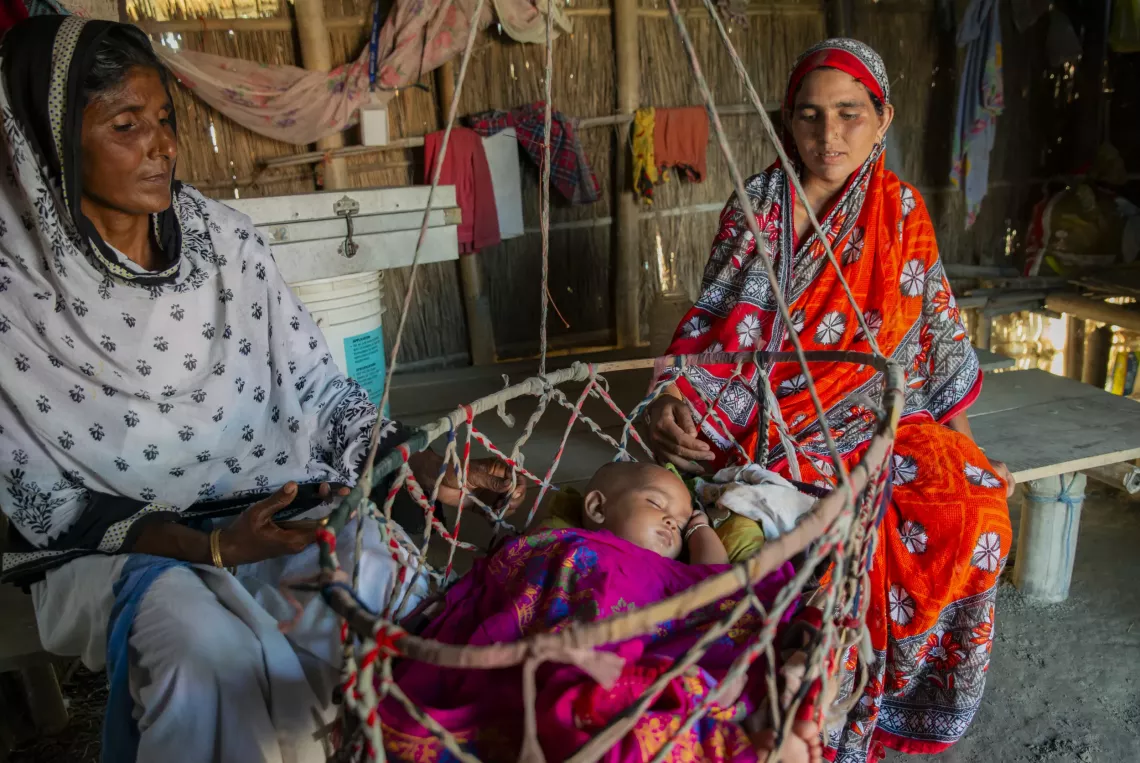
Munawara Khatun is more relaxed than she was on her last visit to the Boat Clinic, in June this year, when her home and village were deeply submerged in floodwaters.
Onboard the Boat Clinic is 41-year-old Nirupoma Roy, a veteran nurse and midwife, working with the Boat Clinic for over a decade. She and her colleagues are working calmly through the morning chaos, updating the beneficiary register, handling the vaccines in the cold chain, and preparing for the makeshift health clinic to be conducted at Noor's village in Khorchimari Island, locally known as chars or saporisas.
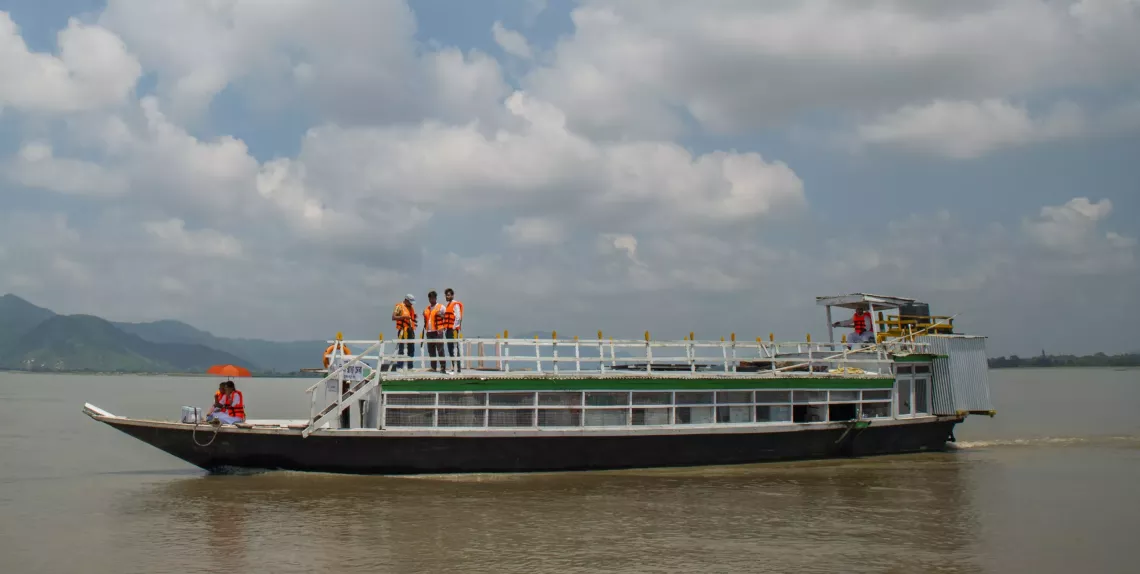
The boat clinic mirrors a Primary Health Centre (PHC) and has all the basic health facilities, such as the laboratory, OPD, pharmacy and cold chain point. The paramedical staff includes two Auxiliary Nurse Midwives (ANM), a pharmacist, a laboratory technician, community workers, and support staff.
Nirupoma's day on the Boat Clinic has just begun as the boat sets sail to Noor’s village.
"These communities don't get any health services other than what we carry to them on the boat. As a result of our visits, they are healthier and happier. When we reach out to them, they feel good, and we feel the same. These children are like my own. I enjoy my work,"
says Nirupoma with a wide smile.
The Boat of Hope
The unique topography of Assam, with its extensive river network and hilly areas, presents significant barriers to healthcare access, particularly in rural and remote regions. Many places become inaccessible during the monsoon season, making it a daunting task for healthcare providers to reach these regions.
Most of these riverine islands in the Bongaigaon district are constantly reshaped by the mighty Brahmaputra River. An island, once thriving with livestock and greenery, can be wiped out overnight during the seasonal rains, leaving its residents vulnerable to displacement and to the extent of the island disappearing altogether.
For thousands of people across the riverine islands of Assam, the Boat Clinic is a beacon of hope to people like Noor's mother. The Boat clinics serve as lifelines, reaching approximately 20,000 people each month with essential medical care and heartfelt compassion.
Due to continuous flooding and erosion in these islands, it's almost impossible to build and maintain permanent housing and basic healthcare structures. Connectivity is limited to country boats. Most of the population is poor, and these villages lack quality maternal, newborn, and childcare services, increasing morbidity and mortality.
In 2004, a local NGO, the Centre for Northeast Studies, and Policy Research (C-NES), launched the Boat Clinics to provide much-needed medical services to the area. UNICEF joined in the initiative and supported the capacity building of health workers. A team under the leadership of Sanjoy Hazarika at C-NES, worked round the clock to design and build Akha – ‘A Ship of Hope in A Valley of Flood.
For the past twenty years, the Boat Clinic has delivered essential healthcare services to 2,500 chars, mainly in 13 districts, including Bongaigaon district, where Noor's family lives. Today, 15 Boat Clinics operate along the river, treating around 18,000 to 20,000 people every month.
"Ten years ago, people here faced many hardships. Travelling was difficult; sick children had no access to medicine at night, and pregnant women rarely received health check-ups. Now, I feel a deep sense of fulfilment knowing people rely on us, and there is a sense of relief when we arrive early," says Nirupoma.
An everyday tale of grit, determination, and commitment
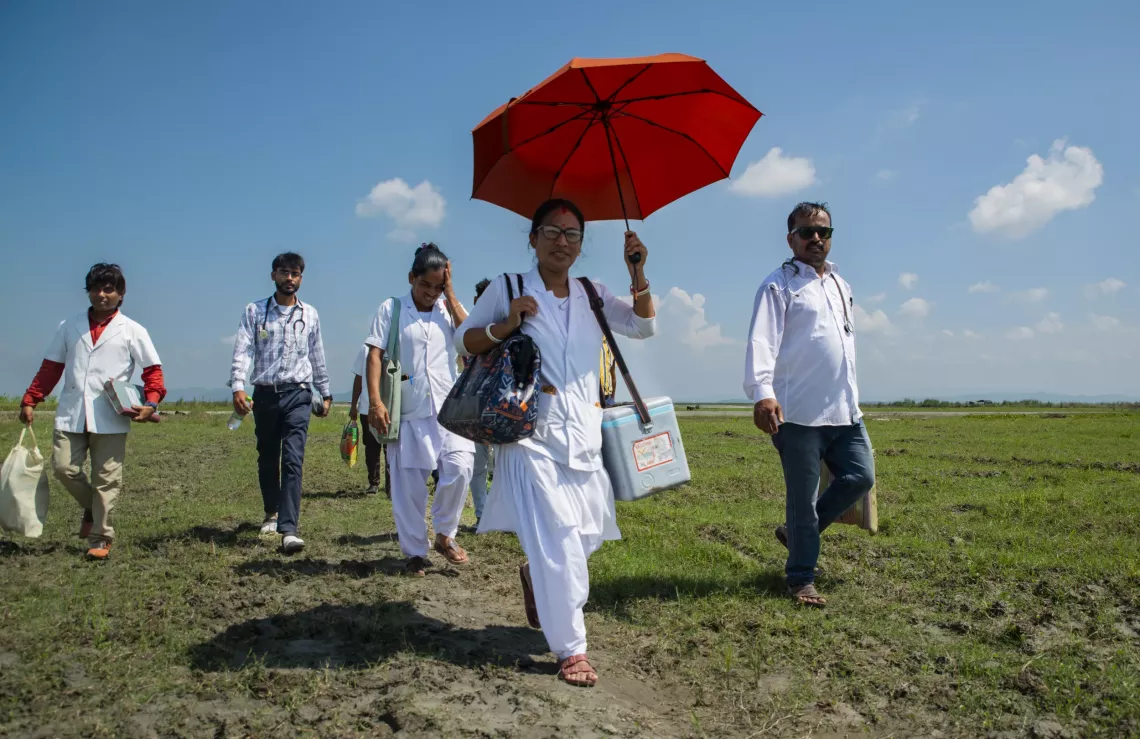
After one and a half hours of sailing on the difficult Brahmaputra, where low currents stalled the boat multiple times, the Boat Clinic finally reached the shores of Khorchimari char. Today is no different from the routine challenges health workers face: under the scorching sun, amidst stifling humidity, they take an arduous journey, over a kilometre and a half on foot, to the makeshift health centre. They also carry medicines, medical equipment, and other heavy supplies essential to providing their services.
"When we arrive, children and pregnant women gather around us. We check pregnant women's height, weight, and blood pressure and vaccinate children, especially newborns, who need doses every 28 days. We visit the char every month for health check-ups and vaccinations," says Dr Nazrul Islam, the Boat Clinic's medical officer.
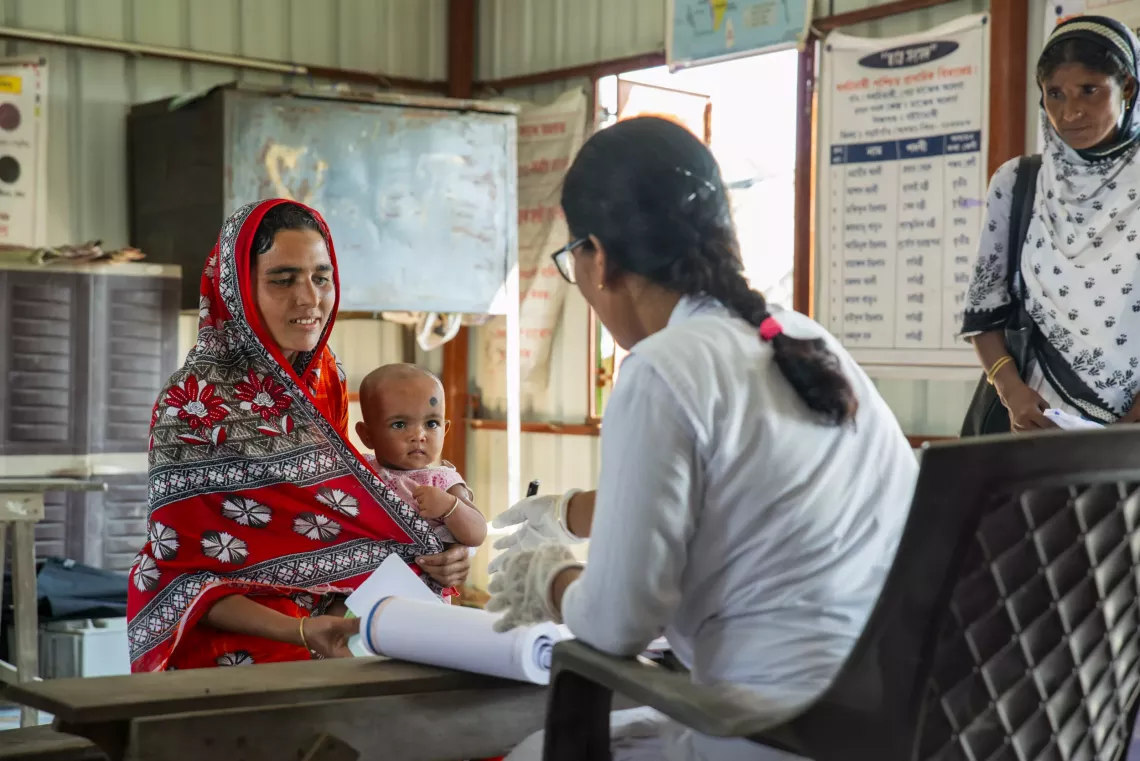
Nirupoma knows most of the people in the community by name. She meets Munawara Khatun and Noor, and they talk about her health and Noor's vaccination schedule. Munawara has been visiting the boat clinic for her last two pregnancies and now for Noor's vaccination. Noor receives her Measles-Rubella (MR) and Japanese Encephalitis (JE) vaccinations, Vitamin A Supplementation, and lots of love.
“During the birth of all my children, I received the necessary vaccinations and medical care whenever I was unwell. The doctors and ANM didi (sister) are very good, and my three children have received their vaccinations and treatment at the boat clinic,” says Munawara Khatun.
Noor’s mother moves to a nearby table to get advice on contraception from Nirupoma's colleagues. She picks up contraceptives on her way out of the health centre.
“The boat clinic has been immensely beneficial for us. It has become extremely helpful for pregnant women in our area, ensuring safer deliveries. Because of the availability of doctors, we can vaccinate our children on time. We are incredibly happy,”
Muzahar Ali, a village elder, says.
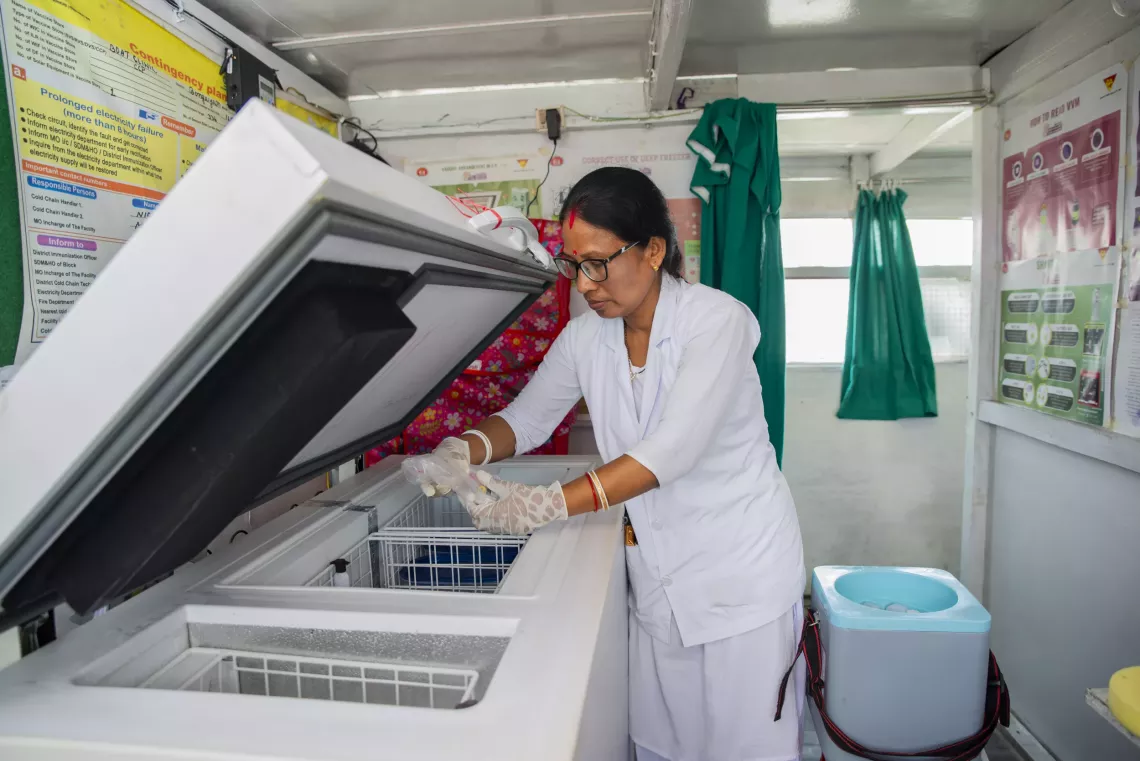
Solar Direct Drive (SDD) refrigeration units – The Game changers
Nirupoma thanks UNICEF for the innovative Solar Direct-Drive (SDD) Refrigeration units. These SDDs have transformed healthcare delivery across the challenging riverine islands in Assam, allowing health workers like Nirupoma to reach and immunize more people on the islands than ever before.
Earlier, healthcare workers had to travel to district health facilities to collect vaccines for Boat Clinics on every visit. This extra step took valuable effort and time before they could begin work at the Boat clinic. Solar-powered refrigerators (SDDs) bring the cold chain, a temperature-controlled system for storing vaccines, directly to the boat clinics.
"SDDs brought the cold chain closer to the people we serve. Now, with the SDDs, the Boat Clinics can safely store vaccines On Board, saving time for health workers - over four hours per trip- that was previously spent on transporting vaccines."
Says David Kiambi Mutuerandu, Chief of Supply & Procurement, UNICEF.
The simple yet effective intervention has significantly improved the efficiency of vaccine delivery. "Before introducing SDD, we travelled 12 kilometres to collect vaccines and lost 3-4 hours daily. Thanks to UNICEF for providing the cold chain point on the boats," says Nirupoma.
UNICEF has been working with the Government of India and its partners for 75 years since 1949, providing basic health services to children, women, and communities, especially those living in hard-to-reach and difficult areas.
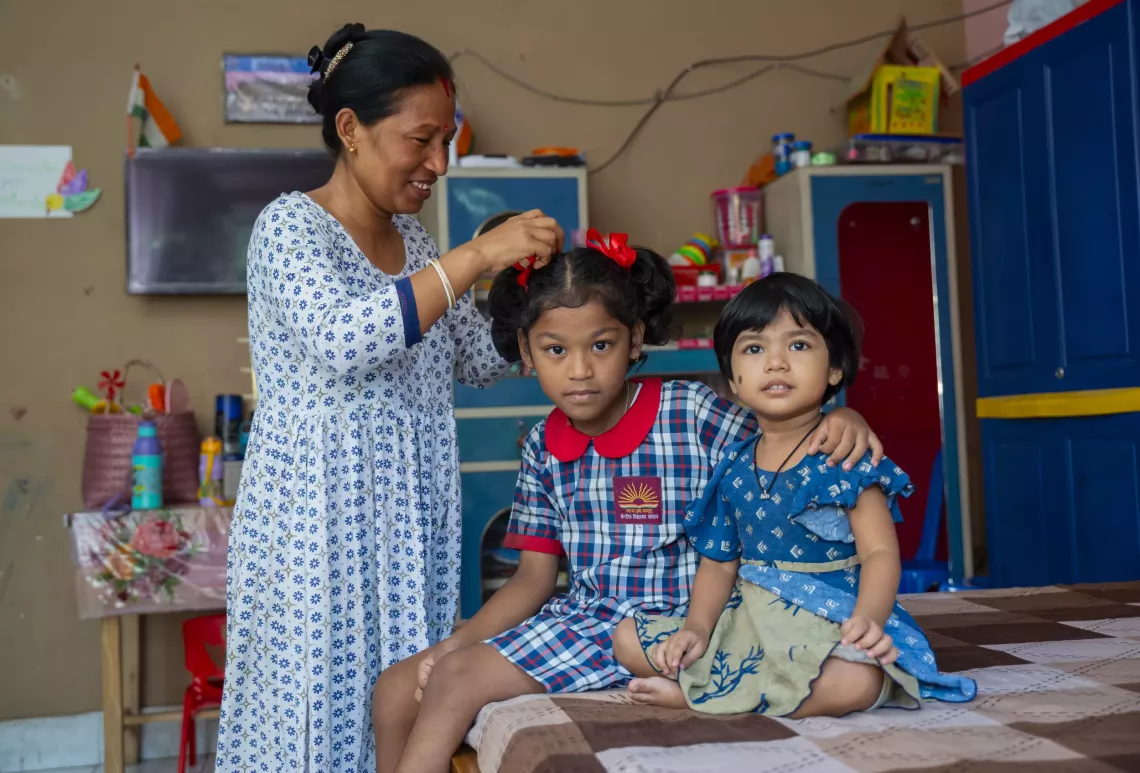
"With the Cold Chain Point on Board, we can cover more islands and spend more time caring for people. It has also been a huge help for me - now I can get home earlier and spend time with my daughters," adds Nirupoma.
She feels a deep sense of satisfaction, knowing she has completed her duties and made a difference in the lives of many. Tomorrow, she’ll wake up again early to start a fresh journey on the Boat Clinic, taking critical healthcare services to the next island.
"Providing health check-ups to those without access to care is deeply fulfilling. As a mother of two daughters, I enjoy meeting the children and pregnant women during these visits," Nirupoma says with a proud smile.