Nearly 386,000 children will be born worldwide on New Year’s Day, says UNICEF
UNICEF challenges nations around the world to make sure more newborns survive their first days of life.
- English
- हिंदी
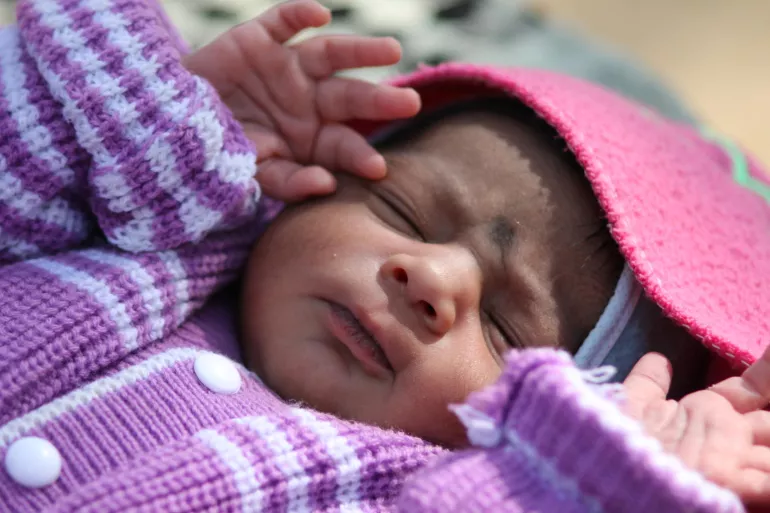
NEW YORK, 1 January 2018 – Approximately 386,000 babies will be born on New Year’s Day, UNICEF said today.
Kiribati’s Christmas Island in the Pacific will most likely welcome 2018’s first baby; the United States, its last. Globally, over half of these births are estimated to take place in nine countries:
- India — 69,000
- China — 44,760
- Nigeria — 20,210
- Pakistan — 14,910
- Indonesia — 13,370
- The United States — 11,280
- The Democratic Republic of Congo — 9,400
- Ethiopia — 9,020
- Bangladesh — 8,370
While many babies will survive, some will not make it past their first day. In 2016, an estimated 2,600 children died within the first 24 hours every day of the year. For almost 2 million newborns, their first week was also their last. In all, 2.6 million children died before the end of their first month. Among those children, more than 80 per cent died from preventable and treatable causes such as premature birth, complications during delivery, and infections like sepsis and pneumonia.
“This New Year, UNICEF’s resolution is to help give every child more than an hour, more than a day, more than a month — more than survival,” said Stefan Peterson, UNICEF’s Chief of Health. “We call on governments and partners to join the fight to save millions of children’s lives by providing proven, low-cost solutions.”
Over the past two decades, the world has seen unprecedented progress in child survival, halving the number of children worldwide who die before their fifth birthday to 5.6 million in 2016. But despite these advances, there has been slower progress for newborns. Babies dying in the first month account for 46 per cent of all deaths among children under five.
Next month, UNICEF will launch Every Child Alive, a global campaign to demand and deliver affordable, quality health care solutions for every mother and newborn. These include a steady supply of clean water and electricity at health facilities, the presence of a skilled health attendant during birth, disinfecting the umbilical cord, breastfeeding within the first hour after birth, and skin-to-skin contact between the mother and child.
“We are now entering the era when all the world’s newborns should have the opportunity to see the 22nd century,” added Peterson. “Unfortunately, nearly half of the children born this year likely won’t. A child born in Sweden in January 2018 is most likely to live to 2100, while a child from Somalia would be unlikely to live beyond 2075.”
###
Notes to Editors
In India, 69000 babies are born every day. The day of birth is the riskiest day for both the mother and the newborn as nearly half of the maternal deaths and 40 per cent of the newborn deaths occur on the day of birth. Measures to ensure that every woman delivers in a health facility assisted by a skilled birth attendant, would be key to preventing these deaths as nearly five million newborns are delivered at home in India every year.
###
The estimates for the number of babies born draws on the period indicators and the life tables of the UN’s World Population Prospects (2017). Building on these datasets, World Data Lab’s (WDL) algorithm projects the number of births for each day by country and gender, and their corresponding life expectancy.
To download photos to accompany this story, visit here. For India pictures please find attached the images of the first baby born on January 1, 2018 at Bairgarh civil hospital, Bhopal in the central Indian state of Madhya Pradesh. Photo Credit: UNICEF/2018/ Anil Gulati
Media contacts
About UNICEF
UNICEF promotes the rights and wellbeing of every child, in everything we do. Together with our partners, we work in 190 countries and territories to translate that commitment into practical action, focusing special effort on reaching the most vulnerable and excluded children, to the benefit of all children, everywhere.
UNICEF India relies on the support and donations from businesses and individuals to sustain and expand health, nutrition, water and sanitation, education and child protection programmes for all girls and boys in India. Support us today to help every child survive and thrive! www.unicef.in/donate
For more information on UNICEF India and its work visit www.unicef.in. Follow us on Twitter, Facebook, Instagram, Google+ and LinkedIn