India: Overweight and obesity rising across all ages – from youngest children to adults
Prevalence among under-five children have more than doubled in just over a decade.
- English
- हिंदी
New Delhi, September 11 — India is witnessing a rapid rise in overweight and obesity across all age groups, from its youngest children to adolescents and adults, experts cautioned at a UNICEF-organized national media roundtable on healthy diets held here today.
According to UNICEF’s Child Nutrition Global Report 2025, launched recently, obesity has, for the first time, surpassed underweight globally as the most common form of Malnutrition among school-aged children and adolescents. Today, one in ten children worldwide, nearly 188 million, live with obesity. Once considered a condition of affluence, obesity is now spreading rapidly in low and middle-income countries, including in India.
Countries in South Asia had the lowest prevalence of overweight in 2000. By 2022, the prevalence had increased almost fivefold among children aged 5–9 years, 10–14 years, and 15–19 years.
Rising rates across India:
According to the National Family Health Survey (NFHS) data, India is witnessing a rapid surge in overweight and obesity among under-five children under five, with prevalence rising by 127 per cent (from 1.5 per cent to 3.4 per cent between NFHS 3 (2005-06) and NFHS 5 (2019-21). Similarly, adolescent girls and boys have seen an increase in overweight and obesity of 125 per cent (from 2.4 per cent to 5.4 per cent) and 288 per cent (from 1.7 per cent to 6.6 per cent) respectively.
In adults, the prevalence increased by 91 per cent among women (from 12.6 per cent to 24.0 per cent) and 146 per cent among men (from 9.3 per cent to 22.9 per cent), indicating a nationwide health crisis. (NFHS 5 2019-2021)
India is expected to be home to over 27 million children and adolescents (5 to 19 years) living with obesity by 2030, and will account for 11 per cent of the global burden. (CNNS 2016-18)
As quoted in the Indian Economic Survey 2024-25, Ultra Processed Food (UPF) consumption in India surged from USD 900 million (2006) to USD 37.9 billion (2019), growing at over 33% annually. Between 2011 and 2021, retail sales of UPFs grew at a Compound Annual Growth Rate (CAGR) of 13.7%.
Drivers of the epidemic
The child nutrition report highlights how fast foods, ultra-processed foods, and beverages — high in fat, sugar, and salt — are increasingly replacing fruits, vegetables, and traditional diets. Aggressive and targeted marketing campaigns, along with easy availability, are influencing food choices for children and adolescents, rather than personal preference.
A range of early-life factors contribute to the rising numbers. These include inadequate maternal nutrition and poor childhood dietary practices, such as insufficient breastfeeding. Social and gender norms whereby adolescent girls and women often eat least and last, further exacerbating the issue.
Additionally, the growing consumption of ultra-processed foods and sugar-sweetened beverages, combined with low levels of physical activity and increased screen time among young children and adolescents, is fuelling the problem. All of this is taking place within an unhealthy food environment dominated by ultra-processed products.
UNICEF’s U-Report poll, conducted among adolescents and young adults aged 13–24 years across 171 countries, reveals that more than two-thirds of young people are exposed to food marketing. In just the week before the poll, 75 per cent reported seeing advertisements for sugary drinks, fast food, or snacks - mostly on social media (52 per cent), followed by the internet (46 per cent) and television (43 per cent). Three in five young people agreed that these advertisements made them want to consume the products they saw.
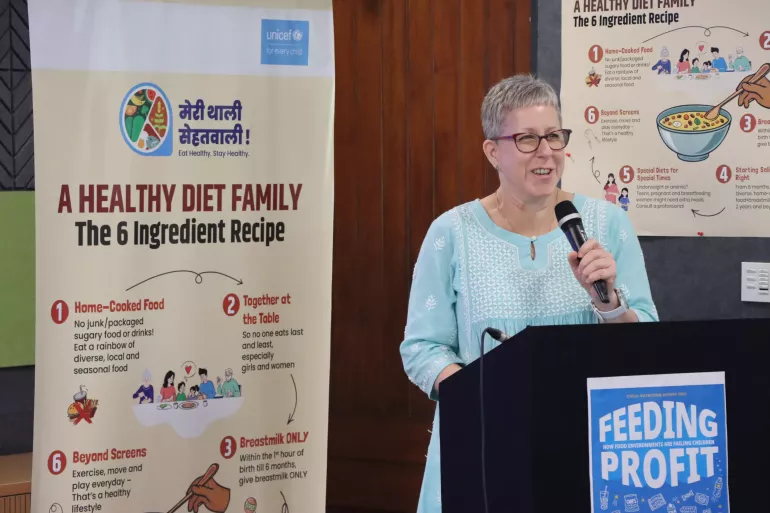
Speaking at the media roundtable, Marie-Claude Desilets, Chief, Nutrition, UNICEF India, said, “With this high level of media exposure and easy access to unhealthy food, India is also following the same global trend with a rapid rise in children and adolescents with overweight and obesity.
The country is beginning to face the triple burden of Malnutrition — stunting & wasting, micronutrient deficiencies and obesity — often coexisting in the same family or even the same person. India has a unique opportunity to act now to prevent overweight and obesity in children.”
The World Obesity Federation estimates that, that in 2019, obesity-related costs were estimated at nearly $29 billion, or 1 per cent of India’s GDP. By 2060, this figure is projected to reach $839 billion — 2.5 per cent of GDP — unless urgent measures are taken. Unhealthy diets are now the leading contributor to India’s disease burden, accounting for 56 per cent of it (ICMR-NIN, 2024).
Dr William Joe, Assistant Professor at the Institute of Economic Growth, Delhi, emphasized the high costs of poor diets, noting, “There is a high cost to poor diets which is fuelling an epidemic of non-communicable diseases. Once established in childhood or adolescence, obesity is complicated to reverse and likely to persist into adulthood, leading to increased risk of diabetes, cardiovascular disease, hypertension and some cancers. The economic and psychological impacts are severe — from draining household savings to stigma and low self-esteem.”
Government of India’s Leadership
India has taken several steps, including the Fit India Movement, the Eat Right India campaign, POSHAN Abhiyan 2.0, and school-based health and wellness programmes. Guidance to place sugar and oil boards in schools and offices has also been introduced. Hon’ble Prime Minister Narendra Modi, in his Independence Day address, urged families to reduce cooking oil consumption by 10 per cent, emphasizing that such small changes can significantly impact public health.
In the report, India has been acknowledged as the first lower-middle-income country to adopt the WHO’s best-practice policy to limit trans fats, while also advancing healthier diets through “Eat Right” schools.
The Let’s Fix Our Food (LFOF) consortium, led by ICMR-National Institute of Nutrition (NIN) and UNICEF and partners, has called for strong measures:
- Health taxes on high-fat, salt and sugar foods and beverages
- Front-of-pack nutrition labelling
- Restrictions on junk food marketing
- Double-duty actions to address both undernutrition and obesity in public-funded programmes (ICDS, PM-POSHAN)
- Nutrition literacy and skills, especially for children and youth
Arjan De Wagt, UNICEF India’s Deputy Representative for Programmes, said: “Malnutrition today is no longer only about undernutrition – the rapid rise of obesity, fuelled by unhealthy foods and beverages, is driving non-communicable diseases even among children and young people.
Without urgent action through stronger policies – such as easy-to-understand front-of-pack nutrition labelling, regulating unhealthy food marketing, introducing health taxes on unhealthy foods, and empowering children and youth with nutrition skills – India risks reversing hard-won gains in child health and locking millions into a lifetime of poor health. Government, civil society, businesses, and community leaders all share a responsibility to protect every child’s right to good nutrition.”
Media contacts
About UNICEF
UNICEF strives to uphold the rights of every child, protecting them from harm and all forms of discrimination, so that they can grow up healthy and educated to reach their full potential. This work is in line with UNICEF’s globally recognized mandate and its support of national priorities.
For more information on UNICEF India and its work visit https://www.unicef.org/india/. Follow us on Twitter, Facebook, Instagram, Google+ and LinkedIn