

Children in Tamil Nadu
The State has India's lowest rates of infant and neonatal mortalities and prevalence of stunting. Primary school enrolment rates are the highest in India.
The challenge
Tamil Nadu lies in the southernmost part of the Indian subcontinent and is bordered by the union territory of Puducherry and the southern Indian states of Kerala, Karnataka, and Andhra Pradesh.
The State is home to several historic buildings, multi-religious pilgrimage sites, hill stations and three World Heritage sites. Tamil Nadu is the seventh most populous state in India. Some 48.4 per cent of the state's population lives in urban areas, and it ranks sixth among Indian states on the human development index.
Tamil Nadu has India's third-longest coastline at about 906.9 km, and this coastline bore the brunt of the 2004 Indian Ocean tsunami when it hit India, resulting in 7,793 direct deaths in the State.
Tamil Nadu is one of India's pioneer states for initiating pro-poor policies and social protection programmes for children and women in the most marginalized communities. The State introduced progressive legislation and schemes, such as social security measures, the expansion of health, nutrition, WASH, and education systems, and public distribution systems.
Over the decades, these social policies were implemented effectively with high public investment in the social sector and strong administrative structures and systems that facilitated effective planning and monitoring. This significantly demonstrated impact on the well-being of children in health, nutrition and education.
Infant and neonatal mortalities and prevalence of stunting among children under five years old are lowest, and primary school enrolment rates are the highest in India.
Advancing children’s rights and well-being
UNICEF focuses largely on enhancing social inclusion and strengthening an enabling environment by developing a convergent social policy approach and comprehensive systems that integrate efforts to achieve greater impact on child well-being.
Considering the substantial progress made in the last couple of decades in improving outcomes for children and reducing multi-dimensional deprivations in Tamil Nadu, the UNICEF state office for Tamil Nadu’s programme efforts focuses largely on enhancing social inclusion and strengthening an enabling environment by developing a convergent social policy approach and comprehensive systems that integrate efforts for greater impacts on child well-being.
The UNICEF State Office aligns its social policy strategy, relevant for the ‘middle income country’ context, which aims to enhance and build on existing systems within the state government, the relevant line departments, the State Child Rights Protection Commission and the local self-governments in both rural and urban areas.
UNICEF works around the three pillars of social policy work - public finance for children, decentralization and child-friendly local governance, and social protection for vulnerable families and their children. These areas are applied to interventions on child survival, child development, and child protection, and they build on child participation.
The three pillars of the social policy programme broadly focus on five key priorities:
A comprehensive approach to strengthen social protection systems for a more integrated approach targeting the most vulnerable, towards greater impact on child well-being and efficient and equitable spending for priorities – including emergency, and reducing vulnerability and risks.
Going beyond child survival and access to early childhood education to develop a comprehensive policy for early childhood development and programmes.
This includes a financing model for all young children, from conception through the age of school entry, to ensure they achieve their developmental potential in equitable, inclusive care environments across programmes and policies, including in humanitarian settings.
We also focus on ensuring that all children up to the age of school entry receive essential services, including quality childcare, health, nutrition, protection, and early learning services, to address their developmental needs.
A comprehensive policy and programme that supports adolescents and young people to reach their full potential as productive and active members of society is a key pillar. Working on people’s agency, it focuses on bringing together public and private partners – as well as young people - to identify and scale solutions.
Opportunities and programme linkages are being created for adolescents and young people to access to develop skills for learning, employability and active civic engagement.
Focusing on the transition from eighth to ninth grade, we are working to enhance government planning for the continuum of 12 years of education to ensure a smooth transition and quality of learning.
Establishing strong monitoring and governance systems for child labour (15-18 years), child marriage and second-generation issues in child protection to support inter-sectoral convergence and reaching the last miles is a focus. Modelling with financing and capacity development strategies to strengthen child protection systems is being explored to enhance social welfare.
To achieve all outcomes for every child and to advocate through a social policy approach, it is imperative to have a strong position to speak on behalf of children, adolescents, and young people and to enable them to speak on issues that impact them.
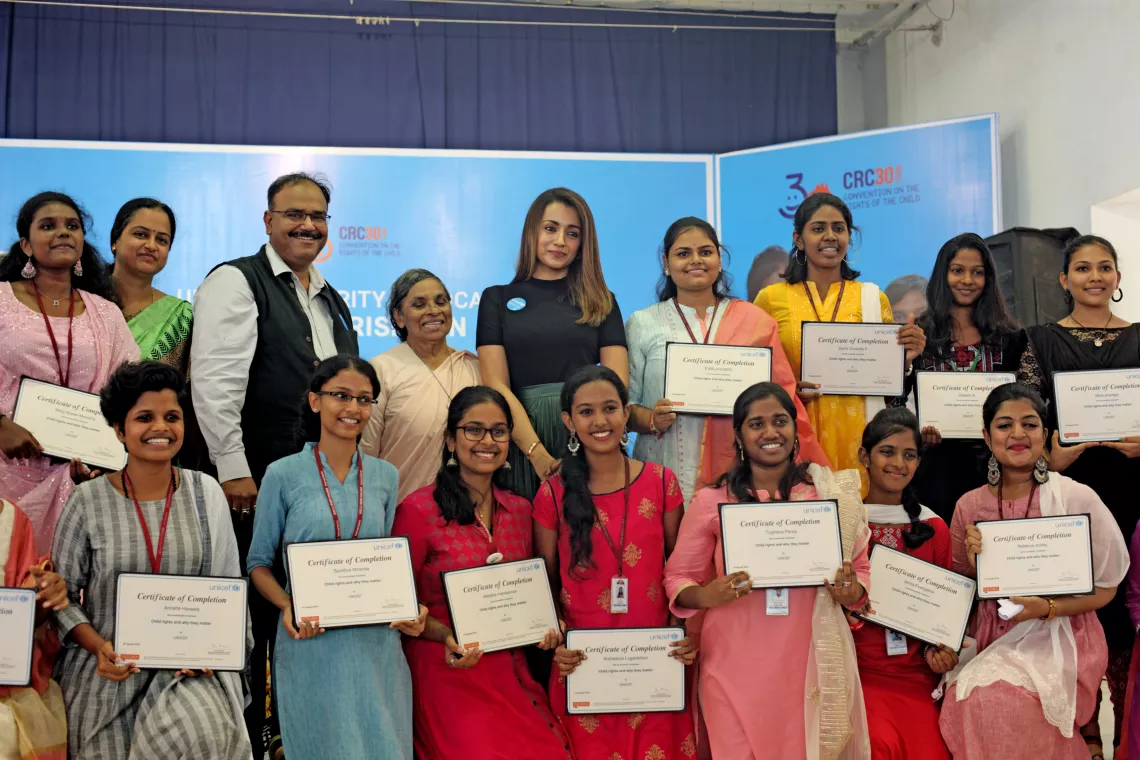
We have built and continue to develop strong partnerships with academia, media, civil society organizations, adolescents, youth-led organizations, and well-known personalities and celebrities to help bring the issue of adolescents and young people’s vulnerability to the forefront of the agenda for decision-makers.