At UNICEF, we’ve always believed that children can become powerful agents of change with the proper guidance and support.
What better example than fourteen-year-old Kritika Kumari, a bubbly girl studying at Adarsh Ramanand Middle School in Purnea district in the eastern Indian state of Bihar. She has played a key role in transforming the thinking of her villagers on a topic that, across India, is still discussed in hushed tones and behind closed doors.
The ‘taboo’ topic of menstruation. When I first met Kritika outside her classroom, she had just passed her 8th standard and planned to move to a new school farther from home.
She oscillated between excitement and unease. Her eyes sparkled at the thought of attending a new school, meeting new teachers, and making new friends. But her anxiety about leaving her current school took over, not because of leaving her classmates, most of whom would join her, but because of losing something special she hesitated to put in words.
“This school gives me safety. I feel secure. My new school won’t provide that,” Kritika said, stringing her jumbled thoughts together.
As a man, a male, and a stranger, my presence didn’t make it easier for Kritika to express her thoughts seamlessly. Wearing a UNICEF T-shirt and sharing light-hearted anecdotes helps lighten the mood. Her friends nudged her to discuss a topic that is still difficult for girls to discuss openly in modern India. The conversation flowed.
“This school gives me safety,” she said, her voice firming up.
“The new school doesn’t have a ‘Saheli Kaksh’, a room that gives us comfort and security during our periods.”
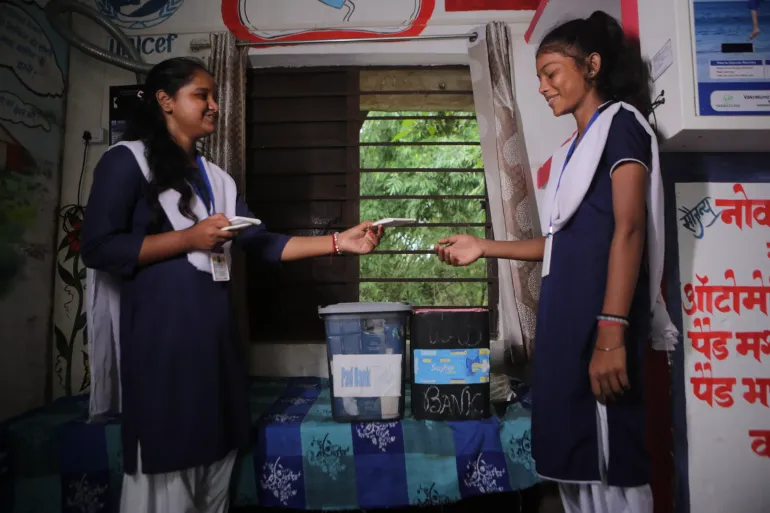
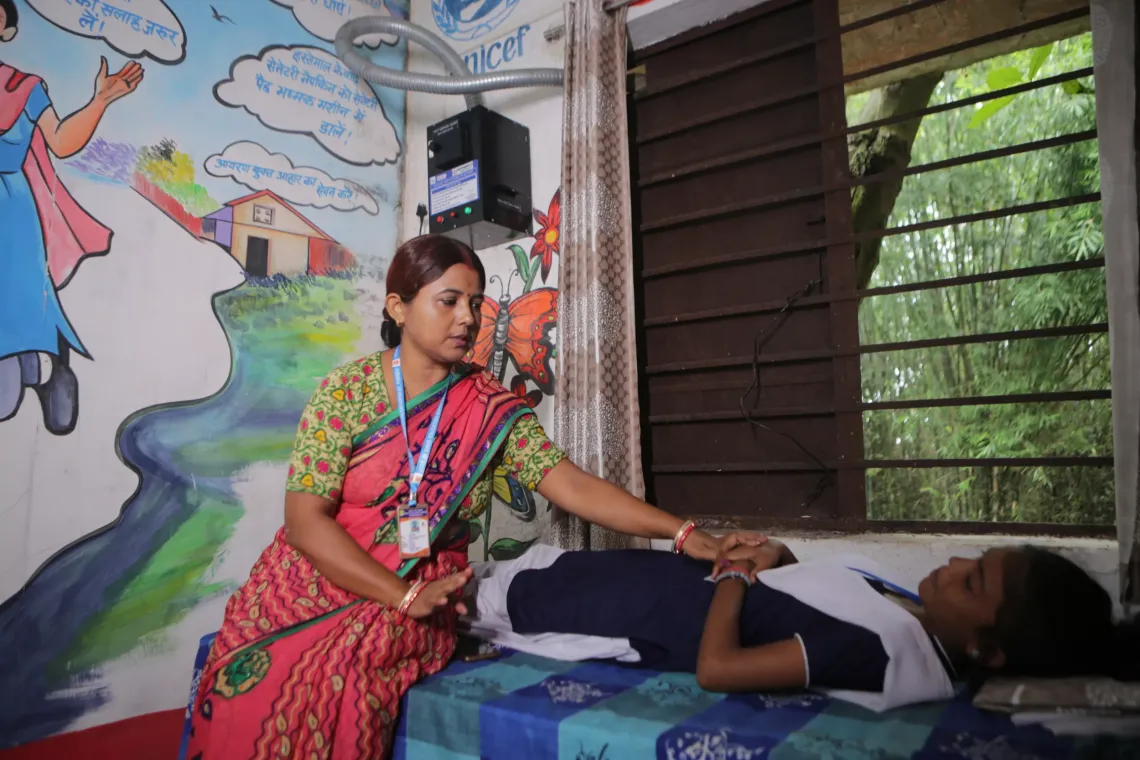
The Saheli Kaksh, or “Friendly Corner,” is more than a room at Kritika’s school. It has become a blessing for girls, a haven that builds their confidence and feeds their dreams and aspirations.
It is equipped with a sanitary pad vending machine, a friendly teacher, an incinerator, a bed for rest, and spare uniforms. It offers comfort and dignity during menstruation. A supportive teacher teaches them that menstruation isn’t something to be embarrassed about but something to celebrate.
“Everything we were told at home and in our village about periods is incorrect. We can enter the prayer room, touch pickles, and do our normal routine during our periods,” Kritika said. “There is nothing impure or taboo about menstruation,” she added, as her friends nodded in affirmation.
Bihar Swachh Vidyalaya Puraskar: A Harbinger of Change
Kritika’s confidence stems from a broader transformation at her school, driven by an initiative called the Bihar Swachh Vidyalaya Puraskar (BSVP), or the Bihar Clean School Award. BSVP is not just an award but a revolution, benchmarking over 60,000 schools across 50 indicators: water supply, toilets, handwashing, waste management, and safe spaces like Saheli Kaksh.
In collaboration with UNICEF, the Bihar Department of Education developed a state-specific WASH in Schools benchmarking system and award guidelines under BSVP. This statewide initiative enhances school hygiene and safety, focusing on essentials such as clean water, sanitation, handwashing facilities, and safe spaces, including the Saheli Kaksh.
“UNICEF has supported conceptualizing the Bihar Swachh Vidyalaya Puraskar and played a pivotal role in its end-to-end implementation in collaboration with the Bihar Education Project Council,” said Sudhakar Reddy, WASH Officer at UNICEF Bihar.
UNICEF piloted the Saheli Kaksh concept in 50 schools in Purnea and Araria, with Kritika’s school being one of them. The UNICEF Bihar state office, along with its implementing partners, provided capacity development support and ongoing supervision in these schools.
Kritika’s school, Adarsh Ramanand Middle School, shines as one of the 54 award-winning schools. It isn’t just the Saheli Kaksh that students speak of with pride when visitors arrive.
The number of girls’ toilets has increased from one to eight, boys’ urinals to 17, and two group handwashing stations, one with 10 taps, another with six, now serve the school. Clean water drums sit outside every classroom.
“I feel very proud to be in this school. Where there was only one girls’ toilet before, we now have eight, plus more for boys and other facilities,” said Kritika’s classmate, Hiradan Kumar, a boy with a shy grin.

Change Beyond the School
Kritika and her friends have taken what they learned about menstruation from school to their village, involving men and women in the conversation. She and her friends educated their mothers, who, in turn, accepted that menstruation is neither dirty nor untouchable.
The children, armed with school knowledge, educate their mothers on proper sanitary pad usage. This shift in understanding has led to a significant decrease in school absenteeism, with girls now attending regularly.
Kritika’s mother, Sita Devi, a changemaker and leader of the women’s Jeevika group in her community, amplifies the messages Kritika brought home.
“Kritika used to miss school, three or four days a month. Now, she goes every day. The Saheli Kaksh is a blessing. The girls talk about menstruation openly now; there’s no shame, and absenteeism has gone down,” says Sita as women in her village listen to her attentively.
Sita, Kritika and Jeevika group have also involved men in conversations around menstruation.
“Just four or five years ago, people in the village held onto outdated beliefs and wouldn't openly discuss menstruation, even with their husbands or family members, due to feelings of shame. Now, they talk openly,” says Kritika.
Her mother adds as her daughter stands beside her.
“Earlier, they hesitated to buy sanitary pads for us; even if they did, they hid them in newspapers. Now, that awkwardness is gone, and they openly purchase them and men and boys in the village understand the topic and are comfortable talking about it,”
As I left the school, I saw Kritika and her friends lingering near the Saheli Kaksh, perhaps for one last moment.
“I dream of a day when every school has a Saheli Kaksh, and every girl feels safe on those important days of the month,” Kritika said.
I wish her dream would come true. I hope every girl in India, as Kritika says, gets the Sukoon that Saheli Kaksh gives them.
The perfect mix of safety, comfort, and dignity.