
Health
Good health for all children
- Français
- English
The issues
The infant and maternal mortality rate in Haiti remains very high compared with other countries in the Caribbean and Latin America.
Out of 1,000 live births in the last five years, 59 children die before reaching their first birthday and 32 die in the first month of their life. Nearly 1 in 12 children die before reaching the age of five (81 deaths out of 1,000 live births), according to the Enquête mortalité, morbidité et utilisation des services (Mortality, Morbidity, and Utilization of Services Survey, EMMUS-VI) 2016-2017.
The biggest challenge is to reduce infant mortality, as well as the number of children who die before reaching their first month of life.
Serious disparities persist between service provision in urban and rural areas, with access to basic services remaining very low, especially in rural areas.
The equity analysis conducted by UNICEF showed that the largest number of unvaccinated children do not live in the most remote rural areas of the country, but rather are concentrated in deprived neighborhoods around the country's five largest cities. Forty-two per cent of children not immunized with Penta 3 over the last three years live in three communes of the metropolitan area (Port-au-Prince, Cité Soleil and Carrefour) and in two large towns (Gonaïves and Saint-Marc) in the Artibonite region.
There are not enough health workers.
The solutions
UNICEF works with government partners, NGOs and other United Nations agencies to improve the health of Haitian children.
Strengthen health systems: Support for the development of documents relating to policies, standards, strategies and action plans. UNICEF advocates for the efficient allocation of resources in the health sector.
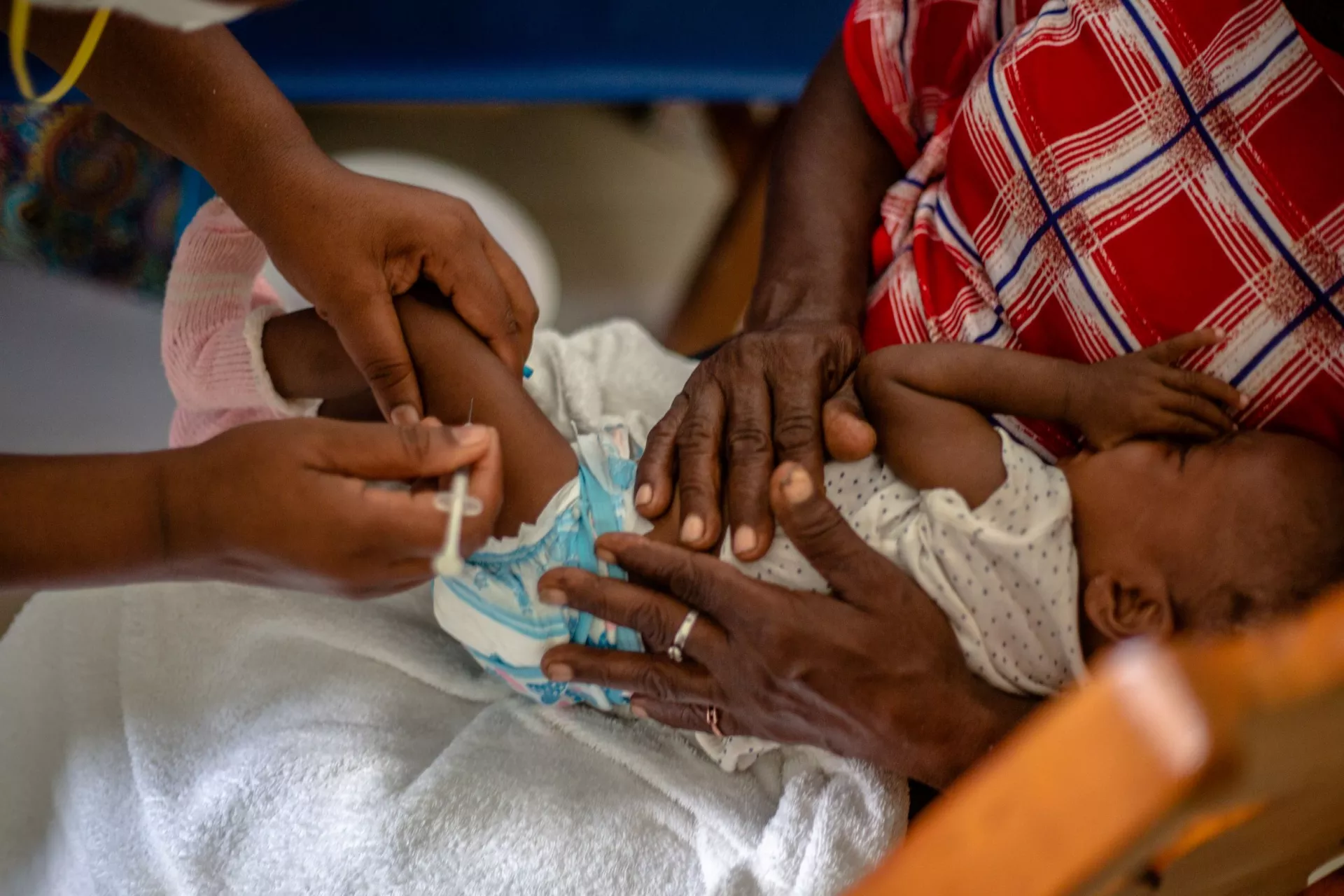
Provision of equitable immunization services: UNICEF supports the "Reaching Every District" approach in 70 communes with low immunization coverage. UNICEF supports the provision of maternal, newborn and child health care (MNCH) and the prevention of mother-to-child transmission of HIV in the most disadvantaged areas.
Capacity building for health workers and health departments: The main objective is to ensure integrated service delivery and good supply chain management, including in emergency situations.
Community mobilization, participation and involvement: UNICEF aims to encourage positive social norms through the establishment of partnerships between civil society organizations, media professionals, religious, traditional and other leaders in order to promote MNCH, adopting innovative approaches to disseminate information in the best possible way.
The health programme in figures
- 97,000 children under the age of one received the third dose of pentavalent vaccine in 2018.
- 351 solar-powered refrigerators installed to strengthen the cold chain and improve the quality of immunization.
- 135,000 people educated about HIV/AIDS.
Resources
UNICEF is a key partner of the Ministry of Public Health and Population. UNICEF supports the Ministry in all public policies aimed at increasing access to health services for the most vulnerable populations.
UNICEF aims to encourage positive social norms through the establishment of partnerships between civil society organizations, media professionals, religious, traditional and other leaders to promote maternal, newborn and child health (MNCH), adopting innovative approaches to disseminate information in the best possible way.
Why are these efforts necessary?
Although the situation of Haitian children has improved somewhat in recent years, progress has been slow and uneven. Deep inequalities and systematic exclusion, because of where they live, their gender or their socio-economic status, still prevent many children from having a good start in life. Children are the first victims of these inequalities, and their full rights guaranteed by the Haitian Constitution and the Convention on the Rights of the Child are not all respected.
You can access our reports and research by clicking on the link below: Ressources et publications