
Education
Equitable access to education for all children
- Français
- English
The issues
According to a study on children out of school (2017), almost 2 out of 10 children aged between 6 and 11 do not attend primary school and around 6 out of 10 children aged 6 start Year 1.
The net primary school enrolment rate is lower in rural areas (80 per cent) than in urban areas (91 per cent), and significantly lower in some departments.
Eighty per cent of children who drop out of school are overaged.
Only 68 per cent of children from the poorest households attend primary school, compared with 92 per cent from the richest households, and the level of learning remains very low.
In Haiti, only 63 per cent of children aged 36-59 months attend a pre-school education programme.
The educational offer is mainly non-public, with more than 80 per cent of schools belonging to the non-public sector.
The solutions
UNICEF is working closely with the Ministry of education and vocational training (MENFP), United Nations partners and other organizations to improve access to free education and quality learning at the right age for all children.
Improving the quality of education and learning: UNICEF is supporting MENFP in the development of a non-formal education policy and alternative programmes to meet the needs of overaged children and those excluded from the school system, as well as in promoting academic success by strengthening reading and writing skills. In public primary schools, UNICEF is helping to establish a quality learning environment in the first cycle (the first four years of schooling), by strengthening learning and teaching methods for reading, writing and calculus, and by improving the pedagogical skills of teachers and inspectors.
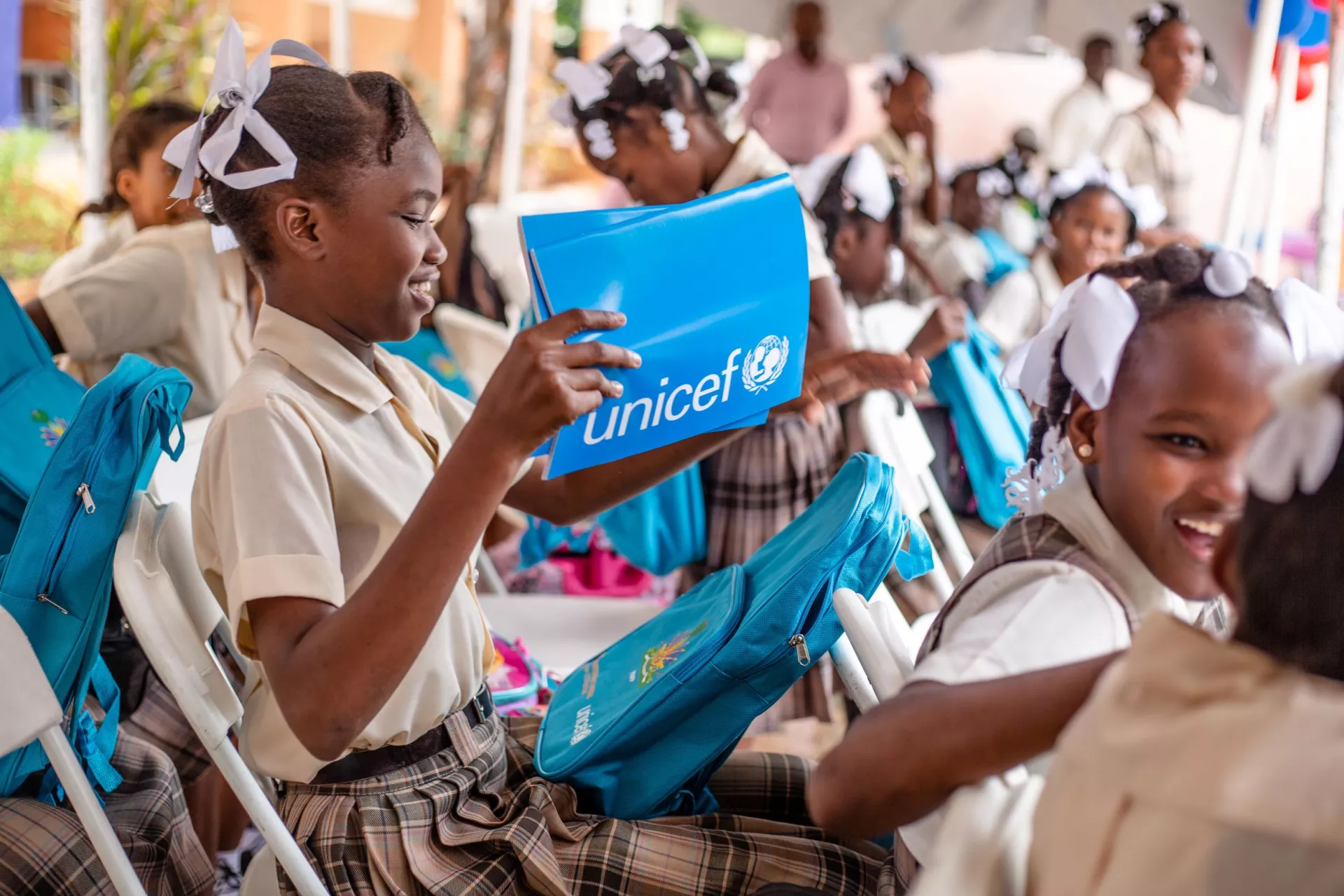
Access to free education: UNICEF supports the Ministry in promoting access to education at the required age (6 years old) to curb the numbers of overaged and dropout pupils, while paying particular attention to the most disadvantaged children, i.e. those living in rural areas. School supplies are provided to new students to reduce the indirect costs of schooling for families. Participatory school management in collaboration with local authorities and back-to-school campaigns should also help to increase school attendance.
Focus on school readiness: The programme also focuses on school readiness through initiatives such as support for preschool education. UNICEF is supporting the Ministry of Education in setting up robust standards and developing tools and materials to improve the quality of pre-school education.
Education in figures
- Increase in the net school enrolment rate from 75.8 per cent to 88 per cent between 2002 and 2016. (Source: MENFP)
- Around 6 out of 10 children in their second year of primary school cannot read by international standards. (Source: Early Grade Reading Assessment)
- The attendance rate for 6–11-year-olds has increased from 50 per cent to 84 per cent. (Source: EMMUS IV and EMMUS VI)
- Nearly 250,000 children aged 6 to 11 are outside the school system, down from 500,000 in 2007. (Source: Study on out-of-school children)
Resources
Through its continuous support to MENFP, UNICEF aims to guarantee equitable access to quality education for the most vulnerable children, to ensure equal opportunities for girls and boys and to improve learning, to combat violence in schools and to strengthen the early childhood sector. Reinforcing the governance and regulatory structures of the education system will also help to improve the quality of educational services and contribute to the success of children.
Why are these efforts necessary?
Access to quality education is still limited, and children's learning levels remain low. Without better learning for children from the start of their school years, their chances of dropping out increase considerably. Children must both enjoy their right to education and acquire skills and knowledge to break the vicious circle of poverty.
It is also necessary to concentrate efforts on the most disadvantaged population groups and areas, to ensure that children enter the education system at the right age, attend school regularly, acquire the necessary knowledge and complete the 9 years of basic education.
You can access our reports and research by clicking on the link below: Ressources et publications