In N'Zérékoré, women join the fight against polio
Guinea is experiencing a polio outbreak, with health workers on the front line and GPEI partners and UNICEF right behind them.

- Français
- English
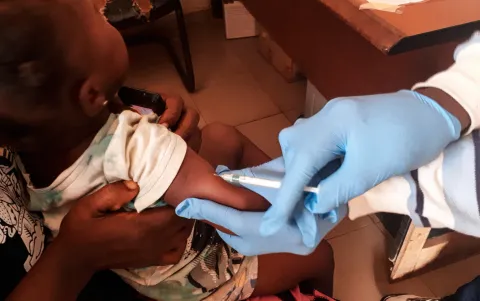
In a small room at the health centre in the heart of N'Zérékoré, Guinea, eight women wearing eight immaculate white coats wait patiently for the mothers who come to them to help vaccinate their children. "We vaccinate about 100 children a week," reveals one of them. "Especially on Mondays. Yesterday it was around 40," adds another.
The polio vaccine: a vital ritual
As part of routine immunisation, the clinic administers the life-saving polio vaccine. Iconic in its simplicity, it consists of two small drops that resemble water in all but taste. But Guinea is currently facing a polio outbreak due to low vaccination rates in certain communities.
"In Guinea, the vaccine is administered four times: at birth, at 45 days, and again at 10 and 14 weeks," explains one of the health workers. "In this region, unvaccinated children are relatively rare, but they are not fully vaccinated. Some mothers either refuse the vaccine or accidentally miss it".
"I was three months late with my twins' vaccinations," says Fatoumata, "because I had to travel to Kouné and never got to the health centre". A few days ago, however, a small team of social mobilisers knocked on her door to remind her of the delay. "I came as soon as I had time," she said. "I want to vaccinate my children, I know it prevents dangerous diseases."
Overcoming Guinea's geography
Remote areas also pose significant challenges to the delivery of vaccines. These life-saving vials are mainly transported by road to the N'zerekore region, a journey that can take up to two gruelling days. Even when the vaccines finally arrive, there's no guarantee they'll reach their intended recipients in time. Many remote villages can only be reached on foot or, at best, by bicycle or motorbike.
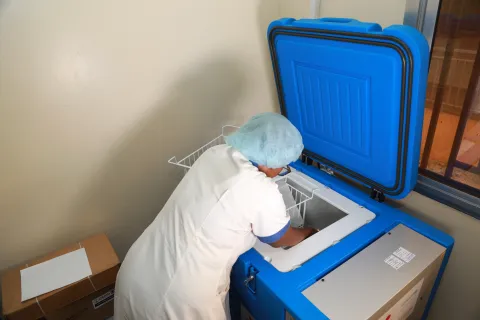
"These transport challenges severely affect the cold chain," the system responsible for keeping vaccines at an optimal temperature as they move from one place to another, explains one health worker. And in these difficult circumstances, some remote communities are simply never reached with doses of vaccine.
Making polio history in Guinea
All of these challenges have contributed to the ongoing polio outbreak, which originally began in Siguiri. But UNICEF, in collaboration with the Government of Guinea and partners in the Global Polio Eradication Initiative, has launched a concerted effort to immunise all unvaccinated children against polio and reach those who may have missed doses.
For this vital initiative, UNICEF and WHO are meticulously training and deploying additional teams of social mobilisers and vaccinators, as well as continuing to procure vaccine doses thanks to the Global Polio Eradication Initiative, with the aim of making polio history in Guinea.
In 2003, the Government of Guinea and partners in the Global Polio Eradication Initiative, including the World Health Organization (WHO), Rotary International, the US Centers for Disease Control and Prevention (CDC), the United Nations Children's Fund (UNICEF), the Bill & Melinda Gates Foundation, and Gavi, the Vaccine Alliance, launched a national immunization campaign to immunize more than 3 million children under the age of five against polio.