Psychological Support for Sudanese Children and Families in Egypt
Through Awareness Sessions and a Safe Educational Environment, UNICEF with partners Help Sudanese Children Overcome Educational Setbacks.

- English
- العربية
With support from UNICEF and partners, under the “Prospects” Programme, the Om Habiba Foundation in Aswan organizes psychological support and community integration sessions for Sudanese parents and caregivers. in what is known as “the Learning Space” at the Gerisab Community Development Association in the villages of Karkar, Aswan. These sessions aim to help families overcome the hardships of the crisis they witnessed in Sudan resulting in their displacement. It also assists them in adopting positive parenting approaches and techniques.

Magdy Salam, a 62-year-old freelance worker in Sudan, fled with his family, the tragic humanitarian crisis in Khartoum. He arrived in Aswan, accompanied by his wife and children “Salam - 15 years old, Lamar - 11 years old, Mayar - 9 years old, and Menna - 6 years old.” This was their first time in Egypt. Magdy expressed, "Our journey to Egypt was difficult and exhausting, especially with children. We couldn’t put up with the harsh living conditions in Sudan, and the lack of water, electricity, food, and safety." He added: "We decided to come to Egypt because it was the only safe place. We registered with the United Nations High Commissioner for Refugees (UNHCR). Our income barely covers food. I've tried to find work, but my age makes it difficult."

“Children Feel Anxious About Their Future”
Magdy is eager to attend parent sessions at the Learning Space of the Garisab Association. "The sessions are exclusively for adults, while children are supervised elsewhere. They consist of informative sessions to raise awareness about paternity, vaccinations, and pregnancy monitoring. Medical convoys come to check on the children, but we wish for more consistent and planned visits because seeking medical care and visiting a doctor in Aswan City can be costly. Overall, having parents gather enables us to share insights on our children's challenges, particularly during adolescence, something that helps me with my son Salam."
Magdy notices that some parents understand the psychological pressures children face due to the war and losing friends and family. They try to relieve their children and create a healthy and calm environment. Other parents, however, struggle to control their emotions.
"Children are anxious about their future and perceive it as uncertain. They often inquire about our return, assuming we are on a trip and can return whenever we wish. The most effective approach, as we have gleaned from training and consultations with the psychological experts, is to engage with them in open dialogues and attentively consider their viewpoints and emotions. Despite my usual role as a companion rather than an authoritarian figure to my son, there are moments when I catch myself raising my voice during our conversations. However, I make a conscious effort to maintain composure, encourage him to take accountability, and provide guidance from a distance."

“Stories and Football Made Me Learn”
Magdy wants his son Salam to take the exams at school in Aswan to secure the certification necessary for the transition from the preparatory or intermediate stage to secondary school. "Lamar, Salam, Mayar, and Menna benefited from the Learning Space at the Garisab Association. They reviewed lessons and remembered details they had forgotten. Their first period at the association was difficult. Initially, they struggled to adapt and do their homework. I tried to answer their questions and concerns, like how we would study. But over time and with daily persistence, they improved. They now study on their own and participate in drawing activities, playing with blocks, singing, and acting."
Salam, 15, smiles as he recalls how he initially resisted going to the association but then changed his mind. "I didn't want to go at first, but I felt they cared about us, and I wanted to learn. They brought us books and stories. I have loved reading since I was young and used to borrow books from the school library in Sudan. I also like writing my thoughts. Here, I made many friends, and we play football together, which made me love going to the Learning Space every day."

"They make us laugh and sing."
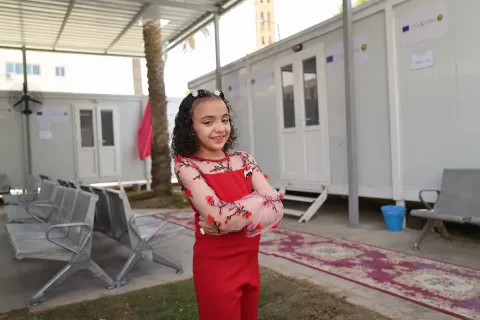
Lamar was playing with her classmates and the activities teacher when she paused to say, "I benefited from Arabic and math lessons, but the best part is drawing and playing with my friends. I enjoy studying with them because my friends share everything with me. The teachers care about each one of us, and encourage us to draw, play, and talk about our drawings. They make us laugh and sing.”

This program is supported by the Bureau of Population, Refugees, and Migration and the "PROSPECTS" program, a partnership between the Netherlands, the International Finance Corporation (IFC), the International Labour Organization (ILO), the United Nations High Commissioner for Refugees (UNHCR), and the United Nations Children's Fund (UNICEF)
The program supports the continuity of education for Sudanese school children in Aswan, addressing the educational and socio-psychosocial needs of new Sudanese refugees and migrants who fled to Egypt due to the crisis that began in April 2023.
Sudanese displaced individuals, mainly living in low-income urban areas, receive immediate educational interventions. The program monitors the number and composition of school-age children, assesses current and potential learning spaces, provides necessary educational materials and equipment, and builds teachers' capacity to implement learning recovery programs and basic literacy and numeracy skills training.
Additionally, the program offers socio-psychosocial support to help children deal with trauma and integrate into new communities through extracurricular activities. This comprehensive approach ensures that these children receive a full package of interventions to resume their education and regain a sense of stability.