Mary had little champs
A school teacher’s success story to include two differently-abled children

- English
- العربية
"I entered the class and said good morning, they all stood up and responded to me except him."
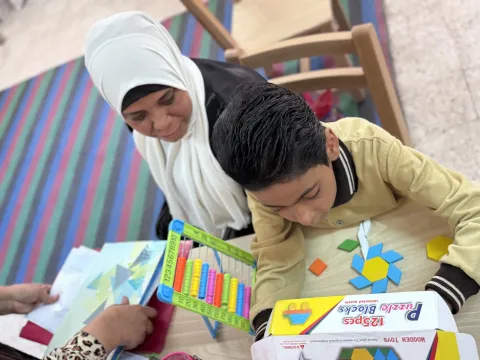
Despite the lack of respect from that student, Mary Zarif, a social studies teacher at Aziz Abaza Primary School in Alexandria Governorate, did not respond aggressively. Instead, she approached him to better understand what the problem was.
She knew his name was Mahmoud, and that he had autism. He was not very popular in the class because of his unusual behavior and untidy looks.
This was Mary's first time dealing with a differently-abled child. She was encouraged to apply what she had learned in UNICEF trainings on inclusive education in terms of characteristics, assessment and teaching strategies for differently-abled children.
After the class, Mary requested to talk to him away from the classroom and asked what was wrong. He said: "Look, my heart is made of flesh. I want to replace it with a heart made of stone.”

Mary was shocked by the cruelty of the expression used by a child in primary school. She felt that the child was suffering because of his classmates hostile attitude. They didn’t play with him and occasionally hit him: “the world is a ruthless jungle”, as he put it, "everyone beats whoever is weaker."
Mary said to Mahmoud that love is able to change many things. "Say there’s a building that someone wants to demolish, can love stop that? " asked Mahmoud. "Yes, love can make people stand together and protect the building!" answered Mary.
Opening such a communication channel and creating a safe space as she was trained to do, Mary saw a glimpse of hope in his eyes. She decided to take the opportunity and asked him to give more care to his personal hygiene to be more accepted by his schoolmates. Next day, he came looking very different: wearing tidy clean clothes and smelling nice. He asked her enthusiastically: "Do I look good, Ms. Mary?"
As a motivation for his positive action, she gave him some time out to play the ball. A few months later, Mary noticed great progress in Mahmoud's academic level and engagement in school activities. "Even if they have the same disability, different children need personalized learning experiences that fit their characters and needs” Mary said.
A different experience with a differently-abled little champ was waiting for Mary: Mariam, a girl with hearing-impairment.
In the beginning, Mary could only see a little girl sitting on the last desk in the classroom. She didn’t seem to follow the class. When she noticed the hearing aid in Mariam’s tiny ear, Mary decided to pay special attention to help the child in the noisy crowded classroom.
She moved Mariam’s desk to be right in front of her and made sure to repeat what she was saying using a louder voice, hand movements and more articulation of words. This made it easier for Mariam, who can read lips, to follow the lessons.

Mary said: "The first day I entered the class, her colleagues said she was almost mute. When she was able to repeat after me as I articulated my words, I made all the class clap for her. Next day, she welcomed me with a hug. Seeing it worked, more children started communicating and interacting with her the same way I did.”
Mary's school is one of Alexandria’s inclusive schools supported by UNICEF and funded by the European Union as part of the “Expanding Access to Education and Protection for at Risk Children in Egypt” program. Mary and many other teachers received UNICEF-supported trainings in partnership with Ain Shams University, Alexandria
University and Zagazig University to support professional development in inclusive education.
To date, 290 schools in Alexandria, Beheira, Assiut, Sohag, Qena, Gharbia and Matrouh governorates have been equipped to accommodate all learning styles and provide quality education for all children. This includes identification of students with learning disabilities using a variety of tools, improving the knowledge and skills of teachers, providing appropriate learning aids and meet accessibility standards.
By 2020, the program aims at meeting the learning needs of around 6,000 differently-abled children included in the 290 public schools. Such upgrade will, consequently, reflect positively on 100,000 children who will benefit from improved teaching and a more child-friendly environment in the targeted schools.