Digital Learning: Insights on Integrating Educational Technology into Teaching
- English
- العربية
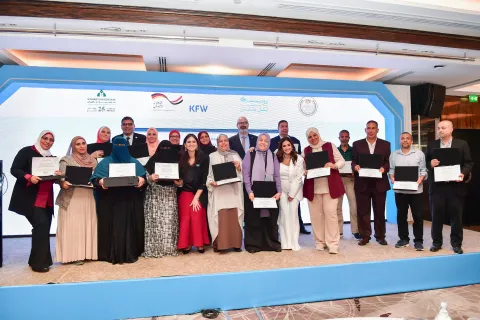
CAIRO, 13 June 2024 - Today, J-PAL MENA at AUC and UNICEF Egypt co-hosted a seminar titled “Digital Learning: Insights on Integrating Educational Technology into Teaching”.
Today's event fostered a conversation between Egypt’s education priorities and the relevant rigorous global evidence on integrating technology into education, ultimately providing insights into how we can incorporate evidence-based solutions in enhancing learning outcomes to ensure that resources are effectively allocated in the Egyptian context. The panel discussion shed light on how evidence from randomized evaluations conducted globally can inform efforts to incorporate low-tech interventions to facilitate student-centered learning and improve access to education for children who are socially and economically marginalized.
Dr. Andreas de Barros shared insights from J-PAL’s global evidence base on integrating Ed-Tech into educational policy, and explained lessons learnt from these interventions. He focused on the following key takeaways:
(a) It is important to think about how EdTech can be thoughtfully integrated into pedagogy rather than using it to replace or crowd-out something that already works well;
(b)Using technology to help structure pedagogy can significantly improve learning outcomes by improving literacy and numeracy skills and improving test scores;
(c) Technology can help in targeting instruction and tailoring it to students’ needs;
(d) Providing parents with information about their children’s performance in school can boost parental engagement and student effort by increasing involvement and interest in their children’s learning process.
LIVE QUOTES FROM SPEAKERS
- Dr Ahmed Daher, Deputy Minister for Technological Development, Ministry of Education and Technical Education, shared that “the objective of MoETE’s strategy is to create innovative learning spaces providing both virtual and physical access and quality education with equality to all students and provide knowledge and tools for teachers and parents to develop skills, value streams, and knowledge.”
- Liban Hussein, Chief of Social Policy and Child Rights Monitoring, and Acting Deputy Representative Programme in UNICEF Egypt, added that “digital learning plays a critical role in providing children with knowledge and skills. This seminar aims to develop evidence for policy makers. Egypt has a high number of students enrolled in schools but many of them need additional support. This underscores the importance of investing in education and schools to enhance learning outcomes. Digital learning is an integral part of this process to equip children with the skills required to increase productivity and labor market growth.”
- Samer Atallah, Associate Dean for Graduate Studies and Research, and Associate Professor of Economics at AUC School of Business., emphasized that “digital education as an enabler of educational experience is the thing we need to focus on in Egypt. We need to learn about the return on investments in infrastructure in terms of the processes. A well-balanced approach is needed to achieve the best possible outcomes. We don’t need to reinvent the wheel – evidence exists from around the world.”
- Ahmed El Sayed, Executive Director of J-PAL MENA at AUC expressed that “through the Global Evidence for Egypt Seminar Series – a collaborative effort between J-PAL MENA at AUC and UNICEF Egypt – we aim to assist the Egyptian government and NGO sector by providing evidence-based insights and ideas to enhance policy effectiveness. This seminar focuses on addressing two pivotal questions:
1. What are the most urgent education priorities that the government faces, and what efforts are currently being made to address them?
2. How can J-PAL’s extensive knowledge on this issue be utilized to craft more effective policies and programs?”
- Shiraz Chakera, Chief of Education, UNICEF Egypt, stated that “the availability of technology is an amazing opportunity to unlock and generate data. We can also use technology for equity – during COVID 19 pandemic, UNICEF launched the ‘Learning Passport’ a digital educational platform - to enable remote learning for refugee students. It served as a tool to improve learning outcomes. It was introduced in many community schools, with an intensive training program for teachers. Empowering teachers is not only about training it’s also about trusting them to use technology.”
- Andreas de Barros, Assistant Professor at the University of California, Irvine’s School of Education and Department of Economics and J-PAL Invited Researcher discussed that “buying stuff does not guarantee an improvement in learning. It’s all about an improvement in learning. It’s all about improved child learning. Programs that only focus on infrastructure improvement do not improve student learning. The key lies in using Edtech to promote concrete strategies that improve student learning such as information provision, structured pedagogy, and targeted remediation.”
This seminar is the eighth in the Global Evidence for Egypt Spotlight Series, which brings together Egyptian policymakers and affiliates in the J-PAL network in a discussion about how to tackle priority policy issues in Egypt. During each seminar, policymakers highlight a particular development priority in Egypt, and J-PAL affiliates offer evidence-informed insights for improving policy and program design from a global perspective. Together, the panel of policymakers and J-PAL affiliates ground the evidence in the Egyptian context and explore possible policy solutions.
The Global Evidence for Egypt (GE4E) Spotlight Seminar Series was launched in 2019, with the support of Allianz, to foster a discussion among Egyptian policymakers, development practitioners, and J-PAL affiliated researchers on timely policy priorities in Egypt using rigorous evidence.
-END-
About J-PAL MENA at AUC
The Abdul Latif Jameel Poverty Action Lab Middle East and North Africa (J-PAL MENA) at The American University in Cairo’s School of Business is a regional office established in July 2020, as a part of a larger network of research centers worldwide working to reduce poverty by ensuring that policy is informed by scientific evidence. Anchored by a network of more than 200 affiliated professors at universities around the world, J-PAL MENA draws on results from randomized impact evaluations to answer critical questions in the fight against poverty. We build partnerships with governments, NGOs, donors, and others to share this knowledge, scale up effective programs, and advance evidence-informed decision-making.
J-PAL was launched at the Massachusetts Institute of Technology in 2003 and has regional centers in Africa, Europe, Latin America and the Caribbean, the Middle East and North Africa, North America, South Asia, and Southeast Asia. For more information, visit povertyactionlab.org
About the American University in Cairo School of Business
Boasting an unrivaled reputation as the top private business school in Egypt and one of the best in Africa and the Arab world, AUC School of Business is dedicated to transforming the eager and innovative minds of today to become the responsible change agents of tomorrow, all while developing relevance and leadership in an evolving ecosystem.
Situated within AUC and enjoying nearly seven decades’ worth of history, the School offers a wide range of programs and activities that extend beyond the classroom to provide a holistic and engaging experiential learning approach. The School’s seal of excellence is the Triple Crown accreditation, which places it among the top 1 percent of educational institutions worldwide to achieve the Association to Advance Collegiate Schools of Business, the Association of MBAs and the European Quality Improvement System accreditations.
For more information, visit business.aucegypt.edu/
About the American University in Cairo
Founded in 1919, The American University in Cairo (AUC) is a leading English-language, American-accredited institution of higher education and center of the intellectual, social, and cultural life of the Arab world. It is a vital bridge between East and West, linking Egypt and the region to the world through scholarly research, partnerships with academic and research institutions and study abroad programs.
The University offers 40 undergraduate, 52 master’s and two PhD programs rooted in a liberal arts education that encourages students to think critically and find creative solutions to conflicts and challenges facing both the region and the world.
An independent, nonprofit, politically non-partisan, non-sectarian and equal opportunity institution, AUC is fully accredited in Egypt and the United States. For more information, visit
Media contacts
About UNICEF
UNICEF promotes the rights and wellbeing of every child, in everything we do. Together with our partners, we work in 190 countries and territories to translate that commitment into practical action, focusing special effort on reaching the most vulnerable and excluded children, to the benefit of all children, everywhere.
For more information about UNICEF and its work for children, visit www.unicef.org/egypt/